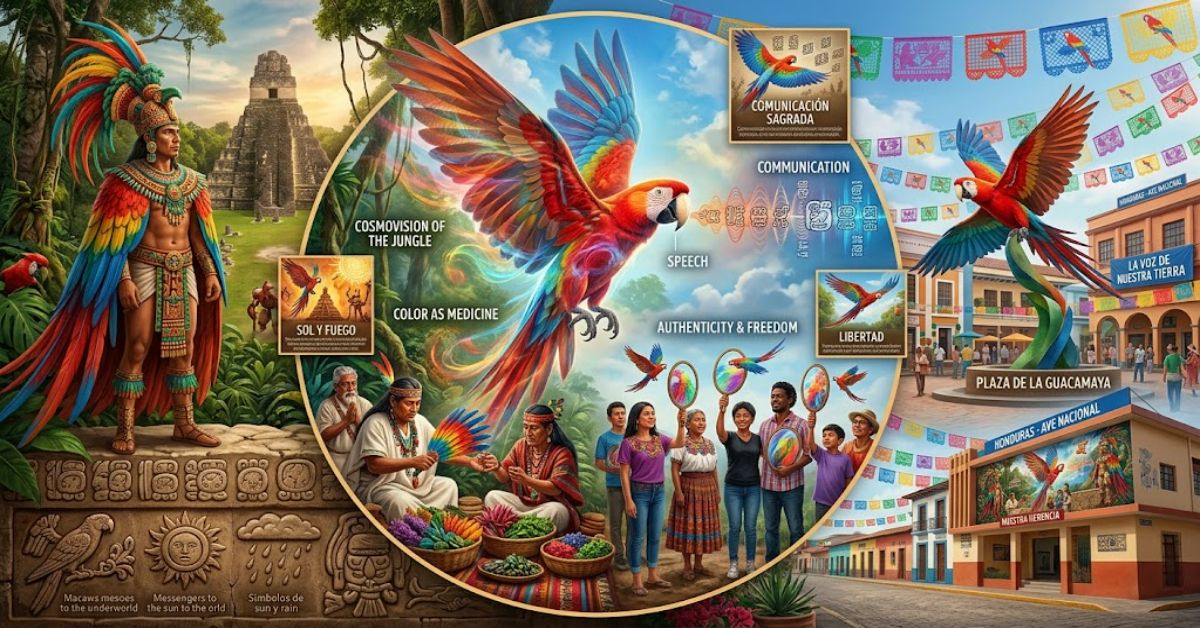
What does the guacamaya represent in Latin culture? In the strongest historical sense, the answer is solar and sacred power, particularly within several Indigenous and Mesoamerican traditions. The scarlet macaw (Ara macao) was admired for its striking red, yellow and blue plumage, colours that could evoke sunlight, fire and the heavens.
The bird’s importance was not simply decorative. Archaeological evidence shows that scarlet macaws and their feathers were transported across substantial distances, sometimes hundreds of kilometres from their natural range. Their presence at important settlements indicates that they could carry social, political and ritual significance.
Among Maya traditions, macaw imagery appears in mythology and art, while in Central Mexican traditions macaw feathers were highly valued in featherwork. Archaeological research has also found evidence that communities in northern Mesoamerica and the American Southwest acquired and even bred scarlet macaws.
This history makes the guacamaya a particularly rich cultural symbol. It can represent solar energy, fire, prestige and a connection between earthly and celestial realms. However, it is misleading to claim that every Latin American culture gives the bird exactly the same meaning.
The modern word “Latin culture” covers hundreds of communities and traditions. The symbolism discussed here is primarily Indigenous and Mesoamerican, and its meanings changed according to place and period.
The Guacamaya as a Symbol of the Sun
One of the clearest historical associations is with the sun.
Archaeological and ethnohistorical research has connected scarlet macaws with solar symbolism in Mesoamerica. Their intense red plumage naturally lent itself to associations with heat, radiance and the sun.
In Maya contexts, macaw imagery could be connected with solar concepts and supernatural beings. The Popol Vuh, the K’iche’ Maya sacred narrative recorded after the Spanish conquest, features Vucub-Caquix, or Seven Macaw, a powerful bird figure who falsely claims solar authority.
This symbolism is more complex than simply saying “the macaw is the sun”. The story uses the bird to explore ideas of pride, false brilliance and cosmic order.
| Symbolic association | Cultural significance |
| Sun | Radiance, heat and celestial power |
| Fire | Energy, transformation and destruction |
| Sky | Connection between earthly and celestial realms |
| Red plumage | Vitality, power and visual prestige |
| Feathers | Status, ceremony and elite identity |
| Macaw imagery | Mythological and religious expression |
Fire, Light and the Heavens
The connection between the guacamaya and fire is closely related to its solar symbolism.
The bird’s vivid colouring made it particularly suitable for representing heat and flame. Research into Mesoamerican macaw symbolism has identified associations with the sun, fire, light and other celestial concepts. (ScienceDirect)
This creates a useful way to understand the bird’s symbolic role. The guacamaya could occupy a conceptual space between the earth and the heavens.
Its ability to fly connected it with the sky, while its red and yellow plumage recalled flames and sunlight. The combination made the bird more than an attractive animal. It became a visual expression of forces that Indigenous societies considered powerful and sacred.
Why Were Guacamaya Feathers So Valuable?
The symbolic importance of the guacamaya also had a practical social dimension.
Bright feathers were difficult to obtain and transport, particularly when birds had to be brought from tropical regions to settlements far from their natural habitat. This rarity increased their value.
Evidence from archaeological sites demonstrates that scarlet macaws were transported over long distances. At Chaco Canyon in present-day New Mexico, direct radiocarbon evidence places the acquisition of scarlet macaws from Mesoamerica as early as approximately AD 900–975. (PubMed)
Their value was therefore linked to more than appearance. Controlling access to rare birds and feathers could help communicate prestige and political authority.
This is one of the less obvious aspects of guacamaya symbolism: sacred meaning and social status could reinforce each other.
Guacamayas, Power and Elite Identity
Scarlet macaw feathers appear in archaeological evidence associated with high-status individuals and ceremonial objects.
Research on pre-Hispanic societies indicates that macaw feathers were incorporated into elite headdresses and other forms of visual display. Among Maya communities, representations of macaws and macaw feathers continued into the Classic period, approximately AD 250–900. (PubMed Central (PMC))
In this context, wearing macaw feathers could communicate access to something rare, distant and symbolically powerful.
The bird therefore operated on several levels at once:
- Spiritual: associated with supernatural and cosmic forces.
- Political: connected with authority and elite status.
- Economic: involved in long-distance exchange networks.
- Artistic: used for striking visual effects in featherwork and imagery.
- Ritual: incorporated into ceremonial practices.
Was the Guacamaya a Symbol of Fidelity?
Modern descriptions sometimes say the guacamaya represents fidelity because macaws form long-term pair bonds.
There is a biological basis for observing strong pair relationships in macaws, but it is important not to project modern romantic symbolism backwards onto every Indigenous tradition.
The claim that the scarlet macaw universally represented romantic fidelity or sacred marriage across Latin culture is too broad.
Historical evidence is considerably stronger for associations with solar power, fire, prestige, ritual and cosmology than for a single pan-Latin symbol of romantic faithfulness.
That distinction matters because cultural symbolism should be based on documented traditions rather than modern interpretations alone.
A Symbol That Travelled Across Regions
The guacamaya’s importance extended beyond areas where scarlet macaws naturally lived.
At Paquimé, in northern Chihuahua, Mexico, archaeologists have found substantial evidence of scarlet macaws. Research suggests that macaws were valuable sources of social and ideological power, while questions remain about precisely why particular birds were transported and maintained. (ScienceDirect)
The American Southwest provides another striking example. Archaeological research at Chaco Canyon demonstrates long-distance acquisition of macaws from Mesoamerica. These networks show that the bird itself could become part of broader systems of exchange, political organisation and ritual life.
This gives the guacamaya another important meaning: connection.
The bird physically and culturally linked distant regions through trade, ceremony and shared visual traditions.
The Meaning of the Guacamaya Today
Today, the guacamaya remains a powerful cultural image throughout parts of Latin America.
Its brilliant colours make it common in visual art, tourism imagery, conservation campaigns and national or regional symbolism. Yet its modern meaning is not always the same as its pre-Hispanic meaning.
For some people, it represents Indigenous heritage and ancestral knowledge. For others, it symbolises tropical biodiversity, freedom or environmental conservation.
The modern conservation dimension is particularly significant because scarlet macaws face habitat loss and other pressures in parts of their range. Protecting the species can therefore preserve not only biodiversity but also an animal with deep archaeological and cultural importance.
The Future of Guacamaya Cultural Symbolism in 2027
By 2027, the cultural conversation surrounding the guacamaya is likely to increasingly combine heritage with conservation.
Museums, archaeologists and Indigenous communities have opportunities to present macaw symbolism with greater historical precision. That means distinguishing Maya, Mexica and other Indigenous traditions rather than treating them as one uniform belief system.
Digital museum collections and archaeological research are also making evidence about ancient macaw trade and ritual use easier to access.
The most responsible future interpretation will therefore avoid a single universal definition. The guacamaya can be a symbol of the sun, fire, prestige, ritual and connection, but its precise meaning depends on the community and historical context.
Key Takeaways
- The guacamaya has strong solar associations in several Mesoamerican traditions.
- Fire and light are closely connected with its vivid red and yellow plumage.
- Macaw feathers functioned as markers of prestige and authority.
- Long-distance trade gave the bird additional economic and political significance.
- The idea of the guacamaya as a universal symbol of romantic fidelity is less securely documented.
- Modern interpretations should distinguish Indigenous traditions rather than treating Latin culture as one single belief system.
Conclusion
The guacamaya represents far more than beauty in the cultural history of Mesoamerica. The scarlet macaw’s brilliant appearance, ability to fly and rarity outside tropical habitats made it an unusually powerful symbol.
Its strongest documented associations include the sun, fire, light, celestial forces, ritual and social prestige. Archaeological evidence also shows that macaws travelled through extensive exchange networks, demonstrating how cultural meaning could move alongside people, feathers and valuable goods.
At the same time, the bird’s symbolism should not be reduced to one universal Latin American meaning. Indigenous societies developed distinct cosmologies, and the guacamaya could occupy different roles within them.
The modern image of the bird continues to evolve. Today it can represent heritage, biodiversity and cultural identity as well as its older associations with solar and sacred power. Understanding that layered history makes the guacamaya a particularly revealing symbol of Indigenous American cultural traditions.
Frequently Asked Questions
What does the guacamaya represent in Latin culture?
In several Mesoamerican traditions, the guacamaya represents the sun, fire, light and celestial power. It could also signify prestige and ritual authority.
What does the scarlet macaw symbolise in Maya culture?
Scarlet macaws appear in Maya mythology and imagery associated with solar and supernatural concepts. Vucub-Caquix in the Popol Vuh is a famous macaw figure connected with claims of solar power.
Why was the guacamaya important to Indigenous cultures?
Its feathers were visually striking and difficult to obtain in regions outside its natural habitat. They therefore became valuable in ceremonial, artistic and elite contexts.
Does the guacamaya represent love and fidelity?
Modern interpretations sometimes associate macaws with fidelity because of their long-term pair bonds. However, stronger historical evidence supports associations with solar power, fire, ritual and prestige.
Was the guacamaya important to the Aztecs?
Macaw feathers were highly valued in Central Mexican featherwork and ceremonial displays. Historical and archaeological evidence indicates that brightly coloured bird feathers had substantial prestige value.
Why are scarlet macaws found at archaeological sites far from their natural range?
They were transported through long-distance exchange networks, and some communities also maintained breeding populations. Chaco Canyon provides strong evidence for the movement of macaws from Mesoamerica.
Methodology
This article separates documented Mesoamerican symbolism from broader modern interpretations of the guacamaya. Evidence was checked against archaeological research, museum material, academic publications and historical sources concerning scarlet macaw use.
Particular attention was given to evidence for solar, fire, ritual and prestige associations. Archaeological findings from Chaco Canyon and other sites were used to establish the bird’s role in long-distance exchange.
A key limitation is that “Latin culture” is a broad modern category that includes many distinct societies. The article therefore focuses primarily on Indigenous Mesoamerican traditions rather than claiming one universal Latin American interpretation.
No fabricated firsthand observations or interviews have been included.
Editorial disclosure: This article was drafted with AI assistance and should be reviewed by a human editor before publication. Named claims, dates and references should be independently checked against the original sources.
References
American Museum of Natural History. (2015). Macaw skeletons offer clues to Pueblo society.
Greshko, M. (2018). Early Native Americans imported exotic parrots, DNA reveals. National Geographic.
Mathiowetz, M. (2025). Scarlet macaws and the Aztatlán tradition of West Mexico: Gulf Coast acquisition and US Southwest/Mexican Northwest dissemination. Crow Canyon Archaeological Center.
McKusick, C. A., et al. (2015). Early procurement of scarlet macaws and the emergence of social complexity in Chaco Canyon, NM. Proceedings of the National Academy of Sciences, 112(26), 8238–8243.
Smithsonian Institution. (n.d.). Birds of the sun: Macaws and people in the U.S. Southwest and Mexican Northwest.