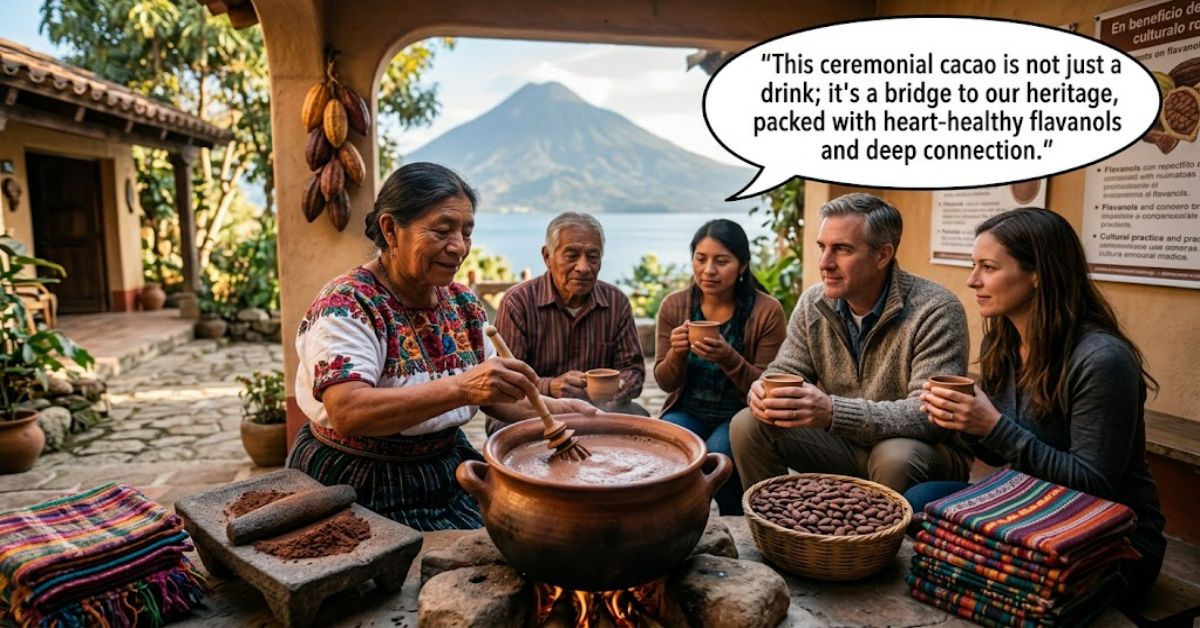
Ceremonial cacao is a form of drinking chocolate made from cacao beans or cacao paste that has undergone relatively limited processing and is traditionally prepared as a rich, unsweetened beverage. Unlike conventional hot chocolate, it is not primarily designed to taste sweet. Instead, it offers an intense cacao flavour and is often consumed slowly as part of a reflective or intentional practice.
The term “ceremonial” also refers to the way the drink is used. Cacao has deep cultural roots in Mesoamerica, where it was valued as food, a social resource and part of ritual life. Archaeological evidence shows that cacao beverages played important roles in Maya society and other Mesoamerican cultures.
Modern cacao ceremonies are different from historical Mesoamerican practices and should not be treated as identical. Today, the drink is often associated with mindfulness, meditation, music, group gatherings or personal reflection.
Nutritionally, cacao contains flavanols and other plant compounds. Research has found that flavanol-rich cocoa products may support vascular function and modestly influence blood pressure. A 2025 systematic review found evidence of improved microvascular responses in several acute studies, while also highlighting limitations caused by differences between studies.
That makes cacao interesting from both a culinary and nutritional perspective, but it is important to separate established evidence from marketing claims.
What Is Ceremonial Cacao?
Ceremonial cacao is generally sold as a solid block, paste, discs or chunks made from processed cacao beans. It is melted into hot water or another liquid to create a thick drink.
It differs from ordinary cocoa powder because cocoa powder is produced after cacao has been processed and much of the cocoa butter has been removed. Cacao paste retains substantially more of the bean’s natural fat.
The word “ceremonial” is not a universal scientific or legal grade. There is no single global standard that guarantees that a product labelled ceremonial has a particular flavanol concentration, fermentation profile or origin.
That is one of the most important points for consumers. A premium label does not automatically establish nutritional quality.
How Cacao Becomes a Drinking Chocolate
The cacao bean goes through several important stages before reaching a cup.
| Stage | What happens | Why it matters |
| Harvest | Ripe cacao pods are collected | Determines raw material quality |
| Fermentation | Beans ferment for several days | Develops flavour and changes chemical compounds |
| Drying | Beans are dried after fermentation | Reduces moisture and stabilises the beans |
| Roasting | Heat develops flavour | Can affect flavour and bioactive compounds |
| Grinding | Beans become cacao liquor or paste | Retains cocoa butter |
| Preparation | Paste is mixed with hot liquid | Creates the finished drink |
Processing matters because cacao flavanols are sensitive to production conditions. Therefore, two products can both be marketed as ceremonial cacao while having different chemical profiles.
Ceremonial Cacao and Heart Health
The strongest scientific interest in cacao concerns flavanols, including epicatechin.
A 2025 meta-analysis examined 145 randomised controlled trials involving 5,205 participants. Flavan-3-ol-rich interventions were associated with reductions in both office and 24-hour blood pressure, with larger effects observed among participants who had higher baseline blood pressure.
However, this evidence should not be interpreted as proof that drinking ceremonial cacao prevents heart disease.
The research covers flavanol-rich foods, beverages and supplements rather than one standardised category called ceremonial cacao. The actual flavanol content of a particular cacao product can vary.
Earlier systematic reviews have also reported improvements in endothelial function and modest reductions in blood pressure following cocoa consumption.
This suggests a potential cardiovascular role, but cacao should remain a food rather than a substitute for prescribed treatment.
Can It Improve Mood and Energy?
Cacao naturally contains compounds such as theobromine and small amounts of caffeine. These can contribute to the stimulating sensation people experience after drinking it.
The effect is different from coffee because cacao generally provides less caffeine, while theobromine has a longer and milder stimulating action.
Many ceremonial practices also emphasise slowing down, breathing, gratitude and mindful consumption. The resulting feeling of wellbeing may therefore come from both the beverage and the context in which it is consumed.
Claims that cacao directly produces powerful emotional or spiritual effects are much less established scientifically than claims concerning its nutritional compounds.
Traditional Roots and Modern Ceremonies
Cacao has a long history in Mesoamerica. Archaeological evidence shows that Maya communities regarded cacao as a valuable food and social resource, with cacao beverages appearing in feasts and ritual contexts.
Modern cacao ceremonies should therefore be approached with cultural awareness.
There is a difference between respectfully learning about cacao’s history and presenting a modern wellness practice as though it were an unchanged ancient ritual. Contemporary ceremonies vary widely and may combine cacao with meditation, breathwork, music or other practices.
The historical record is much broader than the modern wellness interpretation.
Choosing Quality Cacao
A useful purchasing checklist is more practical than relying on the word “ceremonial”.
| Quality factor | What to look for |
| Origin | Clearly stated country or region |
| Ingredients | Ideally simple, with cacao as the main ingredient |
| Processing | Transparent information about fermentation and processing |
| Testing | Evidence of appropriate food-safety testing |
| Flavour | Deep cacao aroma without excessive bitterness or burnt notes |
| Traceability | Information about producers or supply chain |
| Packaging | Clear storage and preparation instructions |
One overlooked issue is heavy-metal contamination. Food-safety authorities have identified cacao as a food that can be exposed to cadmium through soil, while lead can enter cacao through environmental exposure or post-harvest contamination.
This does not mean cacao is unsafe. It means responsible sourcing and testing are important, particularly for people who consume concentrated cacao regularly.
How to Prepare Ceremonial Cacao
A simple preparation usually involves chopping or breaking cacao paste into small pieces before gently melting it into hot water.
A basic serving can include:
- cacao paste
- hot water or milk
- cinnamon
- vanilla
- a small amount of natural sweetener, if desired
The liquid should be hot rather than aggressively boiling. Gentle heating makes it easier to combine the cacao without unnecessarily overheating the mixture.
The final drink should be smooth and thick, with a naturally bitter and earthy flavour.
Risks and Trade-Offs
Ceremonial cacao is not automatically suitable for everyone.
Because cacao contains stimulatory compounds, people who are particularly sensitive to caffeine or theobromine may experience restlessness or difficulty sleeping if they consume it late in the day.
Another consideration is portion size. Cacao paste contains cocoa butter and is therefore energy-dense. Adding coconut milk, nut butter, syrup or other calorie-rich ingredients can make a ceremonial drink substantially more caloric than expected.
The third issue is product quality. Heavy-metal exposure is a legitimate food-safety consideration, making transparent sourcing and testing valuable.
The Future of Ceremonial Cacao in 2027
By 2027, the ceremonial cacao market is likely to become more focused on traceability and product transparency.
Consumers increasingly have access to information about cacao origin, processing and producer relationships. At the same time, scientific research is becoming more precise about flavanol intake rather than treating all chocolate products as nutritionally equivalent.
A key development will be the distinction between cacao marketed for cultural or ceremonial use and cacao evaluated for measurable nutritional properties.
The category is unlikely to receive a single universal definition soon. Instead, consumers may increasingly judge products through origin information, ingredient lists, processing details and independent food-safety testing.
Key Takeaways
- Ceremonial cacao is generally a minimally processed cacao paste prepared as a drink.
- It has deep historical connections to Mesoamerican food and social traditions.
- Cacao contains flavanols that have been studied for vascular and blood-pressure effects.
- Scientific evidence does not support every health claim made by modern cacao marketing.
- The word “ceremonial” does not itself guarantee a particular nutritional composition.
- Origin, processing and food-safety testing are important quality considerations.
- Heavy-metal contamination is a genuine issue that responsible producers should monitor.
Conclusion
Ceremonial cacao sits between food, cultural tradition and modern wellness. Its appeal is easy to understand: it has a rich flavour, contains naturally occurring plant compounds and can turn an ordinary drink into a slower, more deliberate experience.
The nutritional evidence is promising but should be interpreted carefully. Research on cocoa flavanols suggests potential benefits for vascular function and blood pressure, yet studies do not establish that every product sold as ceremonial cacao delivers the same effects.
Its cultural history also deserves respect. Cacao was important to Mesoamerican societies long before the modern wellness industry adopted ceremonial language.
For consumers, the strongest approach is simple: choose products with transparent origins, straightforward ingredients and appropriate food-safety information. Enjoy the drink for its flavour and ritual value, while treating broader health claims with the same care applied to any other functional food.
Frequently Asked Questions
What is ceremonial cacao?
Ceremonial cacao is generally a minimally processed cacao paste prepared as a rich drinking chocolate. It is usually unsweetened and contains naturally occurring cacao compounds, including flavanols.
Is ceremonial cacao the same as cocoa powder?
No. Cacao paste normally retains much of the bean’s cocoa butter, while cocoa powder has undergone further processing and has had much of its fat removed.
Does ceremonial cacao have health benefits?
Cacao flavanols have been associated with improvements in vascular function and modest reductions in blood pressure in controlled research. However, evidence does not prove that every ceremonial cacao product provides these effects.
Does ceremonial cacao contain caffeine?
Yes. Cacao naturally contains caffeine, although it generally contains less caffeine than coffee. It also contains theobromine, another naturally occurring stimulant.
Can you drink ceremonial cacao every day?
Some people choose to consume it regularly, but the appropriate amount depends on the individual, the product and the rest of the diet. Portion size and product quality matter.
How should ceremonial cacao be prepared?
Break the cacao paste into small pieces and gently melt it into hot water or milk. Cinnamon, vanilla or a small amount of sweetener can be added according to taste.
Methodology
This article was prepared using scientific reviews and meta-analyses concerning cocoa flavanols, vascular function and blood pressure, together with food-safety information concerning cacao contamination. Historical context was checked against archaeological research and established reporting on cacao’s role in Mesoamerican societies.
The evidence has an important limitation: research generally examines cocoa, flavan-3-ols or flavanol-rich interventions rather than a universally standardised category of “ceremonial cacao”. Therefore, health findings cannot automatically be transferred to every product carrying that label.
No firsthand product testing or fabricated practitioner interview has been presented. Claims about health effects are attributed to published research, while cultural claims are treated separately from modern wellness interpretations.
This article was drafted with AI assistance and requires human editorial verification before publication. All data, citations and named claims should be independently checked against original sources by the editorial team.
References
Food Standards Agency. (2025). Review of capability of methods for the verification of country of origin for food and feed. FSA Research and Evidence.
Ludovici, V., Bartoloni, A., et al. (2025). The role of cocoa flavanols in modulating peripheral and cerebral microvascular function in healthy individuals and populations at-risk of cardiovascular disease: A systematic review.
Ried, K., Sullivan, T., Fakler, P., Frank, O. R., & Stocks, N. P. (2012). Effect of cocoa on blood pressure. Cochrane Database of Systematic Reviews.
Taubert, D., Roesen, R., & Schömig, E. (2007). Effect of cocoa and tea intake on blood pressure. Archives of Internal Medicine.
Vlachopoulos, C., Alexopoulos, N., & Stefanadis, C. (2009). Effects of cocoa flavanols on cardiovascular risk factors. Current Opinion in Clinical Nutrition and Metabolic Care.
Williamson, G., et al. (2025). Impact of flavan-3-ols on blood pressure and endothelial function in diverse populations: A systematic review and meta-analysis of randomised controlled trials.