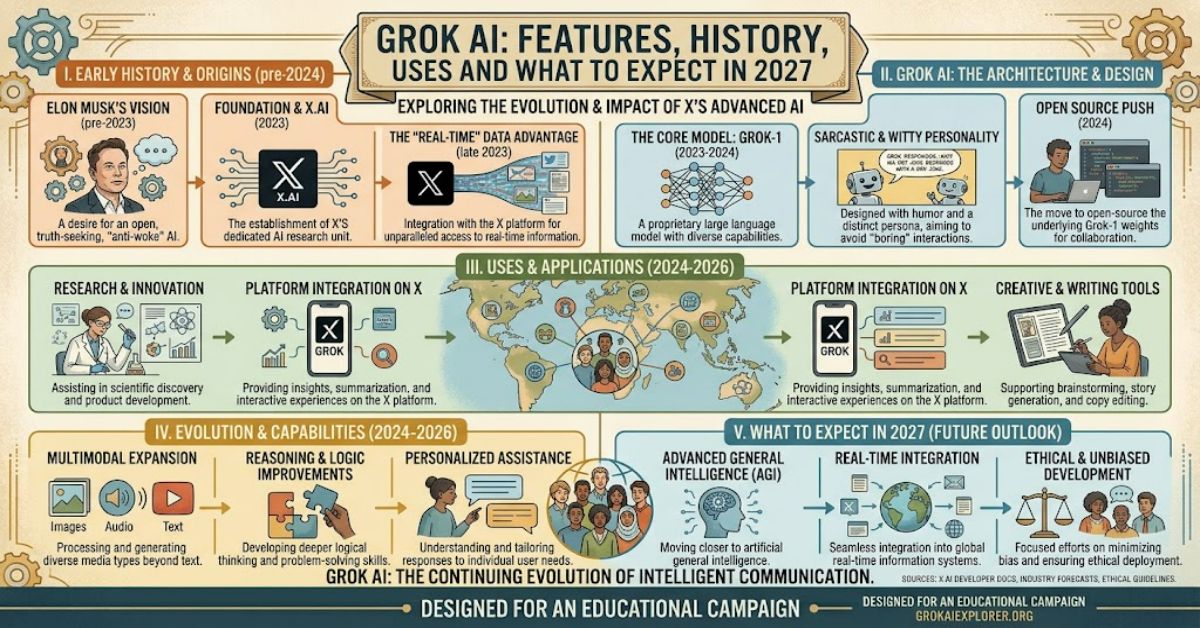
Grok AI is an artificial intelligence assistant developed by xAI, the AI company founded by Elon Musk. It first appeared publicly in November 2023 as an early beta product designed to answer questions, assist with information retrieval and interact with users in a distinctive conversational style. xAI highlighted its connection with X as an important advantage because it could use information from the platform to reflect current events.
Since that early release, Grok has expanded considerably. Current versions support text and image inputs, web and X search, coding, reasoning, voice conversations, file analysis and content generation. xAI’s current documentation describes Grok as an assistant available across the web, iOS and Android, with conversations and settings synchronised between platforms.
The development is significant because AI assistants are increasingly expected to do more than generate text. Users want systems that can research current information, analyse documents, understand images, create media and help complete practical tasks.
Grok’s position is therefore best understood through two elements: its underlying AI models and the tools connected to those models. The distinction matters because an AI model’s training data is not the same thing as live information retrieved through search.
How Grok AI Developed
Grok launched on 3 November 2023. The original Grok-1 was a large language model based on a Transformer architecture. xAI described it as an early system and acknowledged that it could still produce incorrect information.
The development timeline shows how quickly the platform expanded.
| Date | Development | Significance |
| 3 November 2023 | Grok introduced | Initial chatbot release |
| 17 March 2024 | Grok-1 weights released | 314-billion-parameter MoE model made available |
| 12 April 2024 | Grok-1.5 announced | Longer context and improved reasoning |
| 13 August 2024 | Grok-2 announced | New generation of models |
| 2025 | Grok 3 generation | Greater emphasis on reasoning and agents |
| 16 July 2026 | Grok 4.5 announced | Focus on coding, agentic tasks and knowledge work |
xAI’s March 2024 release described Grok-1 as a 314-billion-parameter Mixture-of-Experts model, with only a portion of its weights active for a given token.
By July 2026, xAI described Grok 4.5 as its strongest model at that time, targeting coding, agentic tasks and knowledge work.
What Makes Grok Different?
The most important distinction is not simply the size of the model. It is the collection of tools surrounding it.
| Capability | What it enables |
| Live web search | Research using current online information |
| X integration | Monitoring posts, discussions and breaking trends |
| Vision | Understanding images, screenshots and diagrams |
| File analysis | Reviewing PDFs, spreadsheets, code and other files |
| Voice | Conversational hands-free interaction |
| Image generation | Creating and editing visual content |
| Video generation | Producing short AI-generated videos |
| Coding | Writing, explaining and debugging software |
xAI currently describes Grok as capable of searching both the web and X, while its multimodal functions include image and video generation, voice interaction and file analysis.
This creates a useful distinction between model intelligence and tool access. A strong model can reason about information, but a connected search system can retrieve information that did not exist when the model was trained.
That makes live search particularly valuable for news research, current technology developments, product changes and rapidly changing public discussions.
Practical Uses of Grok
Grok can support several types of everyday work.
For research, live search can help users investigate subjects where older training data would be insufficient. A journalist, student or analyst can ask follow-up questions rather than manually opening multiple sources.
For coding, Grok can generate code, explain programming concepts and assist with debugging. Its newer model development has placed greater emphasis on software engineering and agentic tasks.
Multimodal capabilities also broaden its usefulness. Users can upload documents, images, spreadsheets or code for analysis. This means the interaction does not have to begin with a text-only question.
The creative side has expanded as well. Grok’s Imagine tools support image and video generation, while xAI announced an improved Imagine Video 1.5 system in June 2026.
Risks and Limitations
Live information is useful, but it does not automatically mean every answer is accurate.
The original Grok-1 documentation explicitly warned that models can hallucinate even when external information sources are available. This remains an important principle for using any AI assistant.
A second issue is source quality. Real-time social information can contain rumours, satire, incomplete claims and manipulated material. A system retrieving current posts can therefore become more current without necessarily becoming more reliable.
A third limitation concerns high-stakes decisions. xAI’s current model documentation says Grok is not intended for high-risk applications such as autonomous medical, legal, financial or safety-critical decision-making without appropriate human oversight and expert validation.
These limitations lead to a practical rule: current information should be verified, not simply accepted because it is current.
Three Important Insights About Grok
1. Live access changes the research workflow.
The value of search integration is not merely freshness. It reduces the gap between asking a question and investigating its evidence, particularly when follow-up questions depend on newly discovered information.
2. Multimodality changes the input barrier.
Users can provide documents, images, spreadsheets and other material rather than converting everything into written prompts first. That can make AI more useful in practical workflows.
3. Model capability and reliability are different measurements.
Better reasoning, larger context and stronger benchmark performance do not remove the need for source checking. The quality of retrieved information and the way it is interpreted remain separate problems.
The Future of Grok AI in 2027
Grok’s development heading into 2027 is likely to centre on agentic workflows, multimodal interaction and deeper integration with external tools.
The direction is already visible. Current Grok features include multi-agent processing, live web and X search, coding, voice, image and video generation, file analysis and connected tools.
The important question is not whether AI assistants will gain more features. They almost certainly will. The harder issue is whether those features can operate reliably enough for professional workflows.
Human oversight will remain important, particularly where errors create financial, legal, medical or reputational consequences. The likely competitive advantage will therefore come from combining capable models with better retrieval, clearer citations, stronger tool use and dependable safeguards.
Key Takeaways
- Grok began as an early xAI chatbot in November 2023.
- Its connection with live web and X information is a central part of its identity.
- The platform now extends beyond text into vision, voice, files, coding, images and video.
- Grok-1 demonstrated xAI’s early Mixture-of-Experts approach.
- Later generations have increasingly focused on reasoning and agentic work.
- Live information does not guarantee factual accuracy.
- Human verification remains necessary for high-stakes decisions.
Conclusion
Grok AI has moved rapidly from an experimental chatbot into a broad AI assistant with search, reasoning and multimodal capabilities. Its development reflects a wider change in the AI market: users increasingly expect one system to handle research, communication, coding and creative work rather than perform a single task.
Its connection with current web and X information gives Grok a distinctive role, especially when users need to investigate subjects that change quickly. At the same time, the platform illustrates an important limitation of modern AI: access to more information does not automatically produce reliable conclusions.
The most sensible way to assess Grok is therefore through both capability and verification. Its expanding tools make it increasingly useful, while its potential weaknesses reinforce the need for human judgement.
Frequently Asked Questions
What is Grok AI?
Grok AI is an AI assistant developed by xAI. It can answer questions, reason through problems, search current information, analyse files and images, write code, and generate visual and audio content.
Who developed Grok?
Grok was developed by xAI, an artificial intelligence company founded by Elon Musk. The first public version was announced in November 2023.
Can Grok AI search the internet?
Yes. Current versions of Grok can perform live web searches and search information from X, allowing responses to incorporate more recent information.
Is Grok AI free?
Grok can be started for free, while paid plans provide higher usage limits and additional capabilities. xAI’s current pricing information lists both free and paid options.
Can Grok create images and videos?
Yes. Current Grok tools include image and video generation through Grok Imagine. xAI has continued expanding these creative capabilities during 2026.
Is Grok always accurate?
No. Like other generative AI systems, Grok can produce incorrect information. Users should verify important claims against reliable primary sources, particularly for high-stakes subjects.
Methodology
This article was prepared using current information from xAI’s official product documentation, model documentation and dated company announcements. Particular attention was given to distinguishing documented capabilities from broader interpretations of AI performance.
No independent hands-on testing was conducted for this article, so no fabricated testing results or personal performance claims have been included. Model capabilities and pricing can change, meaning readers should verify current product details before making purchasing or professional decisions.
Editorial disclosure: This article was drafted with AI assistance and should be reviewed by a human editor before publication. Named claims, specifications and current product information should be independently verified against the original source.
References
xAI. (2023, November 3). Announcing Grok. xAI.
xAI. (2023, November 3). Grok-1 model card. xAI.
xAI. (2024, March 17). Open release of Grok-1. xAI.
xAI. (2026, June 16). Grok Imagine Video 1.5. xAI.
xAI. (2026, July 16). Introducing Grok 4.5. xAI.
xAI. (2026). Welcome to Grok. xAI.
xAI. (2026). Grok 4.20 system card. xAI.