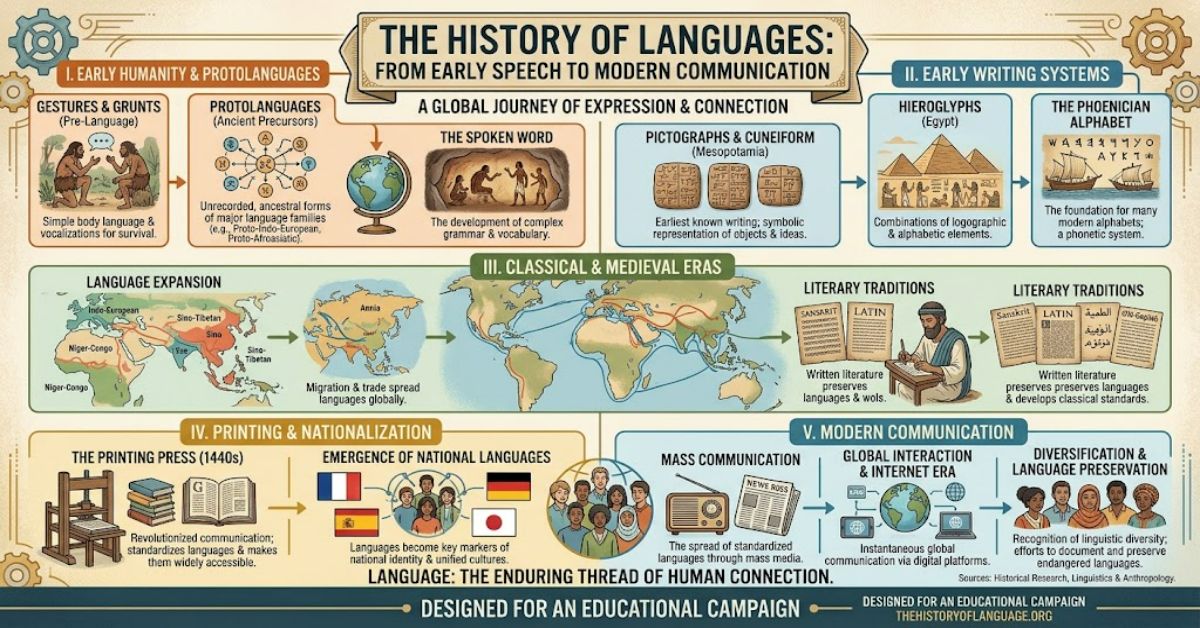
The history of languages is much older than written records. Humans almost certainly developed sophisticated forms of spoken communication thousands of years before anyone created an alphabet, manuscript or inscription. However, researchers cannot identify the exact moment when language began because speech leaves no physical record that can be excavated and dated.
Writing appeared much later. In Mesopotamia, early cuneiform developed around 3200 BC, initially helping societies record goods, food and administrative information. The development of writing transformed communication because information could be preserved beyond the memory of individual speakers.
Language itself is not the same as writing. A language is a system people use to communicate, while writing is a technology that represents language through visible symbols. Many human communities have maintained languages primarily through speech and oral traditions.
Over time, languages have changed as people migrated, traded, formed political states and interacted with neighbouring cultures. Latin eventually gave rise to languages including French, Spanish, Italian and Portuguese. English developed through several Germanic influences while absorbing substantial vocabulary from French, Latin, Norse and other languages.
Today, thousands of languages are spoken around the world. Some have hundreds of millions of speakers, while others are used by relatively small communities and face serious pressure from language shift.
When Did Human Language Begin?
There is no confirmed date for the beginning of human language.
Modern humans have existed for roughly 300,000 years, but scientists cannot simply connect the appearance of Homo sapiens with the invention of language. Human ancestors may have used increasingly complex communication systems long before modern humans appeared.
Archaeological evidence provides clues. Symbolic objects, pigments, ornaments and early artwork demonstrate that ancient humans developed sophisticated ways of representing ideas and communicating meaning.
However, these discoveries cannot reveal exactly what early humans said.
This is one of the biggest challenges in studying language history. Archaeologists can date objects, while linguists can reconstruct relationships between languages, but neither discipline can recover the first spoken sentence.
From Speech to Writing
For most of human history, knowledge was passed from one generation to another through speech, storytelling, gestures, songs and ritual.
Writing changed that relationship.
The earliest known writing systems developed in ancient civilisations where growing populations and increasingly complex economies created a need for reliable records. Mesopotamian cuneiform is one of the earliest examples.
Early cuneiform records were often practical rather than literary. They could document quantities of grain, livestock, workers and other resources.
This provides an important insight into the development of writing: writing may have emerged partly because societies needed better ways to manage information.
Once the technology existed, however, its uses expanded. Writing allowed people to preserve laws, religious traditions, historical accounts, contracts, scientific observations and literature.
Major Milestones in Language History
| Period | Development | Importance |
| Prehistoric period | Spoken communication | Allowed knowledge to pass between generations |
| Hundreds of thousands of years ago | Symbolic behaviour | Evidence of increasingly complex communication |
| Around 3200 BC | Mesopotamian cuneiform | Created durable administrative records |
| Ancient period | Multiple writing traditions | Supported law, religion and literature |
| Medieval period | Language diversification | Migration and political change reshaped languages |
| Early modern period | Printing | Expanded access to written information |
| Modern period | Mass education | Encouraged language standardisation |
| Digital era | Online communication | Accelerated global language contact |
These milestones do not represent a universal path. Different societies developed communication and writing technologies under different circumstances.
How Language Families Developed
Languages are often grouped into families based on shared ancestry.
The Indo-European family is one of the best-known examples. It contains branches including Germanic, Romance, Celtic, Slavic and Indo-Iranian languages.
English and German, for example, share an ancient Germanic connection. Spanish, French, Portuguese and Italian developed from varieties of Latin and therefore belong to the Romance branch.
Linguists use the comparative method to investigate these relationships. They compare vocabulary, pronunciation and grammatical structures, looking for systematic patterns.
Language families should not be viewed as perfectly separated branches. Languages constantly borrow words and expressions from one another.
English demonstrates this particularly well. Its vocabulary reflects centuries of contact with Norse-speaking communities, French-speaking rulers, Latin scholarship and many other cultures.
Why Languages Change
Language change is normal. No living language remains completely fixed.
Migration
When groups move to new regions, their language may develop differently from the language spoken by people who remain behind. Over generations, separate varieties can become increasingly distinct.
Trade and Cultural Contact
Trade introduces communities to new objects, foods, technologies and ideas. New vocabulary often enters a language through these relationships.
Political Influence
Governments, empires and educational institutions can encourage particular languages or varieties. A politically dominant language may become important in administration, education and commerce.
Technology
Printing, radio, television and the internet have all affected language use. Digital communication has increased the speed at which new expressions can spread between countries and communities.
Language and Cultural Identity
Language is more than a practical communication system. It can carry traditions, historical memories and cultural knowledge.
Names for plants, landscapes, family relationships and traditional practices may contain information developed over generations. Oral stories and songs can also preserve knowledge that may not exist in written records.
This makes language preservation important for cultural heritage.
UNESCO has highlighted the vulnerability of many of the world’s languages. Its work on linguistic diversity also shows why digital access matters. A language that lacks appropriate fonts, keyboards, educational resources or digital archives can face additional barriers in the modern communication environment.
Three Important Insights About Language History
Writing Did Not Create Language
Humans communicated for thousands of years before writing appeared. Writing should therefore be understood as a technology for recording language, not the origin of language itself.
Early Records Were Often Practical
Some of the oldest surviving written documents concern administration, goods and resources. Everyday record keeping unintentionally created valuable evidence about ancient societies.
Digital Technology Is Becoming Part of Language Preservation
Preserving a language today may involve more than recording words in a dictionary. Digital archives, speech recordings, searchable databases and compatible writing systems can help communities maintain linguistic traditions.
The Future of Language History in 2027
By 2027, technology is likely to play a larger role in how researchers study and preserve languages.
Artificial intelligence, speech recognition and large linguistic databases can help researchers analyse pronunciation, vocabulary and grammar across extensive collections of material. These tools may be particularly useful for languages with limited written documentation.
However, technology cannot guarantee survival.
A language remains strongest when communities continue to use it in homes, schools, workplaces and cultural activities. Digital tools can support speakers, but they cannot replace the social conditions that keep a language alive.
The future of language history will therefore involve two connected challenges: using technology to understand linguistic change while ensuring that smaller languages are not excluded from the digital world.
Key Takeaways
- Human speech existed long before writing.
- The precise origin of language remains unknown.
- Cuneiform was among the earliest writing systems.
- Languages change through migration, contact and cultural development.
- Language families reveal relationships between older and modern languages.
- Writing helped societies preserve information across generations.
- Digital technology now offers new tools for documenting linguistic diversity.
Conclusion
The history of languages reflects the history of humanity itself. People have always needed ways to share information, teach younger generations, organise communities and preserve collective knowledge.
The earliest stages remain hidden because spoken language leaves little direct evidence. Archaeology can reveal symbolic behaviour, while linguistics can reconstruct relationships between languages, but the first human words are beyond recovery.
The arrival of writing around the fourth millennium BC created a major turning point. For the first time, some human communication could survive independently of individual memory.
Since then, languages have continued to evolve. Migration, trade, political power, education and technology have all shaped the vocabulary and structure of languages.
Today, the challenge is not simply understanding where languages came from. It is also preserving the diversity that remains. As communication becomes increasingly digital, language history is continuing to develop rather than becoming a closed chapter.
Frequently Asked Questions
What is the history of languages?
It is the study of how human languages originated, changed, divided into families and interacted with societies throughout history.
When did spoken language begin?
There is no confirmed date. Researchers believe complex spoken communication is extremely ancient, but direct evidence of the earliest speech does not survive.
What was the first written language?
Sumerian is one of the earliest languages known from substantial written records. It was recorded using cuneiform in ancient Mesopotamia.
Why do languages change?
Languages change through migration, cultural contact, trade, political influence, education and technological developments.
What is a language family?
A language family is a group of languages believed to have descended from a common ancestral language.
Why are some languages disappearing?
Languages can decline when younger generations stop learning them and shift towards another language that offers greater educational, economic or social opportunities.
Methodology
This article history of languages draws on established research and institutional material concerning human evolution, archaeological evidence, ancient writing systems, comparative linguistics and linguistic preservation. Key claims should be checked against original sources before publication.
The exact origin of spoken language remains uncertain, so the article avoids assigning a definitive date. Archaeological evidence for symbolic behaviour is treated separately from evidence for fully developed spoken language.
No fabricated interviews, personal testing or invented firsthand observations have been included. Human editorial verification is required for all historical dates, statistics and references before publication.
Editorial disclosure: This article was drafted with AI assistance and should be reviewed and fact-checked by the RubbleMagazine.co.uk editorial team before publication.