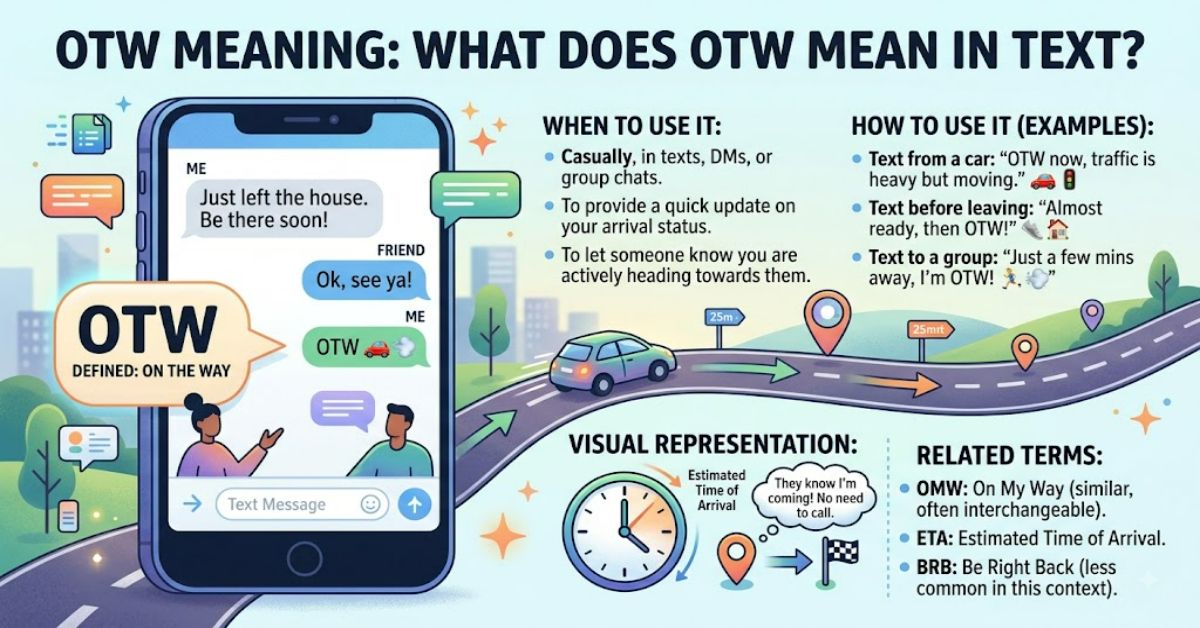
The otw meaning is simple in most conversations: it stands for “on the way”. People use the abbreviation in text messages, social media and online chats to tell someone that they are currently travelling or moving towards a specific location, person or destination.
For example, if a friend asks, “Are you coming?”, the reply “OTW” normally means, “Yes, I am on the way.” The same abbreviation can also appear when discussing deliveries, documents or other items that are expected to arrive soon.
Its simplicity explains why OTW has become such a familiar part of digital communication. Typing three letters is faster than writing a full sentence, and the meaning is usually clear from context. Yet there is a small complication: “on the way” can mean different things to different people.
Someone may send OTW after leaving home. Another person may use it more loosely to mean they are about to leave. In work communication, the difference between those interpretations can matter.
Understanding internet abbreviations is therefore not only about memorising definitions. It is also about recognising the expectations hidden inside casual language.
What Does OTW Stand For?
OTW stands for:
On the way
The phrase generally communicates movement from one place or stage to another. In everyday conversation, it is most commonly connected with travel.
Examples include:
- “I’m OTW to the restaurant.”
- “The driver is OTW.”
- “OTW now, see you soon.”
- “Your order is OTW.”
The abbreviation is particularly useful in mobile messaging because it communicates both action and progress. The recipient does not simply learn that something will happen. They understand that the process has supposedly already started.
That distinction makes OTW different from phrases such as “I’m leaving soon” or “I’ll come later”.
How OTW Is Used in Different Situations
The meaning remains broadly consistent, but context changes the precise interpretation.
| Situation | Meaning of OTW | Example |
| Personal chat | Travelling to meet someone | “OTW, be there in 15 minutes.” |
| Work message | Heading towards a location or completing a delivery | “The documents are OTW.” |
| Food or parcel delivery | An item is moving through the delivery process | “Your order is OTW.” |
| Social media | Announcing arrival or movement | “OTW to the concert.” |
| Casual conversation | Sometimes means “coming soon” rather than physically travelling | “The photos are OTW.” |
This flexibility is one reason abbreviations survive. A single expression can work across several forms of communication without requiring a new phrase for every situation.
OTW Meaning in Text Messages
In text messaging, OTW is usually informal and conversational. It works best when the recipient already understands where the sender is expected to go.
Imagine this exchange:
Person A: “Are you still coming?”
Person B: “Yes, OTW.”
The destination is already established, so no further explanation is necessary.
However, context can create ambiguity. If someone simply sends “OTW” without an existing conversation about a destination, the recipient may need to ask, “On the way where?”
A useful rule is that abbreviations save time only when both people share enough background information to understand them.
OTW and Other Common Text Abbreviations
Digital language is filled with shortened expressions that perform different communication functions.
| Abbreviation | Meaning | Main Purpose |
| OTW | On the way | Indicates movement or progress |
| BRB | Be right back | Signals a temporary absence |
| IDK | I don’t know | Expresses uncertainty |
| BTW | By the way | Introduces additional information |
| FYI | For your information | Shares useful information |
| IMO | In my opinion | Signals a personal viewpoint |
The interesting difference is that OTW describes status. It answers an implicit question: “What is happening now?”
This makes it particularly useful in coordination. Friends arranging to meet, colleagues travelling to a venue and customers tracking deliveries all need quick updates.
The Hidden Problem With Saying “OTW”
One of the most useful things to understand about the otw meaning is that the abbreviation can create a stronger expectation than the sender intends.
There is a significant difference between:
- “I’m getting ready.”
- “I’m leaving now.”
- “I’m on the way.”
Each statement represents a different stage of progress. Yet in casual messaging, people sometimes use OTW before they have physically started travelling.
This can create friction. The recipient may begin calculating an arrival time based on the assumption that the journey has already begun.
The same issue appears in business communication. If an employee says a report is “OTW”, a manager may reasonably expect that the document has been sent or is close to completion. Using vague status language can therefore cause unnecessary confusion.
A clearer alternative is to include a time estimate: “OTW now, should arrive at 6.30 pm.”
That small addition turns a vague update into useful information.
Why Short Forms Like OTW Became So Popular
Abbreviations developed naturally alongside digital communication. Early text messaging had character limits, mobile keyboards were slower, and online chat encouraged rapid exchanges.
Although modern smartphones make full sentences easier to type, abbreviations remain popular because they have become part of internet culture.
Their role has also changed. They are not only shortcuts. They can communicate tone.
“On my way” may sound neutral and complete. “OTW” feels quicker and more casual. The choice between them can signal how formal the conversation is.
This reflects a wider shift in digital language. Communication is increasingly shaped by speed, platform conventions and shared cultural knowledge.
The ability to understand shorthand is now a form of digital literacy, particularly when people communicate across different age groups, workplaces and online communities.
When Should You Avoid Using OTW?
OTW is useful, but it is not appropriate in every situation.
Avoid it when:
- the recipient may not understand internet slang;
- the message is part of a formal business communication;
- precise timing is important;
- ambiguity could create a safety or logistical problem;
- you are communicating with a customer or professional contact who expects formal language.
For example, “OTW” may be perfectly acceptable in a group chat but less suitable in a formal email.
The key issue is audience awareness. Good communication adapts to the person receiving the message.
Structured Insights: OTW and Communication Expectations
| Communication Factor | What OTW Communicates | Potential Limitation |
| Speed | A quick status update | May lack important details |
| Tone | Informal and relaxed | Can feel unsuitable professionally |
| Timing | Suggests progress has begun | Actual departure time may be unclear |
| Shared context | Works well between familiar contacts | Can confuse unfamiliar readers |
| Efficiency | Saves typing time | May encourage vague communication |
This highlights an important point: shorter messages are not always clearer messages.
The best communication depends on the consequences of misunderstanding. If being five minutes late has little importance, “OTW” may be enough. If a missed appointment, delivery or meeting depends on precise information, a full update is better.
The Cultural Impact of Internet Shorthand
Text abbreviations such as OTW reveal how language adapts to technology. Informal expressions can move quickly from messaging platforms into spoken conversation, social media captions and even marketing language.
At the same time, digital slang has a short cultural lifecycle. Some abbreviations remain widely understood for decades, while others disappear as platforms and communication habits change.
OTW has remained relatively stable because its function is practical. People will continue to need a quick way to tell others that they are travelling or that something is approaching.
The abbreviation also demonstrates how meaning depends on shared knowledge. Three letters carry little meaning in isolation. Within a familiar messaging context, however, they communicate a complete idea.
The Future of OTW Meaning in 2027
By 2027, OTW is likely to remain understandable because “on the way” is a practical expression rather than a trend tied to one particular social media platform.
However, the way people use it may continue to change. Real-time location sharing, delivery tracking and automated status notifications increasingly provide more precise information than a simple text message. A map can show where someone is. A delivery application can provide estimated arrival times.
This creates an interesting limitation for abbreviations like OTW. As automated systems become more detailed, casual shorthand may become less important for factual tracking but remain valuable for social communication.
A friend may already be able to see your location, yet you might still send “OTW” as a social signal. The phrase confirms intention as well as movement.
Artificial intelligence and predictive messaging may also suggest abbreviations automatically. Even so, their meaning will continue to depend on human context. Technology can predict a phrase, but it cannot remove the need for people to communicate honestly about their actual status.
Key Takeaways
- OTW almost always means “on the way”.
- It is commonly used to describe travel, deliveries or something expected soon.
- The abbreviation works best when the destination is already clear.
- OTW can create an expectation that movement has already started.
- Adding an estimated arrival time makes the message more useful.
- Shortened digital language remains valuable because it combines speed with shared cultural understanding.
Conclusion
The otw meaning is straightforward, but the way people use the abbreviation reveals more about modern communication than its three letters initially suggest. In most cases, OTW means “on the way” and provides a quick update about travel, movement or expected arrival.
Its usefulness comes from speed and familiarity. Friends can coordinate plans with minimal typing, while delivery services and online conversations can communicate progress quickly. However, brevity also creates room for misunderstanding. One person may interpret OTW as “I have already left”, while another may use it to mean “I am about to leave”.
That difference matters when timing is important. The most effective use of the abbreviation combines casual language with clear expectations. A short message such as “OTW, arriving at 7 pm” remains fast while providing useful detail.
As digital communication continues to change, OTW is likely to remain part of everyday language because the basic need it serves is unlikely to disappear.
FAQ
What does OTW mean in texting?
OTW means “on the way”. It is commonly used in text messages to tell someone that you are travelling towards a location or that something is currently moving towards its destination.
What is the OTW meaning on social media?
On social media, OTW usually still means “on the way”. Someone might write “OTW to the airport” or “OTW to the concert” to share what they are currently doing.
Does OTW mean that someone has already left?
Usually, that is the expected meaning. However, some people use OTW loosely when they are preparing to leave. If timing matters, it is better to ask for or provide a specific estimated arrival time.
What does OTW mean in delivery tracking?
In delivery-related communication, OTW generally means an item, driver or order is on its way to the next destination. The exact stage may depend on the company’s tracking system.
Is OTW formal or informal?
OTW is mainly informal. It is suitable for chats, texts and casual workplace messages where abbreviations are commonly understood. Formal communication usually benefits from writing “on the way” in full.
Can OTW mean something other than on the way?
In most modern messaging contexts, “on the way” is the intended meaning. Other interpretations are uncommon and usually depend on specialised communities or context.
Methodology
This article OTW Meaning analyses OTW as a widely recognised English-language text abbreviation. The explanation is based on established definitions of digital shorthand and common communication contexts, including personal messaging, social media and delivery updates.
The analysis also considers the practical limitations of abbreviated language, particularly ambiguity around timing and status. No invented surveys, user testing or personal interviews have been presented as evidence. Because internet language changes according to region, platform and community, individual usage may differ from the examples provided.
A balanced interpretation recognises that abbreviations can improve speed and convenience while also increasing the risk of misunderstanding when context is limited.
Editorial disclosure: This article was drafted with AI assistance and reviewed and verified by [Author Name]. All data, citations and claims should be independently confirmed before publication.
References
Cambridge University Press & Assessment. (n.d.). On the way. Cambridge Dictionary.
Merriam-Webster. (n.d.). Texting and internet abbreviations. Merriam-Webster Dictionary.
Oxford University Press. (n.d.). Digital communication and the English language. Oxford Reference.