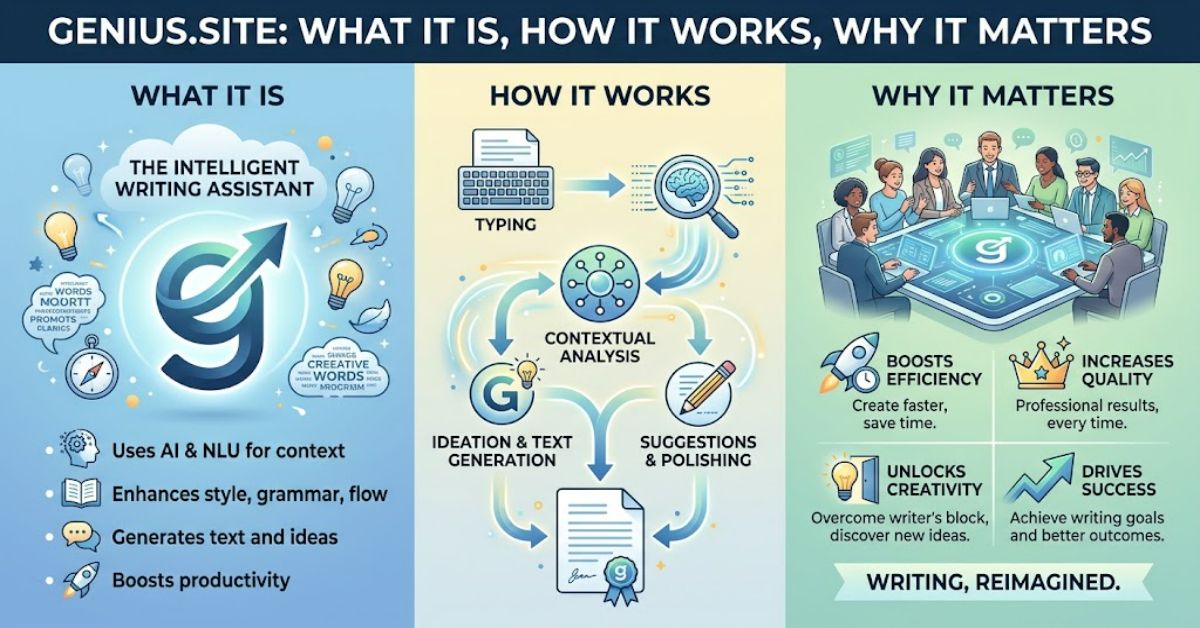
Genius.site is a search term that can lead users towards information connected with Genius, a platform centred on song lyrics and musical knowledge. The supplied brief describes Genius as the world’s biggest collection of song lyrics and musical knowledge.
The broader Genius platform is recognised for presenting lyrics alongside annotations and explanations. Instead of treating a song as a simple block of text, the service creates a layer of context around lyrics. Users can explore references, phrases, cultural details and interpretations while reading a song.
That approach has helped change the way people search for music online. A listener might begin with a song title but continue searching for the meaning of one particular line, the identity of a reference or the story behind an artist’s words.
Genius sits at the intersection of music discovery, fan communities and searchable cultural information. Its value therefore extends beyond displaying lyrics. The surrounding knowledge can help readers understand why particular songs matter and how their words connect to wider culture.
For users searching specifically for Genius.site, however, domain awareness is important. A search result using a similar name or domain should not automatically be assumed to represent the official Genius service. Checking the actual destination and domain is sensible before entering information or interacting with an unfamiliar website.
How the Genius Model Works
The central idea behind Genius is relatively straightforward: combine lyrics with additional information that helps explain them.
A typical music page can contain several layers of information:
| Layer | Purpose |
| Song information | Identifies the artist, title and recording |
| Lyrics | Provides the written words of the song |
| Annotations | Explains selected lines or references |
| Artist context | Adds background about the performer or work |
| Community contributions | Allows knowledgeable users to add information |
| Cultural references | Connects lyrics with people, events or ideas |
This structure makes the platform different from a basic lyrics directory. A directory answers the question, “What are the words?” An annotation-based platform can also explore, “What do these words mean?”
That distinction is particularly useful for songs containing slang, historical references, wordplay, samples, personal stories or multiple interpretations.
Why Lyrics and Annotations Matter
Lyrics have always been part of music culture, but the internet changed how listeners interact with them.
Before searchable online lyric databases became widespread, understanding a difficult lyric could require repeated listening, printed liner notes or discussion with other fans. Search engines made individual phrases discoverable, while platforms such as Genius created dedicated spaces for interpreting those phrases.
Annotations can also preserve knowledge that might otherwise disappear. An artist may reference an older song, a local expression or an event that is unfamiliar to younger listeners. An explanation can provide the missing context.
There is also a social dimension. Music interpretation is rarely completely objective. Two listeners can hear the same lyric and understand it differently. Community annotation allows multiple perspectives to exist around the same text.
The challenge is that community interpretation is not automatically authoritative. An annotation can be insightful, but readers should distinguish between an artist-confirmed explanation, a sourced factual note and an individual interpretation.
Genius, Search Behaviour and Music Discovery
Music websites increasingly function as discovery tools as well as reference sources.
A person searching for a song may arrive because they want the lyrics. Another user may be searching for a phrase they heard but could not identify. Someone else may be interested in the meaning of an album or a particular reference.
This creates several types of search intent:
| Search intent | Typical user need |
| Navigational | Find a particular song or artist page |
| Informational | Understand a lyric or musical reference |
| Discovery | Find related artists or songs |
| Contextual | Learn the story behind a recording |
| Interpretive | Explore possible meanings of lyrics |
The ability to satisfy several types of intent on one platform helps explain why lyric websites have become part of the wider music-information ecosystem.
The Difference Between Facts and Interpretation
One of the most important issues when using lyric annotations is separating factual information from interpretation.
A statement such as an artist’s birth date can be checked against reliable biographical sources. A claim about the meaning of a metaphor may depend on context or the artist’s own explanation.
This can be represented simply:
| Information type | Verification approach |
| Song title | Recording or official release information |
| Release date | Label, artist or recognised music database |
| Artist statement | Interview or direct statement |
| Historical reference | Independent historical source |
| Lyric interpretation | Context, commentary and artist explanation |
| Fan theory | Treat as interpretation rather than fact |
This distinction becomes more important when a song deals with politics, religion, relationships, social conflict or historical events.
Practical Benefits for Music Fans
For ordinary listeners, the biggest advantage of an annotated music platform is convenience.
A listener can move from hearing a song to reading its lyrics and then exploring references without changing the basic subject of the search. This can turn a casual listening session into deeper research.
Students and writers may also find music annotations useful as starting points for cultural research. However, annotations should not automatically be treated as academic sources. Important claims should be checked against original interviews, books, academic publications or primary documents.
Artists can benefit from the same ecosystem because detailed pages may help listeners understand their work. Music that contains dense references can become more accessible when additional context is available.
Risks and Limitations
The model also has limitations.
Copyright is one of the most important issues surrounding online lyrics. Lyrics are creative works, and publishing them involves legal rights that differ from simply discussing a song.
Another issue is accuracy. Community-created information can vary considerably in quality. A confident explanation is not necessarily a verified explanation.
There is also the risk of reducing artistic ambiguity. Some songs deliberately leave meaning open to interpretation. An annotation can provide useful context, but it should not necessarily be treated as the single definitive explanation.
Finally, users searching for Genius.site should pay attention to domain authenticity. A familiar brand name appearing in a URL does not, by itself, establish that a website is operated by the organisation associated with that name.
The Future of Genius.site and Online Music Knowledge in 2027
By 2027, music knowledge platforms are likely to face growing pressure to distinguish verified information from automated or community-generated material.
Artificial intelligence can make lyrics, summaries and explanations easier to produce, but that does not automatically make them more reliable. Provenance will become increasingly important. Users may want to know whether an explanation came from an artist, an identified expert, a documented interview or an anonymous contributor.
Search behaviour is also changing. People increasingly ask conversational questions rather than entering only song titles. A music knowledge platform that can provide reliable context around those questions may remain useful.
At the same time, copyright restrictions and licensing arrangements will continue to shape what lyrics services can display and how they can operate.
The likely direction is therefore not simply “more lyrics”. It is richer metadata, stronger source attribution and clearer distinctions between verified facts and interpretation.
Key Insights
- Lyrics become more useful when readers can access reliable context around them.
- Community annotations can provide valuable cultural knowledge but should not automatically be treated as authoritative.
- Artist statements are particularly important when determining intended meaning.
- Search intent around music extends beyond finding lyrics to understanding references and discovering related material.
- Domain verification matters when users encounter websites using names associated with established music brands.
- Copyright remains a central consideration for any online lyrics service.
- Future music platforms will need stronger provenance as AI-generated explanations become more common.
Conclusion
Genius has helped establish a model in which lyrics and musical knowledge can exist together rather than as separate forms of information. Its broader significance comes from turning song pages into spaces for context, annotation and discussion.
For users searching for Genius.site, the first practical consideration is to identify the correct website and distinguish official services from similarly named domains. Once there, the wider Genius approach demonstrates why annotated music information remains valuable: listeners often want to know not only what an artist said, but also the references, history and ideas surrounding those words.
The strongest use of music annotations is therefore as contextual guidance rather than unquestionable authority. Facts should be sourced, artist statements should be identified clearly, and interpretations should remain recognisable as interpretations. That balance allows lyric platforms to support music discovery while maintaining a useful standard of accuracy.
FAQ
What is Genius.site?
Genius.site is a search term associated with the wider Genius concept of lyrics and musical knowledge. Users should verify the exact domain before assuming that a website is an official Genius property.
What is Genius mainly known for?
Genius is primarily known for song lyrics, annotations and music-related knowledge. Its pages can combine lyrics with explanations of references, phrases and cultural context.
Is Genius only a lyrics website?
No. Lyrics are central to the service, but its broader model includes annotations, artist information, explanations and community contributions that add context to songs.
Are Genius annotations always factual?
No. Some annotations provide factual information, while others may reflect interpretation or community commentary. Important claims should be checked against reliable primary or independent sources.
Why do people use Genius for music research?
People use it to find lyrics, understand difficult phrases, investigate references and explore the context surrounding songs and artists.
Should Genius information be used as an academic source?
It can be useful as a starting point, but important academic claims should normally be supported with primary sources, scholarly publications, interviews or other authoritative references.
Methodology
This article follows the supplied editorial brief and focuses on the stated description of Genius as a collection of song lyrics and musical knowledge. The discussion distinguishes general platform characteristics from interpretation and avoids treating community-generated explanations as automatically authoritative.
Because the supplied source identifies the keyword and a short description rather than providing detailed corporate, legal or technical documentation, those areas have been discussed at a general level rather than presented as specific claims about Genius.site. The exact ownership or relationship of any particular domain should be independently verified before publication.
References
Genius. (n.d.). Genius: Song lyrics and musical knowledge. Genius.
RubbleMagazine.co.uk. (2026). Article Writing Prompt — Production Version. Internal editorial brief.