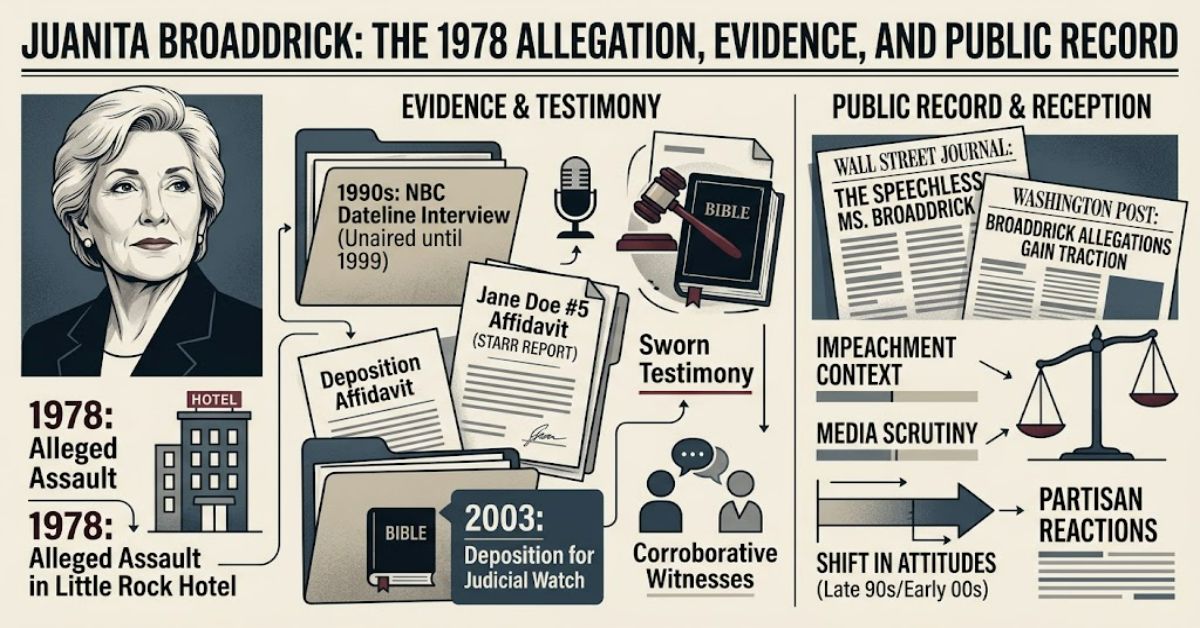
Juanita Broaddrick is an American former nursing home administrator who became a nationally known figure in 1999 after publicly alleging that Bill Clinton sexually assaulted her in 1978. The allegation concerned an encounter at the Camelot Inn in Little Rock, Arkansas, where Broaddrick was attending a nursing home administrators’ conference. The supplied brief identifies 25 April 1978 as the date of the alleged incident.
At the time, Clinton was Arkansas attorney general and was preparing for another run for governor. Broaddrick had met him through political activity and had volunteered during his campaign.
Her allegation did not become a major national news story until more than two decades later. In February 1999, she gave interviews to journalists and appeared on NBC’s Dateline. The timing placed the story in the final stages of the political controversy surrounding Clinton’s presidency and his Senate impeachment trial.
The distinction between an allegation and a proven fact is important. Broaddrick gave a detailed account of what she said happened, while Clinton, through his lawyer David Kendall, denied the allegation.
What Did Broaddrick Allege?
According to contemporary reporting, Broaddrick said Clinton initially arranged to meet her while she was staying at the Camelot Inn. She said that after meeting her, he suggested they have coffee in her hotel room because the hotel lobby was crowded with reporters.
Broaddrick later told reporters that Clinton began making unwanted sexual advances. She said she resisted and that the encounter became physically coercive. She described the incident as rape during her 1999 NBC interview.
Her account also included a claimed physical injury. She said her lip had been swollen following the encounter. One woman interviewed by NBC said she had seen Broaddrick shortly afterwards and recalled injuries that she associated with the account.
These details became part of the media discussion because they provided potentially corroborating evidence about Broaddrick’s condition after the alleged encounter. They did not, however, independently establish what had happened inside the hotel room.
The Earlier Affidavit and Change in Her Account
One of the most significant complications in the public record is Broaddrick’s earlier sworn statement.
When lawyers representing Paula Jones investigated allegations concerning Clinton, Broaddrick was identified as “Jane Doe No. 5”. She initially signed an affidavit denying that Clinton had made an unwelcome sexual advance towards her. She also gave testimony consistent with that position.
Broaddrick later changed her account. She told investigators working for independent counsel Kenneth Starr that her earlier statement was untrue because she did not want to become involved in the Jones litigation. Contemporary reporting said Starr’s investigation did not establish the allegation conclusively.
That reversal became central to subsequent assessments of the story. Supporters of Broaddrick’s account pointed to people who said she had described the encounter soon afterwards. Critics highlighted the earlier sworn denial and the absence of direct witnesses to the alleged assault.
The historical record therefore contains both evidence supporting aspects of her account and significant reasons for caution.
What Did Bill Clinton Say?
Clinton did not publicly provide a detailed personal account of the alleged encounter when the story emerged nationally in February 1999. Instead, his lawyer David Kendall issued a statement describing the allegation as false. Clinton later referred reporters to his lawyer’s statement.
The White House archives also record a March 1999 press conference in which Clinton was asked directly about Broaddrick’s allegation and his relationship with her. He referred back to his previous position rather than providing a detailed response.
The absence of a detailed public account from Clinton became part of the media discussion, particularly because the allegation emerged during an already intense period of scrutiny over his personal conduct.
What Was Established About 25 April 1978?
Contemporary reporting found some contextual evidence surrounding the date.
Broaddrick was in Little Rock for a nursing home administrators’ conference at the Camelot Inn. Newspaper records also indicated that Clinton had a public appearance in the area that evening. However, detailed records establishing exactly where he was during the relevant period were not available.
There were no independent witnesses to the alleged assault itself, and contemporary reporting noted the absence of police or medical records documenting the incident.
This distinction matters. Evidence that two people were in the same location can establish opportunity, but it does not by itself establish what occurred between them.
Evidence and Limitations
| Public-record element | What it shows |
| Broaddrick’s account | A detailed allegation of sexual assault |
| Earlier affidavit | An initial denial later withdrawn |
| Friends’ accounts | Some people said Broaddrick described the incident afterwards |
| Hotel and conference records | Support the broader timeline and location |
| Clinton’s response | His lawyer denied the allegation |
| Criminal prosecution | No charges were brought |
The record therefore does not support presenting the allegation itself as a judicially established fact.
Why Did the Story Become National News in 1999?
The story arrived at a politically charged moment. Clinton’s presidency was already under extraordinary scrutiny because of the Monica Lewinsky investigation and impeachment proceedings.
NBC had interviewed Broaddrick but delayed broadcasting the interview while conducting additional checks. The network’s president said the organisation wanted more information and corroboration before proceeding.
Broaddrick subsequently spoke publicly through several media outlets. Her account attracted significant attention because it concerned conduct allegedly dating back to Clinton’s early political career and because she had previously remained outside the public spotlight.
The episode also illustrates the difficulty journalists face when investigating historical allegations. The passage of 21 years meant that documentary evidence was limited, memories could differ, and many potential records or witnesses were unavailable.
The Future of Juanita Broaddrick’s Public Record in 2027
By 2027, the significance of the Juanita Broaddrick story is likely to remain primarily historical rather than legal. The central documents are already decades old, and no criminal prosecution resulted from the allegation.
Its continuing relevance lies in how historical sexual-assault allegations are reported, investigated and evaluated. The case demonstrates several recurring issues: delayed reporting, conflicting sworn statements, corroborating witnesses who did not directly observe the alleged event, incomplete documentary records and the difficulty of assessing claims long after the alleged incident.
Modern reporting standards also place greater emphasis on clearly separating an allegation from an established finding. That distinction is especially important when the person accused is a major political figure and when the evidence remains contested.
Key Insights
- Broaddrick’s public account emerged more than 20 years after the alleged 1978 encounter.
- Her earlier sworn denial is an important part of the documented chronology.
- Several people reportedly supported aspects of her account, but none witnessed the alleged assault itself.
- Clinton’s legal representative denied the allegation.
- Contemporary investigators did not establish the allegation conclusively.
- No criminal charges were brought against Clinton over the allegation.
- The episode remains an example of the evidentiary and journalistic challenges involved in reporting historical accusations.
Conclusion
Juanita Broaddrick name became closely associated with one of the most contested allegations surrounding Bill Clinton’s presidency. Her account concerned an alleged sexual assault in Little Rock on 25 April 1978, when Clinton was Arkansas attorney general. She eventually described the encounter publicly in 1999 after years of avoiding the spotlight.
The historical record contains several competing elements: her detailed account, statements from people who said she discussed the incident, contextual records concerning the hotel and conference, her earlier sworn denial and the subsequent retraction of that denial. Clinton’s attorney rejected the allegation, and no criminal charges followed.
For that reason, responsible accounts should distinguish carefully between what Broaddrick alleged, what contemporary reporting documented and what was ultimately established. That distinction remains essential when examining any historical allegation involving a prominent public figure.
FAQ
Who is Juanita Broaddrick?
Juanita Broaddrick is an American former nursing home administrator who became nationally known in 1999 after publicly alleging that Bill Clinton sexually assaulted her in 1978.
What did Juanita Broaddrick allege?
She alleged that Clinton sexually assaulted her in a Little Rock hotel room on 25 April 1978. Clinton’s attorney denied the allegation.
Was Juanita Broaddrick’s allegation proven in court?
No. The allegation was never established through a criminal prosecution or court finding, and no criminal charges were brought over it.
Why did Broaddrick initially deny the allegation?
She initially gave a sworn statement denying an unwelcome sexual advance. She later said that statement was false because she did not want to become involved in the Paula Jones litigation.
Did anyone support Broaddrick’s account?
Contemporary reporting identified friends and acquaintances who said Broaddrick had described the encounter or appeared distressed afterwards. None was a direct witness to the alleged assault.
When did the allegation become widely known?
The allegation received major national attention in February 1999, when Broaddrick gave interviews and appeared on NBC’s Dateline.
Methodology
This article separates documented chronology from disputed allegations. It uses the supplied editorial brief together with contemporary reporting from The Washington Post and archived White House material. Limitations include the age of the allegation, incomplete records from 1978, the absence of direct witnesses to the alleged assault and the conflicting accounts in the historical record.
The article does not treat an allegation as an established fact and does not infer guilt or innocence beyond what the documented record supports.
References
Kurtz, H. (1999, February 20). ‘Jane Doe No. 5’ goes public with allegation. The Washington Post.
Kurtz, H. (1999, February 24). NBC ready to air ‘Jane Doe’ interview. The Washington Post.
Kurtz, H. (1999, February 25). Clinton accuser says she thought no one would believe her account. The Washington Post.
Clinton White House. (1999, March 19). Press conference. William J. Clinton Presidential Materials.
Washington Post Fact Checker. (2015, December 30). A guide to the allegations of Bill Clinton’s womanizing. The Washington Post.
Editorial note: This article was drafted with AI assistance. Historical claims and citations should be independently checked against the original sources before publication.