Ipswich history is unusual because the same name belongs to three historically significant places on opposite sides of the world. The best-known is Ipswich in Suffolk, England, an ancient town whose urban story reaches back to the Anglo-Saxon period. Another Ipswich developed in Massachusetts in the 17th century, while Ipswich in Queensland emerged from Australia’s colonial expansion during the 19th century.
These communities were not founded at the same time or under the same circumstances. Their histories reflect very different forces: North Sea commerce, medieval politics, European colonisation, Indigenous heritage, convict labour, coal mining, manufacturing and railway development.
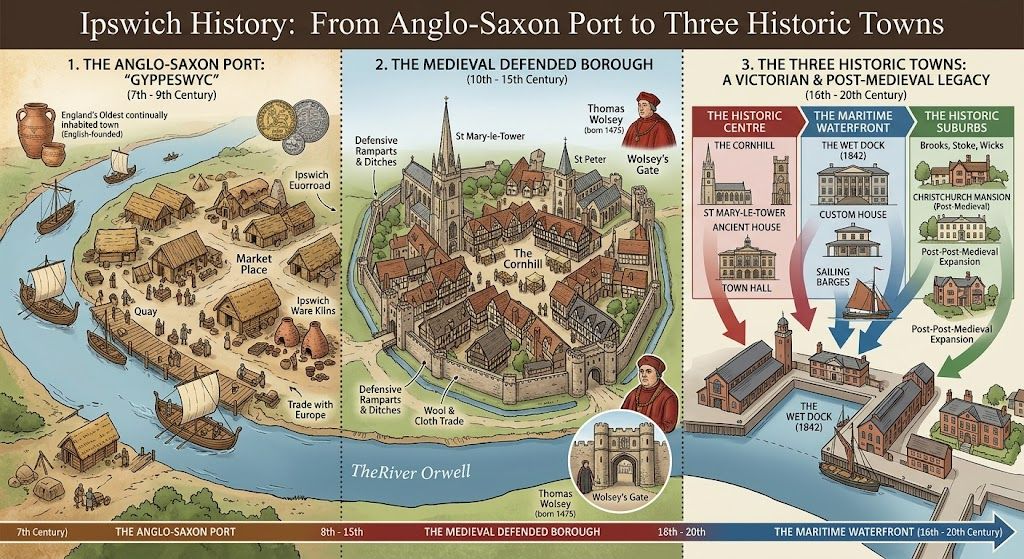
The English town is the oldest of the three. Archaeological evidence indicates that a settlement developed on the site of modern Ipswich during the early 7th century. By around AD 720, it had expanded into a substantial trading and manufacturing centre covering roughly 50 hectares.
The Massachusetts settlement followed more than nine centuries later. It was incorporated in 1634 on land traditionally associated with Indigenous communities known as the Agawam. The Queensland settlement was later still, beginning its colonial history in 1827 before becoming a municipality in 1860.
Understanding these three places together reveals how a single name can connect very different stories of migration, commerce, government and cultural change.
The Origins of Ipswich in England
The foundations of Ipswich lie in the Anglo-Saxon period. Archaeological evidence suggests that activity on the site became established during the 7th century, after the decline of Roman urban life in Britain.
Around AD 720, the settlement expanded dramatically. Its location near the River Orwell gave it access to maritime routes, allowing merchants and craftsmen to participate in wider North Sea networks. Ipswich became one of the major trading settlements of Anglo-Saxon England.
Pottery production was particularly important. Archaeological excavations have revealed evidence of workshops, imported goods, waterfront structures and residential buildings. The town’s importance was therefore not simply commercial; it was also a centre of manufacturing.
Suffolk’s archaeological record describes Ipswich as one of only four major international ports of the Middle Saxon period. Excavations between 1974 and 1990 at 34 sites provided extensive evidence of urban life, trade and craft production.
Scandinavian Influence
The arrival of Scandinavian forces in eastern England changed Ipswich again. Following the invasion of 865 AD, Scandinavian settlement became permanent in East Anglia.
Ipswich was fortified during this period, and craft production increased. Metalworking and pottery manufacture became important parts of the urban economy.
West Saxon forces conquered the area in 920. Although Ipswich remained significant, its growth slowed during the following period. The town nevertheless retained its position as an important regional centre.
Medieval Ipswich and Economic Change
The Norman Conquest of 1066 brought another major turning point.
The Domesday survey of 1086 indicates that Ipswich had suffered a substantial decline. Suffolk Heritage Explorer records that hundreds of burgess plots were described as waste, demonstrating the scale of the economic disruption.
The town eventually recovered. During the medieval period, Ipswich developed new religious institutions, churches and commercial areas. Its trading identity survived even as political authority and economic networks changed.
This pattern is one of the most interesting features of Ipswich history: decline did not mean disappearance. The settlement repeatedly adapted to new political and economic conditions.
A Town Built on Archaeology
Modern Ipswich contains an unusually valuable archaeological record. Historic England identifies substantial evidence from early medieval, medieval and post-medieval periods.
The archaeological remains demonstrate that today’s streets sit above layers of earlier settlement. Some areas preserve evidence of workshops, homes, town defences and waterfront activity.
| Period | Major development | Historical importance |
| 7th century | Anglo-Saxon settlement expands | Urban development begins |
| c. 720 AD | Large Middle Saxon town develops | International trade and manufacturing |
| 865 AD onward | Scandinavian settlement | Cultural and political change |
| 920 AD | West Saxon conquest | End of Scandinavian rule |
| 1086 | Domesday survey | Evidence of major economic decline |
| Medieval period | Commercial and religious expansion | Revival of urban importance |
Ipswich, Massachusetts
The American Ipswich has a very different origin.
The area was inhabited by Indigenous peoples long before European settlement. The modern town’s official history acknowledges archaeological evidence of human occupation stretching back thousands of years, including material associated with the Paleo-Indian period.
European colonisation began in the 1630s. The settlement was incorporated as Ipswich in 1634 and named in honour of the English town and its merchants.
The local geography helped shape its development. The Ipswich River provided freshwater, transport opportunities and waterpower. Early residents worked as farmers, fishermen, shipbuilders and traders.
By 1646, the settlement had nearly 800 inhabitants. During the 18th century, wharves, storehouses, shipbuilding facilities and other businesses developed around the river.
From Fishing to Textiles
The Massachusetts community later developed an industrial identity. Home industries included lace making and stocking production.
A major turning point came in 1868, when the Ipswich Hosiery Mills began operating in an existing stone mill on the Ipswich River. By the beginning of the 20th century, the business had become the largest stocking mill in the United States, according to the town’s historical account.
Its well-preserved historic buildings are another important part of the town’s identity. Because Ipswich remained relatively small for much of the 19th and early 20th centuries, many older houses survived rather than being extensively modernised.
Ipswich, Queensland
The Australian Ipswich emerged in a completely different historical setting.
The area is traditionally associated with the Jagera, Yuggera and Ugarapul peoples, whose connections with the land and waters extend across generations. European colonial development began in 1827, when a lime-burning operation was established in the area as part of the Moreton Bay penal system.
The convict era ended in 1839, after which free settlers increasingly moved into the area. Coal, limestone and transport soon became central to its economy.
Queensland’s first coal mine opened at Redbank in 1843. These resources helped Ipswich become an important industrial settlement.
| Ipswich | Key historical turning point | Long-term identity |
| Suffolk, England | Anglo-Saxon trading town | Historic port and heritage centre |
| Massachusetts, USA | Incorporation in 1634 | Colonial, maritime and textile history |
| Queensland, Australia | Colonial settlement from 1827 | Mining, manufacturing and railway heritage |
Railways and Industrial Growth in Queensland
Ipswich’s importance increased rapidly during the 19th century.
The settlement became a municipality in 1860 and was officially recognised as a city in 1904. The Ipswich to Grandchester railway, completed in 1865, was Queensland’s first railway.
This railway connection transformed the city’s economic possibilities. Ipswich was positioned between Brisbane and the agricultural and pastoral regions further west, making transport infrastructure particularly valuable.
Coal mining, manufacturing and railway activity subsequently became major parts of the local economy.
The city’s development was significant enough that Ipswich was once seriously considered as a possible capital of Queensland. Brisbane ultimately became the capital, but Ipswich retained a major regional role.
What Makes the Three Ipswiches Connected?
The connection between these places is more than a shared name.
The Massachusetts settlement was deliberately named after Ipswich in England. Queensland’s Ipswich also developed during the British colonial era, when British place names were frequently transferred to settlements across the empire.
Yet each community developed its own identity.
The English Ipswich was shaped by medieval and North Sea commerce. Massachusetts became associated with agriculture, maritime activity and textiles. Queensland developed around colonial administration, mining, railways and manufacturing.
The comparison shows how geography can transform an inherited name into three distinct cultural identities.
The Future of Ipswich History in 2027
By 2027, digital preservation is likely to remain an important part of how these communities interpret their past.
Queensland’s council has already digitised historical municipal meeting minutes covering the period from 1860 to 1893, making previously difficult-to-access records more useful to researchers and residents.
In England, archaeological recording remains equally important because redevelopment can affect buried evidence. The extensive excavations carried out in Ipswich demonstrate how modern construction can create opportunities to recover information that would otherwise remain inaccessible.
The challenge is balance. Historic preservation cannot freeze a city in time, while unchecked development can permanently remove evidence of earlier communities.
Key Takeaways
- Ancient origins: English Ipswich developed as a major Anglo-Saxon trading settlement during the 7th and 8th centuries.
- Archaeological value: Excavations have revealed extensive evidence of homes, crafts, trade and waterfront activity.
- Colonial connection: Ipswich, Massachusetts, was named after the English town when it was incorporated in 1634.
- Industrial transformation: Queensland’s Ipswich became strongly associated with coal, railways and manufacturing.
- Indigenous history: The Australian site has a much older cultural history than its European settlement.
- Shared name, different stories: Each Ipswich developed according to its own geography, economy and political circumstances.
Conclusion
Ipswich history is best understood as three separate stories connected by geography, migration and naming traditions.
The English Ipswich has the deepest urban history, emerging as a major Anglo-Saxon port and manufacturing centre more than 1,000 years ago. Its archaeological remains continue to provide evidence of early urban life and international commerce.
Ipswich in Massachusetts developed from a 17th-century colonial settlement on land with a much older Indigenous history. Its river supported farming, fishing, shipping and eventually textile manufacturing.
Queensland’s Ipswich followed a different path, moving from a convict-era colonial outpost to an industrial city shaped by coal and railways. Its first railway helped establish its importance in Queensland’s economic development.
Together, the three places demonstrate how settlements evolve through trade, technology, migration, political change and cultural memory. The shared name provides the starting point, but their individual histories give each Ipswich its distinctive character.
Frequently Asked Questions
What is the main focus of Ipswich history?
Ipswich history can refer to the development of Ipswich in Suffolk, England, or the later settlements named Ipswich in Massachusetts and Queensland.
When did Ipswich in England begin?
The present town developed during the 7th century. Around AD 720, it expanded into a substantial Middle Saxon settlement involved in international trade and manufacturing.
Why was Ipswich, Massachusetts, given its name?
The Massachusetts settlement was named after Ipswich in England. It was incorporated in 1634 and developed beside the Ipswich River.
When was Ipswich, Queensland, founded?
European colonial development began in 1827 with a lime-burning operation. The settlement later became a municipality in 1860 and a city in 1904.
What made Ipswich, Queensland, important?
Coal, manufacturing and railways were central to its growth. Queensland’s first railway connected Ipswich with Grandchester in 1865.
Is Ipswich one of England’s oldest towns?
Ipswich is one of England’s earliest continuously occupied urban settlements. Archaeological evidence places its major Anglo-Saxon development in the 7th century.
Methodology
This article was researched using official heritage and government sources from Suffolk County Council, Historic England, the Town of Ipswich in Massachusetts and Ipswich City Council in Queensland. Archaeological claims were cross-checked against heritage records where possible. The article distinguishes between documented history and broader interpretation and does not claim firsthand visits, interviews or original field research.
The historical record for each Ipswich reflects different source traditions, so comparisons should not be interpreted as evidence that the three communities developed in identical ways.
Editorial disclosure: This article was drafted with AI assistance and should be reviewed by a human editor before publication. Named claims, dates and historical details should be independently checked against the original sources.
References
Historic England. (n.d.). Ipswich: Local Heritage Hub.
Historic England. (n.d.). Area of Middle and Late Saxon town, off Greyfriars Road, Ipswich.
Ipswich City Council. (2025). Happy birthday Ipswich! The city that was almost Queensland capital turns 165.
Ipswich City Council. (2026). Decades of Ipswich history unlocked with digitisation.
Ipswich City Council. (n.d.). Council history.
Town of Ipswich, Massachusetts. (n.d.). History.
Town of Ipswich, Massachusetts. (n.d.). Community profile: History.
Suffolk County Council. (n.d.). Ipswich: A historical port and town.
Suffolk County Council. (n.d.). Ipswich Saxon.
Suffolk County Council. (n.d.). Ipswich medieval.