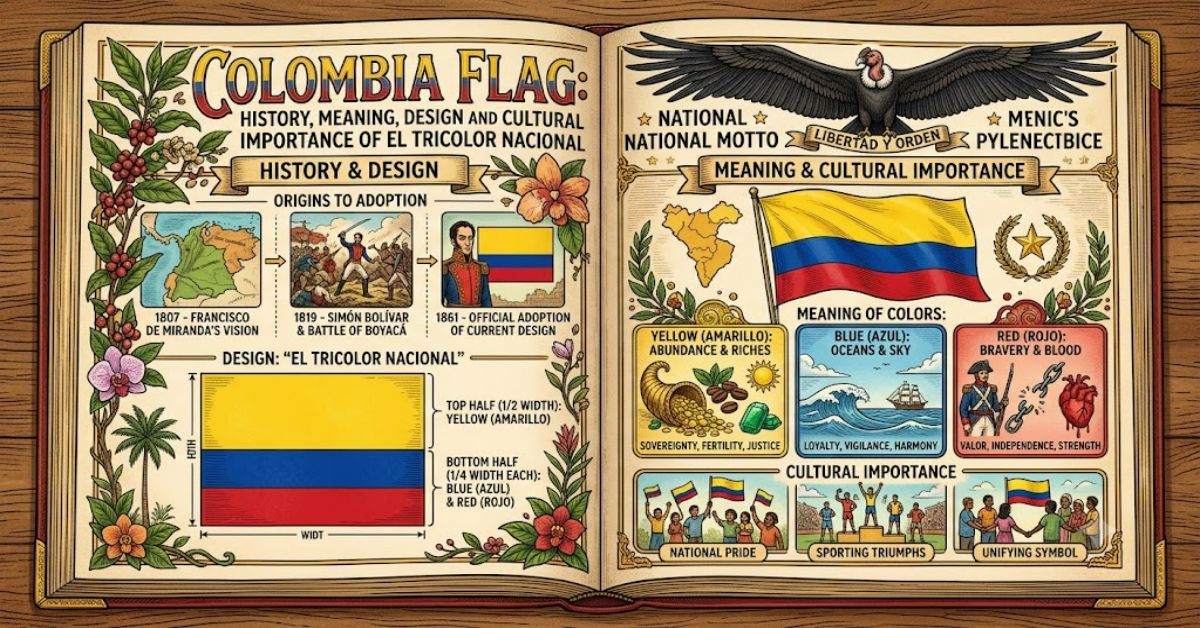
The Colombia flag is the national symbol representing the Republic of Colombia and is recognised globally through its distinctive horizontal bands of yellow, blue, and red. Known officially as El Tricolor Nacional, the flag reflects Colombia’s historical development, independence movement, and cultural identity.
The modern design traces its origins to the early 19th century during the struggle for independence from Spanish colonial rule. Created from ideas associated with independence leader Francisco de Miranda, the colours became connected with the broader liberation movements of South America.
Today, the flag appears on government buildings, military uniforms, international events, sporting competitions, and national celebrations. For Colombians, it represents more than a visual emblem; it reflects shared history, resilience, biodiversity, and national pride.
Understanding the meaning behind the flag requires examining its design, historical evolution, official usage, and cultural significance. Unlike many national flags that have undergone frequent changes, Colombia’s tricolour has maintained remarkable continuity since independence.
Historical Origins of Colombia’s National Flag
The roots of Colombia’s flag date back to the independence era of the early 1800s. Venezuelan revolutionary Francisco de Miranda introduced a yellow, blue, and red colour scheme in 1806, which later influenced several South American nations.
When Colombia formed the Republic of Gran Colombia in 1819, the tricolour became an official symbol. Gran Colombia included territories that today form Colombia, Venezuela, Ecuador, and Panama.
After Gran Colombia dissolved in 1831, Colombia continued using variations of the same colours. The current arrangement was officially established in 1861 under President Tomás Cipriano de Mosquera.
The continued use of these colours demonstrates how national symbols can survive political changes while maintaining cultural meaning.
The Meaning Behind the Colombia Flag Colours
Each colour carries symbolic interpretations connected to Colombia’s landscape and history.
| Colour | Traditional Meaning |
| Yellow | Represents gold, natural resources, agriculture, and Colombia’s wealth |
| Blue | Symbolises seas, rivers, and the skies surrounding the country |
| Red | Represents the sacrifices and struggles during independence |
The yellow section occupies half of the flag’s total area, while blue and red each occupy one quarter. This unique proportion distinguishes the Colombian design from many other national flags.
The symbolism also reflects Colombia’s geography. The country is known for its Amazon rainforest, Caribbean coastline, Pacific shores, mountain ranges, and agricultural production.
Design Features and Official Use
The Colombia flag follows specific design standards established by national regulations. It has a horizontal layout consisting of three stripes:
- A large yellow stripe at the top
- A blue stripe in the centre
- A red stripe at the bottom
The flag does not include symbols, text, or national emblems in its basic form. However, government institutions may use versions featuring the national coat of arms.
Comparison of Colombian National Symbols
| Symbol | Purpose | Historical Role |
| Flag | Represents national identity | Connected to independence movements |
| Coat of Arms | Represents official state authority | Used by government institutions |
| National Anthem | Expresses patriotic identity | Adopted in 1920 |
The simple design allows the flag to be easily recognised internationally while maintaining strong historical associations.
Cultural Impact of Colombia’s Flag
The flag plays an important role in Colombian society. It appears during Independence Day celebrations on 20 July, sporting events, military ceremonies, and international diplomatic occasions.
During global football tournaments and Olympic competitions, the colours become a visual representation of national unity. Supporters often wear yellow shirts or display flags to demonstrate national pride.
The symbol also has significance among Colombian communities abroad. Colombian expatriates frequently display the flag during cultural festivals, helping maintain connections with their heritage.
A practical observation from international cultural events is that national flags often become identity markers for diaspora communities. Colombia’s tricolour is particularly effective because its bold colours remain recognisable even from a distance.
Global Recognition and Diplomatic Importance
National flags serve important diplomatic functions. Colombia’s flag is displayed at embassies, international organisations, and official meetings.
The colours also support Colombia’s international branding efforts. Tourism campaigns frequently connect the flag’s colours with the country’s landscapes, biodiversity, and cultural diversity.
However, there is a challenge: simplified representations of national symbols can sometimes remove historical context. A flag used only as a decorative image may lose the deeper meaning connected to independence and national development.
Data Insights: Colombia Flag in Context
| Insight Area | Information |
| Official name | El Tricolor Nacional |
| Adoption of current design | 1861 |
| Independence celebration date | 20 July |
| Main colours | Yellow, blue, red |
| Related national symbols | Coat of arms and anthem |
One overlooked aspect of Colombia’s flag is how its continuity has helped preserve historical memory. While governments and borders have changed, the tricolour has remained a stable connection between generations.
The Future of Colombia’s Flag in 2027
By 2027, Colombia’s flag is likely to remain unchanged as a central national symbol. National flags generally evolve slowly because they represent historical continuity rather than temporary political movements.
Digital platforms may increase the visibility of Colombian symbols worldwide. Social media, virtual events, and international communities will continue using the flag as a cultural identifier.
Another emerging trend is the connection between national symbols and tourism branding. Colombia’s biodiversity and cultural exports may strengthen international recognition of the tricolour.
However, debates may continue around how national symbols are used commercially. Maintaining respect for historical meaning while allowing modern cultural expression will remain an important balance.
Key Takeaways
- Colombia’s flag originated during the independence movements of the early 19th century.
- The yellow, blue, and red colours represent resources, geography, and sacrifice.
- The current design has remained officially established since 1861.
- The flag plays a major role in national celebrations and international representation.
- Colombian communities worldwide use the flag to preserve cultural connections.
- Its simplicity has helped make it one of South America’s most recognisable national symbols.
Conclusion
The Colombia flag represents centuries of history, independence, and cultural identity. Its yellow, blue, and red colours tell a story connected to Colombia’s natural environment, national struggles, and hopes for the future.
Beyond its physical design, the flag serves as a shared symbol that connects citizens within Colombia and communities around the world. Its continued presence at national celebrations, sporting events, and diplomatic gatherings demonstrates the lasting power of visual symbols.
Although simple in appearance, the tricolour carries deep historical significance. Its survival through political changes shows how national symbols can provide continuity and strengthen collective identity across generations.
Frequently Asked Questions
What do the colours of the Colombia flag mean?
The yellow represents wealth and resources, blue represents seas and skies, and red represents sacrifices made during independence.
When was the Colombia flag officially adopted?
The current version was officially established in 1861, although the colours originated during the independence period.
Why is the Colombia flag called El Tricolor Nacional?
The name refers to its three national colours: yellow, blue, and red.
Does the Colombia flag have a symbol in the centre?
The standard national flag does not. A version with the coat of arms is used for certain official purposes.
What is Colombia’s flag used for?
It is used during national holidays, government events, international ceremonies, and cultural celebrations.
How is the Colombia flag different from Ecuador’s flag?
Both use yellow, blue, and red colours, but Colombia’s flag has different proportions and does not normally include Ecuador’s coat of arms.
Methodology
This article was prepared using historical information from recognised institutional sources, including Colombian government resources, historical archives, and cultural references. The analysis focuses on verified information about the flag’s origins, symbolism, and modern role.
Limitations include the interpretation of colour meanings, as symbolic explanations can vary between historical sources. Cultural perceptions may also differ among individuals and communities.
This article was drafted with AI assistance and requires editorial review to verify all historical claims, citations, and publication details before release.
References (APA Style)
Encyclopaedia Britannica. (2024). Colombia: History, geography and national symbols. Encyclopaedia Britannica.
Government of Colombia. (2024). National symbols of Colombia. Republic of Colombia.
Library of Congress. (2023). Colombia: Country profile and historical overview. Library of Congress.