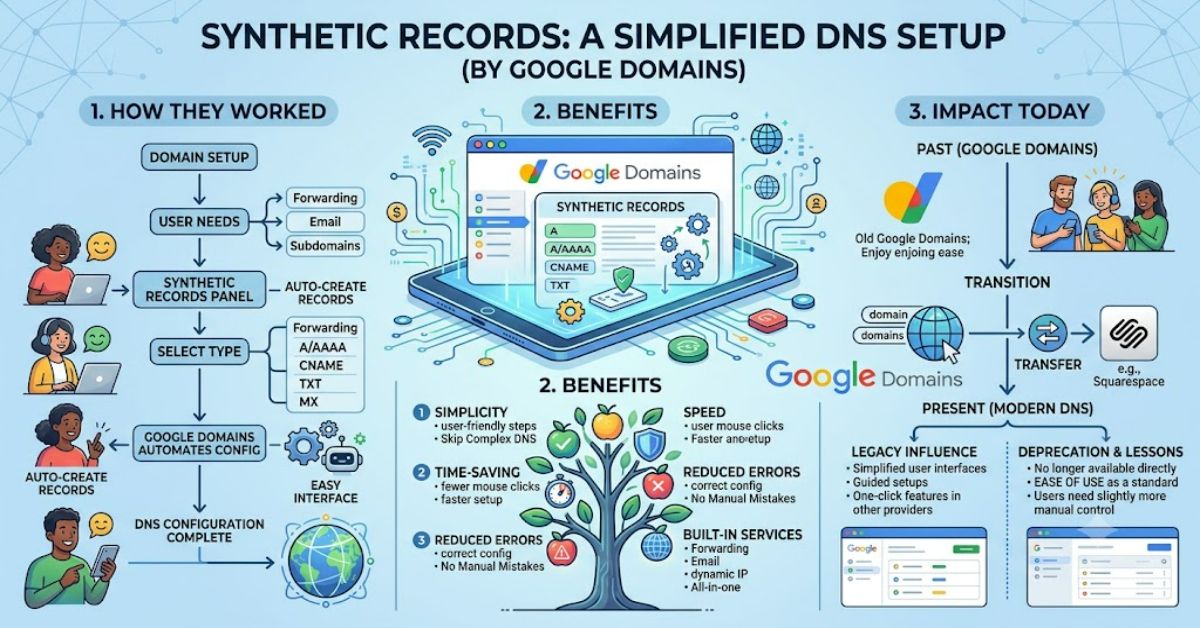
Google Domains synthetic records were automated shortcuts that helped users configure web services without manually creating multiple DNS entries. Instead of individually adding standard records such as A records for website addresses, MX records for email routing, or TXT records for verification, Google Domains could automatically generate and manage related settings.
For many small businesses, developers, and website owners, DNS management represented a technical barrier. Traditional domain configuration requires understanding how different records control website hosting, email delivery, security verification, and third-party integrations. Synthetic records reduced this complexity by allowing users to select a service-based option rather than manually entering every required value.
Google launched its domain registration service in 2014, offering a cleaner alternative to many traditional registrars. The platform focused on simplicity, modern DNS management, and integration with Google services. However, in September 2023, Google announced the sale of Google Domains assets to Squarespace, marking a major shift in the domain management market.
Understanding this feature remains useful because synthetic records demonstrate a wider trend in technology: hiding complicated infrastructure behind simpler user interfaces. Although the original Google Domains platform no longer operates independently, the principles behind automated DNS management continue across modern hosting providers.
What Were Google Domains Synthetic Records?
DNS, or Domain Name System, acts as the internet’s address directory. It translates human-readable domain names into technical information that computers use to locate websites and services.
Normally, configuring a domain requires adding several records manually:
| DNS Record | Purpose |
| A Record | Connects a domain to an IPv4 address |
| AAAA Record | Connects a domain to an IPv6 address |
| MX Record | Directs email delivery |
| TXT Record | Provides verification and security information |
| CNAME Record | Creates domain aliases |
Synthetic records simplified this process by grouping multiple DNS changes into a single automated setting.
For example, connecting a domain to a Google service might require several DNS entries. Instead of manually adding each one, the synthetic option handled the configuration automatically.
How Automated DNS Configuration Worked
The concept behind synthetic records was similar to an automation layer placed above traditional DNS management.
A user selected a service, and the platform generated the necessary DNS configuration in the background. This approach reduced errors caused by incorrect record values, missing verification entries, or conflicting settings.
A typical workflow looked like this:
- User selects a service connection option.
- Google Domains identifies required DNS records.
- The platform creates the necessary configurations.
- DNS propagation allows internet systems to recognise the changes.
This approach benefited users who needed quick deployment without becoming DNS specialists.
Comparing Manual DNS Records and Synthetic Records
| Feature | Manual DNS Management | Synthetic Records |
| Technical knowledge required | Higher | Lower |
| Configuration control | Complete | Limited |
| Setup speed | Slower | Faster |
| Error risk | Higher | Lower |
| Best suited for | Developers and advanced users | Beginners and small businesses |
The trade-off was flexibility. Experienced administrators often preferred manual control because automated systems could hide important technical details.
Practical Benefits and Limitations
The strongest advantage of automated records was accessibility. A small organisation launching a website or email system could avoid complex DNS documentation and configuration steps.
However, automation introduced limitations.
Reduced Visibility
Advanced users sometimes require precise control over DNS behaviour. Automated settings can make troubleshooting more difficult because users may not immediately see every underlying record being managed.
Migration Challenges
When Google Domains moved to Squarespace after the 2023 acquisition, users needed to understand how their DNS configurations would transfer. Automated features created questions about whether existing settings would continue functioning exactly as before.
Dependency on Platform Decisions
Synthetic systems rely on provider support. If a company changes its products or removes a feature, users may need to recreate configurations manually.
Real-World Impact of Simplified DNS Tools
The rise of simplified DNS management reflects a broader shift in web infrastructure. Many businesses now expect technical platforms to provide guided workflows rather than requiring specialist knowledge.
Platforms such as website builders, cloud providers, and hosting services increasingly automate infrastructure tasks. This trend has helped more individuals launch online services without dedicated IT teams.
A practical example can be seen in small businesses creating websites through hosted platforms. Instead of hiring a network administrator to configure DNS, owners can connect domains through guided dashboards.
This approach has expanded access to digital services while creating a need for better transparency in automated systems.
The Future of DNS Automation in 2027
By 2027, DNS management is likely to become increasingly automated through artificial intelligence, security tools, and cloud-based workflows.
Modern platforms are moving towards predictive configuration, where systems detect common requirements and recommend appropriate settings. Security features such as automated domain verification and certificate management are also becoming standard.
However, automation will not remove the need for technical expertise. Businesses operating complex systems will still require detailed DNS knowledge for performance, security, and reliability.
The future direction appears to be a balance between simplicity for everyday users and advanced controls for professionals.
Key Takeaways
- Synthetic records reduced the complexity of traditional DNS management.
- Automation improved accessibility for non-technical users.
- Greater simplicity can create challenges during migration or troubleshooting.
- Google Domains’ transition highlighted the importance of understanding underlying infrastructure.
- Modern DNS tools continue building on the same automation principles.
Conclusion
Google Domains synthetic records represented an important step towards making internet infrastructure easier to manage. By automating groups of DNS configurations, they allowed users to connect services without manually handling every technical record.
Although Google Domains itself transitioned to new ownership in 2023, the underlying idea remains highly relevant. Modern web platforms continue moving towards automated infrastructure that hides complexity while improving usability.
The challenge for future systems will be maintaining this simplicity while providing enough transparency for professionals who need deeper control. DNS automation is not replacing technical knowledge; it is changing how and when that knowledge is required.
Frequently Asked Questions
What were Google Domains synthetic records?
They were automated DNS configurations that created multiple related records automatically for common services, reducing manual setup requirements.
Are Google Domains synthetic records still available?
Google Domains was transferred to Squarespace in 2023, so the original feature set is no longer available under Google’s domain service.
Why were synthetic records useful?
They helped users avoid manually entering complex DNS settings and reduced configuration mistakes.
What DNS records did synthetic settings replace?
They commonly automated records such as A, MX, CNAME, and TXT entries depending on the connected service.
Do modern domain providers use similar features?
Yes. Many hosting and domain companies now provide automated DNS tools and guided configuration systems.
Methodology
This article was prepared using publicly available information about Google Domains, DNS architecture, and domain management practices. Technical explanations are based on established DNS standards and documented platform behaviour.
The analysis considers both advantages and limitations of automated DNS systems, including usability improvements and potential migration challenges. Before publication, a human editor should verify current provider documentation, historical Google Domains details, and any platform-specific claims.