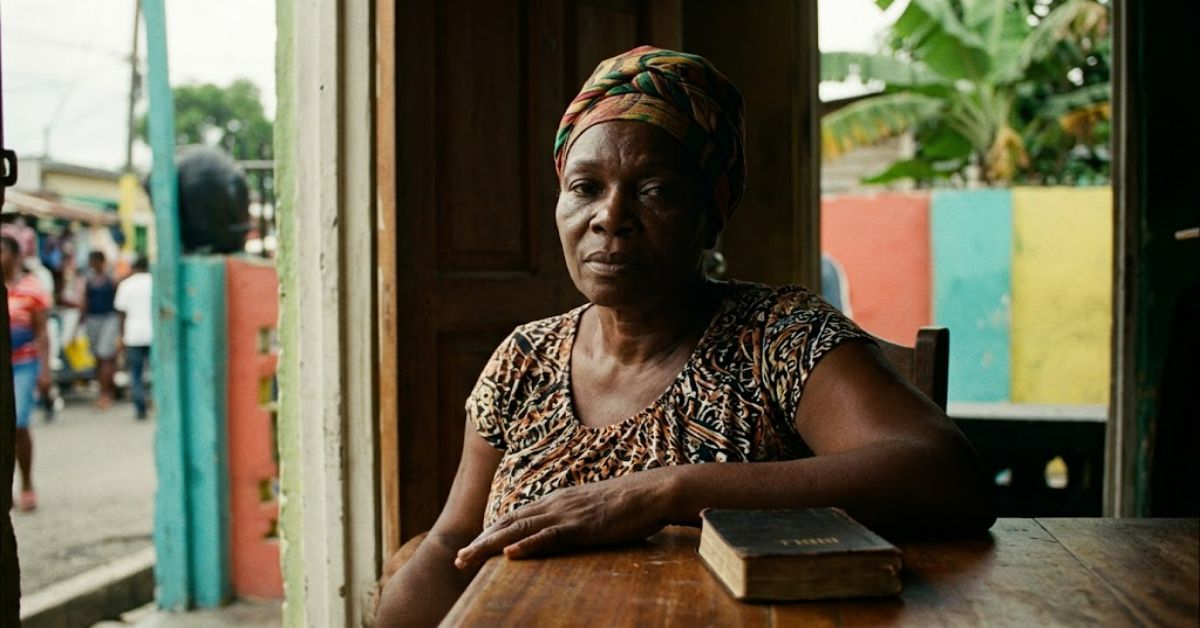
Black Mother is a 2018 documentary directed by Khalik Allah that explores Jamaica through intimate portraits, fragmented conversations, personal history and highly stylised cinematography. Rather than presenting a conventional chronological account of the country, Allah builds an impressionistic portrait from the people, landscapes, memories and spiritual ideas he encounters. The film runs for approximately 77 minutes and was presented at festivals including True/False and Sheffield Doc/Fest in 2018.
Allah approaches Jamaica from a particularly personal position. His mother is Jamaican, giving the film a connection to family and heritage rather than the perspective of a detached visitor. His grandfather also becomes an important presence, linking individual memory with questions of ancestry, mortality and faith.
The film’s title can initially suggest a straightforward examination of motherhood. Its meaning is broader. Motherhood becomes connected to land, ancestry, femininity, birth and the transmission of culture between generations.
The result is less a conventional factual documentary than a cinematic essay. Voices do not always correspond directly with the people shown on screen. Images shift between digital footage, film and historical material, while the editing creates associations rather than a simple sequence of events. Critics have repeatedly identified this separation between sound and image as central to Allah’s method.
What Is Black Mother About?
At its centre, Black Mother is a portrait of Jamaica. But it is also a portrait of how a filmmaker understands a place connected to his own family.
Allah’s subjects include women, children, religious figures, workers and people living under difficult economic circumstances. Their voices address subjects including history, sexuality, spirituality, poverty, race, education and national identity. The film therefore moves between intimate individual experiences and larger questions about Jamaican society.
The documentary’s unusual structure is essential to understanding it. Instead of presenting interviews as conventional talking-head sequences, Allah frequently separates recorded voices from the images accompanying them. The viewer may hear one person while seeing another location, face or landscape.
That technique prevents the audience from treating every statement as a simple piece of visual evidence. Instead, sound becomes another layer of interpretation.
| Conventional documentary | Black Mother |
| Chronological explanation | Associative structure |
| Talking-head interviews | Voices separated from images |
| Consistent visual format | Digital, film and archival material |
| Explicit exposition | Poetry and visual suggestion |
| Individual subjects | Interconnected social portrait |
This approach is one reason the film has been described as closer to an epic poem or visual essay than a traditional documentary. The Guardian’s 2018 review specifically highlighted its impressionistic treatment of Jamaican identity.
Motherhood, Pregnancy and the Structure of the Film
Pregnancy provides one of the documentary’s most important organising devices.
Black Mother is structured around the three trimesters of a woman’s pregnancy. This gives the film a loose progression even though its individual scenes can feel fragmented. The pregnancy connects the personal experience of one woman with broader questions about birth, inheritance and the society into which a child is entering.
The structure becomes more significant when the film places birth alongside death. Allah’s grandfather represents another generation, while the pregnant woman represents a future generation.
This creates a cycle rather than a conventional narrative arc:
Ancestry → memory → pregnancy → birth → mortality → continuity
That is one of the film’s strongest analytical features. Jamaica is not presented simply as a geographical location. It becomes a living inheritance passed between generations.
Jamaica Through Image and Sound
Allah’s background as a photographer strongly shapes the film. His camera often remains close to people’s faces, allowing expressions, skin texture and physical presence to occupy the frame.
His earlier film, Field Niggas, used a similarly distinctive approach to portraiture in Harlem. Black Mother expands that method from a single urban intersection to an entire country. Critics have identified this connection as an important part of Allah’s development as a filmmaker.
The documentary also uses contrasting visual formats. Digital footage sits alongside 16mm film, videotape and historical material. This mixture prevents the image from feeling temporally uniform. Past and present appear to coexist.
| Film element | Function |
| Close portraiture | Centres individual presence |
| Desynchronised voices | Separates testimony from literal imagery |
| Multiple formats | Connects different periods and memories |
| Jamaican landscapes | Establishes geographical and emotional context |
| Pregnancy | Provides structural continuity |
| Family footage | Connects national history with personal memory |
The effect is deliberately sensory. The viewer is expected to interpret relationships between images, words and sounds rather than receive every idea through explicit explanation.
Spirituality, History and Identity
Religion is another recurring element. Christian language, spiritual belief and questions about faith appear throughout the documentary. These ideas are not presented as a simple explanation of Jamaican society. They sit alongside conversations about colonialism, poverty, race and cultural identity.
This produces an important tension. Spirituality can appear as a source of resilience, while organised religion can also be examined through the historical influence of colonialism. Reviewers have identified both dimensions within the film.
The film therefore avoids reducing Jamaican identity to a single category. Its portrait includes beauty and hardship, tradition and contradiction, personal faith and historical pressure.
That complexity is also a limitation. Because Allah chooses an intensely subjective and poetic form, Black Mother should not be treated as a comprehensive sociological survey of Jamaica. One critic explicitly cautioned against assuming that a single artwork could encompass the depth and contradictions of an entire island.
Why the Film Remains Significant
Black Mother matters partly because it demonstrates how documentary filmmaking can operate without conventional explanatory structure.
Its subject is Jamaica, but its method raises wider questions about representation. Who gets to describe a community? How does a filmmaker portray people who are socially marginalised? Can a personal connection produce greater intimacy, or does it introduce another layer of subjectivity?
These questions are especially important because Allah’s camera focuses on people and circumstances that mainstream visual culture can overlook.
The film’s reception also demonstrates its artistic impact. It competed for the Art Doc Award at Sheffield Doc/Fest in 2018, where the BFI described it as an examination of Jamaican history and identity built from voices and haunting imagery.
Its critical reception was not universally uncomplicated. Sight and Sound praised the film’s visual and literary ambition while questioning aspects of its representation of Black femininity and the limited inclusion of queer and transgender women.
That criticism is useful because it shows why the documentary should be approached as a specific artistic interpretation rather than a definitive representation of Jamaican womanhood.
The Future of Black Mother in 2027
By 2027, Black Mother is likely to remain relevant less because of contemporary news cycles and more because of its place within documentary and visual-art discussions.
Allah’s later work reinforces the importance of the techniques established in Black Mother. The BFI has described continuity between the film and his later documentary IWOW: I Walk on Water, including the use of multiple formats and desynchronised sound.
For documentary studies, that makes Black Mother useful as an example of hybrid filmmaking: part ethnographic portrait, part family history, part visual essay and part personal meditation.
Its lasting value will depend on continued discussion rather than a single interpretation. As newer documentary filmmakers experiment with mixed media, fragmented testimony and subjective storytelling, Allah’s work provides a clear example of how those techniques can challenge conventional documentary grammar.
Key Insights
- Black Mother uses Jamaica as both a geographical subject and a personal site of ancestry.
- Its three-trimester structure turns pregnancy into a framework for thinking about generations.
- Desynchronised sound prevents the film from functioning like a conventional interview documentary.
- Allah’s photographic background is central to the film’s emphasis on faces and physical presence.
- The documentary combines personal intimacy with questions about colonial history and spirituality.
- Its subjective approach is also its limitation: it should not be mistaken for a comprehensive portrait of Jamaica.
- Critical disagreement about representation is part of understanding the film rather than something to overlook.
Conclusion
Black Mother is difficult to categorise because Khalik Allah deliberately works between documentary, photography, autobiography and cinematic essay. Its Jamaica is not presented as a neutral geographical subject. It is filtered through family history, memory, spirituality and the filmmaker’s own relationship with his mother’s homeland.
The documentary’s most distinctive feature is the way it connects intimate human experiences with broader historical questions. Pregnancy becomes a meditation on the future; an elderly relative represents memory and mortality; religious testimony intersects with colonial history; and individual portraits become fragments of a larger national identity.
The film’s limitations are equally important. Its intensely subjective perspective means that it cannot represent every Jamaican experience, and its treatment of gender and spirituality has attracted critical debate. Yet those tensions make it a richer subject for discussion.
Rather than offering a definitive answer about Jamaica, Black Mother asks viewers to experience a place through overlapping voices, faces, memories and contradictions.
Frequently Asked Questions
What is Black Mother about?
Black Mother is a 2018 documentary directed by Khalik Allah about Jamaica, his mother’s homeland. It explores identity, family, spirituality, history, gender and social conditions through an impressionistic visual style.
Who directed Black Mother?
Black Mother was directed by Khalik Allah, a New York-based photographer and filmmaker. He also handled major creative roles on the film, including cinematography and editing.
How long is Black Mother?
The documentary has a running time of approximately 77 minutes.
Why is pregnancy important in Black Mother?
Pregnancy provides the film’s underlying structure. The documentary follows the three trimesters while connecting birth with ancestry, family history, mortality and the future of Jamaican society.
Is Black Mother a traditional documentary?
Not in the conventional sense. Allah frequently separates recorded voices from the images shown, combines several visual formats and uses associative editing instead of straightforward exposition.
What themes does Black Mother explore?
Major themes include Jamaican identity, motherhood, spirituality, colonial history, poverty, race, sexuality, family, birth and death. The film approaches these subjects through personal testimony and visual portraiture.
Methodology
This article was researched using film-festival records, established film publications, contemporary reviews and documentary databases. Key details about the film’s 2018 release, 77-minute running time, director, structure and filmmaking techniques were cross-checked across sources including MUBI, BFI, The Guardian, RogerEbert.com and contemporary festival coverage.
The analysis distinguishes documented characteristics of the film from critical interpretation. Reviews disagree on aspects of its representation, particularly around gender and spirituality, so those criticisms are attributed rather than presented as settled fact.
No firsthand viewing or testing claim has been invented for this article.
References
Allah, K. (Director). (2018). Black Mother [Film]. Rada Film Group.
British Film Institute. (2018). Film highlights of Sheffield Doc/Fest 2018. BFI.
Calhoun, D. (2018). Black Mother. Time Out.
Laffly, T. (2019). Black Mother. RogerEbert.com.
MUBI. (n.d.). Black Mother. MUBI.
Rose, S. (2018). Black Mother review – an epic odyssey through Jamaican identity. The Guardian.
Schindel, D. (2018). True/False 2018 review: Khalik Allah’s Black Mother. Vague Visages.
Ooi, J. (2018). ND/NF review: Black Mother is a beautiful, lyrical ethnographic portrait of Jamaica. The Film Stage.