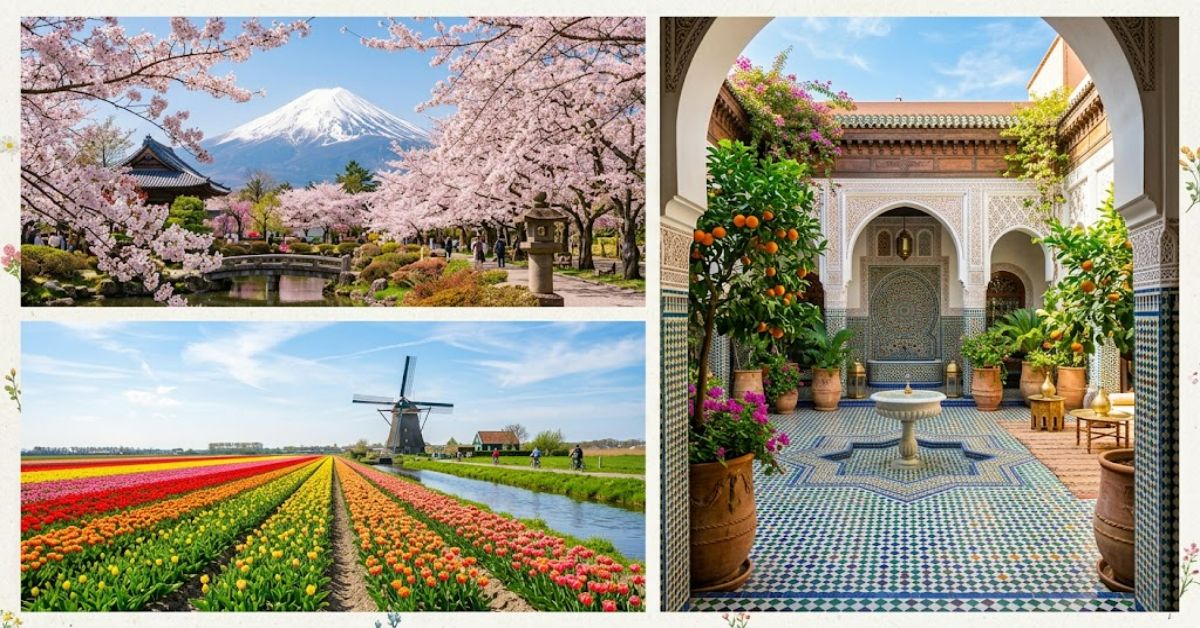
Finding the best places to visit in spring depends on what you want from the season. Some travellers want cherry blossoms and traditional festivals, while others prefer colourful flower fields, comfortable walking temperatures or mountain landscapes before summer heat arrives.
Three destinations stand out for very different reasons: Japan for its famous sakura season, the Netherlands for tulips and Morocco for a combination of city culture and outdoor adventure. Japan’s spring appeal is especially strong in Kyoto and Tokyo, where cherry blossom viewing can be combined with temples, gardens, food and neighbourhood exploration. Kyoto’s well-known blossom locations include the Philosopher’s Path and Maruyama Park.
The Netherlands offers a more concentrated seasonal spectacle. Keukenhof is designed around spring flowers, making timing particularly important because the experience changes as different varieties bloom.
Morocco provides a different proposition. Marrakech can be more comfortable for sightseeing before the hottest months, while the Atlas Mountains offer opportunities for walking and experiencing rural landscapes.
Spring travel also has a practical advantage: conditions can be more manageable than the height of summer in many destinations. But this should not be confused with guaranteed low crowds. Japan’s blossom period, for example, is a major travel season in its own right.
The right destination therefore depends on the experience, timing and pace you prefer rather than a universal ranking.
Japan: Cherry Blossoms in Kyoto and Tokyo
Japan is arguably the most recognisable spring destination on this list. The attraction is not simply the cherry trees themselves. Sakura season changes the visual character of parks, temple grounds, streets and riversides for a short period.
Kyoto is particularly suited to travellers interested in heritage. Visitors can combine blossom viewing with Kiyomizu-dera, historic Higashiyama, the Philosopher’s Path and traditional districts.
Tokyo provides a sharper contrast. Its larger scale means visitors can combine parks and blossom spots with museums, shopping districts and contemporary neighbourhoods.
| Destination | Best spring experience | Ideal for | Main consideration |
| Kyoto | Cherry blossoms and historic sites | Culture and photography | Peak periods can be crowded |
| Tokyo | Urban parks and sakura | First-time visitors | Large distances and busy transport |
| Netherlands | Tulip fields and Keukenhof | Flowers and day trips | Short seasonal window |
| Marrakech | Medina and outdoor sightseeing | Culture and food | Temperatures rise later in spring |
| Atlas Mountains | Hiking and scenery | Active travellers | Mountain conditions vary |
One important planning issue is that blossom timing varies from year to year. A traveller booking solely around a fixed calendar date risks arriving before or after peak flowering.
The smarter approach is to build flexibility into the itinerary and monitor official seasonal forecasts closer to departure.
The Netherlands: Tulips and Keukenhof
For travellers who want spring scenery without crossing the world for cherry blossom season, the Netherlands is a strong European option.
Keukenhof is the obvious centrepiece, but the wider bulb-growing landscape is equally important. The attraction is not just one garden. The surrounding countryside creates opportunities to see fields of flowering bulbs and explore smaller towns by bicycle or public transport.
The seasonal window is relatively narrow, which creates both appeal and a logistical challenge. Visitors need to check opening dates and expected flowering conditions rather than assuming that every spring week will look identical.
This makes the Netherlands particularly suitable for a short break. A traveller can base themselves around Amsterdam and plan a dedicated flower-focused day, rather than constructing an extensive multi-city itinerary.
Why Timing Matters
Spring flowers do not follow a rigid schedule. Weather affects development, flowering and how long individual varieties remain at their best.
That means a photograph seen online from early April does not guarantee the same appearance on the same date in another year.
This is one of the less obvious planning lessons of seasonal travel: the destination is only half the decision; the biological calendar matters too.
Morocco: Marrakech and the Atlas Mountains
Morocco offers a different version of spring. Instead of travelling primarily for one seasonal event, visitors can combine several experiences within one trip.
Marrakech provides historic architecture, souks, gardens, food and the atmosphere of the medina. Spring can also be useful for travellers who prefer sightseeing before the stronger heat associated with summer.
The Atlas Mountains add geographical contrast. A trip can move from the urban environment of Marrakech towards mountain valleys and villages, giving travellers access to hiking and panoramic scenery.
| Destination | Spring strength | Trip style | Planning priority |
| Japan | Sakura and culture | Cultural | Blossom timing |
| Netherlands | Tulips | Short break | Flowering window |
| Morocco | Mild city and mountain travel | Mixed adventure | Regional weather |
The biggest advantage is variety. Morocco can suit travellers who do not want an entire holiday organised around a single natural event.
The trade-off is that mountain conditions cannot be judged from Marrakech’s forecast alone. Altitude creates different temperatures and weather conditions, so hikers should check conditions for their specific route.
How to Choose Between the Three
The easiest way to decide is to start with the experience rather than the country.
Choose Japan if cherry blossoms are the main reason for travelling and you want culture, food, history and major cities alongside seasonal scenery.
Choose the Netherlands if you want a shorter European escape centred on flowers, photography and easy day trips.
Choose Morocco if you want greater variety, combining historic city experiences with mountains, markets and outdoor activities.
Budget and travel time should also influence the decision. Japan generally requires more planning for a long-distance trip, while the Netherlands can work particularly well as a European short break. Morocco sits between these models, offering both city-based and active itineraries.
Risks and Trade-Offs of Spring Travel
Spring is not automatically perfect.
Weather can change quickly, seasonal attractions can become crowded and popular dates may carry higher accommodation costs. Japan’s blossom season demonstrates the problem clearly: the very thing that makes the destination attractive also concentrates demand.
There is also a sustainability consideration. Large numbers of visitors arriving at the same natural or cultural attraction within a short period can increase pressure on local infrastructure.
Travellers can reduce that pressure by visiting at less concentrated times, using public transport where practical and spreading spending beyond the most famous attractions.
For seasonal destinations, flexibility is therefore more valuable than a rigid itinerary.
The Future of Spring Travel in 2027
Spring travel in 2027 is likely to remain strongly influenced by seasonal tourism, but travellers may increasingly need to plan around variability in weather and natural cycles.
Japan’s blossom season, Dutch flower displays and mountain conditions all demonstrate the same underlying issue: seasonal experiences are dependent on environmental conditions rather than fixed dates.
Travel planning is also becoming more information-led. Visitors can increasingly monitor weather forecasts, transport updates, attraction calendars and local guidance before departure.
That does not remove uncertainty, but it makes flexible planning easier.
For 2027, the most reliable strategy will be to treat seasonal dates as planning windows rather than guarantees.
Key Takeaways
- Japan offers the strongest choice for travellers prioritising cherry blossoms and cultural experiences.
- Kyoto is particularly attractive for combining seasonal scenery with historic districts and temples.
- The Netherlands works well for a concentrated tulip-focused spring break.
- Morocco offers more variety, pairing Marrakech with the Atlas Mountains.
- Seasonal travel requires flexibility because flowering and weather conditions vary.
- Popular spring destinations can still be crowded despite pleasant temperatures.
- Responsible travel means spreading visits and spending beyond the busiest attractions.
Conclusion
The best places to visit in spring are not necessarily the destinations with the most famous photographs. They are the places where seasonal conditions match the type of holiday you actually want.
Japan is the standout choice for cherry blossoms, cultural heritage and a memorable first encounter with sakura season. The Netherlands is more focused, offering a spectacular flower experience around Keukenhof and the wider bulb fields. Morocco provides the greatest contrast, allowing travellers to combine Marrakech’s historic atmosphere with the landscapes of the Atlas Mountains.
Each destination also has a limitation. Japan’s blossom season is highly popular, Dutch flower displays depend on a narrow biological window, and Morocco’s mountain conditions can differ considerably from those in Marrakech.
The practical lesson is simple: spring travel rewards careful timing. Instead of treating a particular date as a guarantee, build some flexibility into the itinerary, monitor local conditions and choose activities that remain enjoyable if nature does not follow the expected schedule.
Frequently Asked Questions
What are the best places to visit in spring?
Japan, the Netherlands and Morocco are strong choices for different reasons. Japan is ideal for cherry blossoms, the Netherlands for tulips and Morocco for comfortable city sightseeing combined with mountain experiences.
Where is the best place to visit in spring for cherry blossoms?
Japan is the classic choice, particularly Kyoto and Tokyo. Kyoto combines blossom viewing with temples, gardens and historic neighbourhoods, while Tokyo offers large urban parks and a modern city setting.
Is the Netherlands worth visiting in spring?
Yes, particularly for travellers interested in tulips. Keukenhof and the surrounding bulb-growing region provide a highly seasonal experience, but visitors should check opening information and flowering conditions before travelling.
Is Morocco good to visit in spring?
Morocco can be an excellent spring destination. Marrakech offers cultural attractions and food experiences, while the Atlas Mountains provide a contrasting outdoor environment.
Which are the best places to visit in spring?
The Netherlands can work especially well for a short break because flower attractions can be combined with Amsterdam and nearby towns without requiring a long itinerary.
When should I book a spring holiday?
Book major transport and accommodation early when travelling during highly popular seasonal periods. However, leave some flexibility for weather and natural events where possible.
Methodology
This article best places to visit in spring compares the three destinations using seasonal characteristics, recognised attractions and current travel-planning considerations. Kyoto’s attraction mix was cross-checked against current destination information, while broader travel-risk considerations were treated separately from destination appeal. Kyoto’s documented spring attractions include the Philosopher’s Path and Maruyama Park.
No firsthand trip testing or original field reporting was conducted for this article, so no personal observations or invented traveller experiences have been presented as firsthand evidence. Readers should verify attraction opening dates, entry requirements, weather conditions and current travel advice before departure.
The seasonal nature of flowers and cherry blossoms is also a limitation: exact flowering dates can change between years.
Editorial disclosure: This article best places to visit in spring was drafted with AI assistance and should be reviewed and independently verified by the RubbleMagazine.co.uk editorial team before publication, including destination details, dates and references.