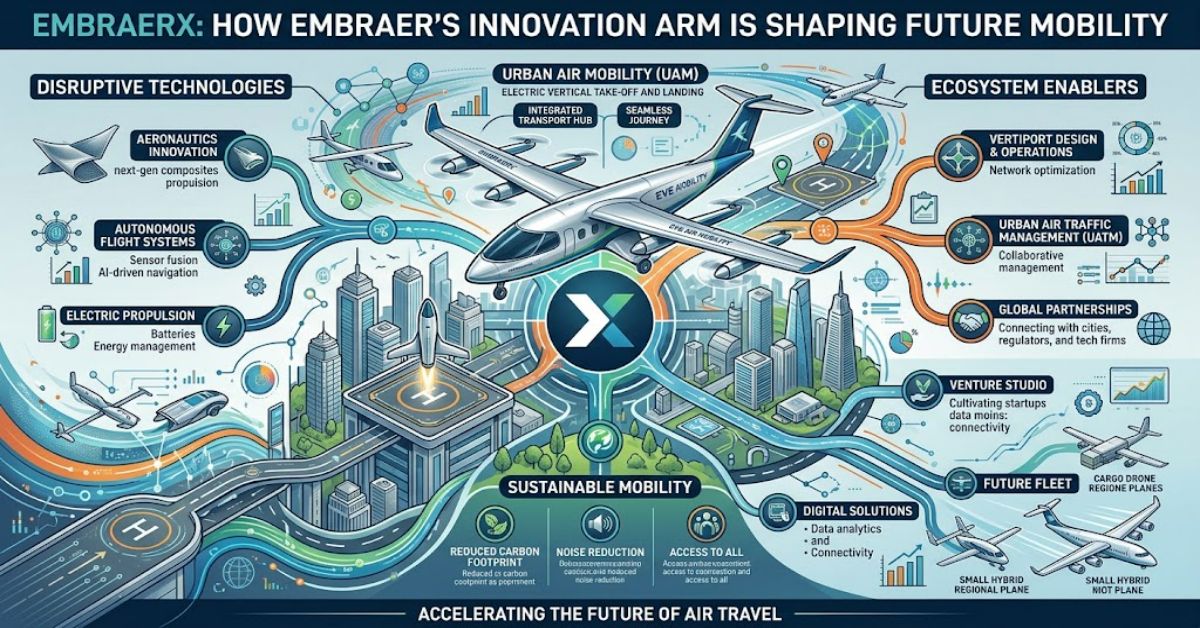
EmbraerX is the innovation and business-development arm created by Brazilian aerospace manufacturer Embraer to investigate opportunities beyond conventional aircraft programmes. Launched in 2017, it was designed as a market accelerator rather than a traditional research department, combining engineering expertise with human-centred design, start-up methods and external partnerships.
The central idea was straightforward: large aerospace companies have considerable technical expertise, but their established structures are not always suited to testing unfamiliar business models quickly. EmbraerX provided a separate environment for exploring technologies and services that could eventually become independent businesses.
Its best-known project became urban air mobility. The concept eventually developed into Eve, an independent company focused on electric vertical take-off and landing aircraft, urban operations, services and air-traffic-management technology. Eve was the first company to graduate from EmbraerX and subsequently became publicly listed in 2022.
That history makes EmbraerX more significant than a conventional corporate innovation programme. It provides a case study in how an established aerospace organisation can experiment with new markets without forcing every early-stage idea through the same processes used for mature aircraft programmes.
What Is EmbraerX?
EmbraerX was established in 2017 as a disruptive business subsidiary and market accelerator. Its mandate was to identify opportunities where technology, changing consumer expectations and new operating models could create new aviation businesses.
The approach combined several disciplines:
| EmbraerX approach | Practical purpose |
| Human-centred design | Understand passenger and operator needs |
| Agile experimentation | Test ideas before committing major resources |
| Aerospace engineering | Apply established technical knowledge |
| External partnerships | Access specialist technology and markets |
| Business-model development | Test commercial viability |
| Spin-off strategy | Allow successful concepts to operate independently |
This structure matters because aerospace development is expensive and heavily regulated. A new aircraft can require years of testing and certification before generating revenue. Separating early experimentation from mature production programmes can therefore reduce organisational friction.
From eVTOL Concept to Eve
Urban air mobility became the clearest demonstration of the EmbraerX model.
In 2017, the future Eve programme began as a project within EmbraerX. By 2019, EmbraerX was publicly presenting an electric vertical take-off and landing concept designed around urban transportation. Its designers emphasised a relatively simple architecture rather than maximum technical complexity.
The project became an independent company in 2020. Eve subsequently developed its own eVTOL aircraft programme while retaining access to Embraer’s aerospace expertise and global support capabilities.
The progression is important because it demonstrates a complete innovation pipeline: identify a problem, develop a concept, test the business model, create an independent venture and then move towards certification and industrialisation.
Why the Spin-Off Model Matters
| Traditional aerospace programme | EmbraerX-style venture |
| Built around established product lines | Built around emerging opportunities |
| Long planning cycles | Rapid experimentation |
| Existing customers and markets | New customer discovery |
| Engineering-led decisions | Human-centred and engineering-led |
| Internal development | Partnerships and external ecosystems |
| Integrated corporate structure | Potential independent spin-off |
The objective is not simply speed. In aerospace, safety and certification cannot be rushed. The advantage is the ability to determine earlier whether an idea deserves the substantial investment required for full development.
Beyond Urban Air Mobility
Although Eve became its most visible project, EmbraerX also explored digital aviation services.
Beacon, for example, was developed as a maintenance-coordination platform designed to connect aviation resources, aftermarket suppliers and professionals during aircraft maintenance interruptions. It addressed a practical operational problem rather than attempting to create another aircraft.
EmbraerX also partnered with autonomous aviation company Pyka in 2021 to explore electric autonomous agricultural aircraft. The project demonstrates how the accelerator could investigate opportunities outside passenger aviation while still drawing on Embraer’s aerospace capabilities.
This creates a broader picture of the organisation’s purpose.
| Innovation area | Example | Strategic objective |
| Urban mobility | Eve | Create a new aviation market |
| Aircraft maintenance | Beacon | Digitise aviation services |
| Autonomous aviation | Pyka partnership | Explore new aircraft applications |
| Digital systems | Air-traffic and service technologies | Build supporting infrastructure |
The Real Test: Turning Innovation Into Operations
The strongest evidence of EmbraerX’s effectiveness is not the number of concepts it produced. It is what happened after concepts left the accelerator.
Eve’s development illustrates that transition. Its full-scale engineering prototype completed its first flight on 19 December 2025. By April 2026, the aircraft had completed 50 successful test flights and accumulated more than two hours of flight time.
On 3 August 2026, Eve reported its first partial transition flight, activating the rear pusher propeller as the aircraft began moving from vertical flight towards wing-borne flight.
These are not commercial-service milestones, but they are valuable evidence that the original innovation concept has progressed into a structured aircraft-development and certification programme.
A second insight follows from this: the accelerator’s real value is not simply generating ideas but creating a pathway for ideas to survive contact with engineering, regulation and customers.
Risks and Trade-Offs
Corporate innovation has obvious advantages, but it also creates risks.
The first is strategic dilution. A company investigating too many emerging technologies can spread engineering talent and capital across projects that never reach commercial scale.
The second is regulatory exposure. Aviation innovations cannot be deployed like ordinary software. Aircraft require certification, trained operators, infrastructure and airspace integration.
The third is infrastructure dependency. An eVTOL aircraft is only one part of an urban-air-mobility system. Vertiports, charging, maintenance, air-traffic management and community acceptance all influence whether the business model works.
Eve’s current development reflects this reality. Its programme includes not only an aircraft but also services and an urban air-traffic-management solution.
The Future of EmbraerX in 2027
By 2027, the most useful way to assess EmbraerX will be through the businesses and technologies that emerge from its innovation pipeline rather than through experimental concepts alone.
Eve is already moving through flight testing and certification preparation. In July 2026, it announced progress towards validation with the European Union Aviation Safety Agency while Brazil’s ANAC opened consultation on updated airworthiness criteria.
That regulatory progress highlights a key constraint. Advanced mobility will not become commercially meaningful simply because aircraft technology works. Certification, infrastructure and operating procedures must develop alongside the vehicle.
The same principle applies to digital aviation services. Technologies such as predictive maintenance, air-traffic management and fleet monitoring can become commercially valuable when they solve measurable operational problems.
For EmbraerX, 2027 is therefore likely to be less about futuristic concepts and more about conversion: turning validated ideas into durable businesses.
Key Takeaways
- EmbraerX was launched in 2017 to accelerate disruptive aviation businesses.
- Its approach combines aerospace expertise with start-up experimentation.
- Eve provides the clearest example of a concept progressing into an independent company.
- Beacon demonstrates that innovation can target aviation services as well as aircraft.
- Certification and infrastructure remain major barriers to advanced air mobility.
- The strongest innovation programmes connect technology with a viable operating model.
- EmbraerX’s long-term value depends on how successfully experiments become scalable businesses.
Conclusion
EmbraerX represents an important experiment in corporate innovation within aerospace. Rather than treating innovation purely as research, Embraer created a market accelerator designed to explore new businesses, technologies and mobility models outside conventional aircraft programmes.
Its history shows why that distinction matters. The development of Eve demonstrates how an idea can move from an internal project into an independent company, while Beacon shows how digital services can address operational problems within established aviation markets.
The model is not without risk. Aerospace innovation remains capital-intensive, highly regulated and dependent on infrastructure. Yet EmbraerX offers a practical response to those constraints by allowing early experimentation before successful concepts require the resources of full-scale industrial development.
Its significance in 2027 will ultimately depend on execution. The most meaningful measure will not be how many ambitious ideas are proposed, but how many can progress through certification, commercial testing, infrastructure development and sustainable operations.
FAQ
What is EmbraerX?
EmbraerX is Embraer’s market accelerator for disruptive businesses and emerging aviation technologies. It was launched in 2017 to explore new opportunities through experimentation, partnerships and human-centred design.
What did EmbraerX create?
One of its most important ventures is Eve Air Mobility, which originated as an urban-air-mobility project within EmbraerX. Beacon was another business incubated by the accelerator.
Is Eve part of EmbraerX?
Eve originated within EmbraerX but became an independent company. It later completed a business combination and became publicly listed on the New York Stock Exchange in 2022.
What does EmbraerX focus on?
Its work has included urban air mobility, autonomous aviation, digital aviation services and other emerging technologies connected with future mobility.
What is the EmbraerX approach to innovation?
The model combines human-centred design, aerospace engineering, partnerships and business-model experimentation. The intention is to validate opportunities before scaling them into larger businesses.
What is the connection between EmbraerX and eVTOL aircraft?
The Eve eVTOL programme began within EmbraerX. Eve now operates independently while continuing to benefit from Embraer’s aerospace experience and support ecosystem.
Methodology
This article was researched using Embraer corporate disclosures, Embraer annual-report material, Eve Air Mobility announcements, U.S. Securities and Exchange Commission filings and specialist aviation reporting. Historical claims were cross-checked against corporate and regulatory documentation where possible.
The main limitation is that EmbraerX has evolved over time and not every project associated with the accelerator remains an active standalone business. The article therefore distinguishes between the accelerator’s historical activities and the current development of companies such as Eve. No personal testing or firsthand reporting was conducted for this article.
Human editorial disclosure: This article was drafted with AI assistance and should be reviewed and independently verified by a human editor before publication.
References
Embraer. (2019). EmbraerX and the future of urban mobility. SXSW.
Embraer. (2025). Annual report 2024. Embraer S.A.
Eve Air Mobility. (2021, 1 July). Eve Urban Air Mobility announces cooperation with Beacon’s maintenance platform.
Eve Air Mobility. (2026, 9 April). Eve Air Mobility builds flight-test momentum with 50 successful flights.
Eve Air Mobility. (2026, 3 August). Eve Air Mobility achieves first transition flight milestone, advancing eVTOL programme toward wing-borne flight.
U.S. Securities and Exchange Commission. (2021). Embraer S.A. annual report on Form 20-F.