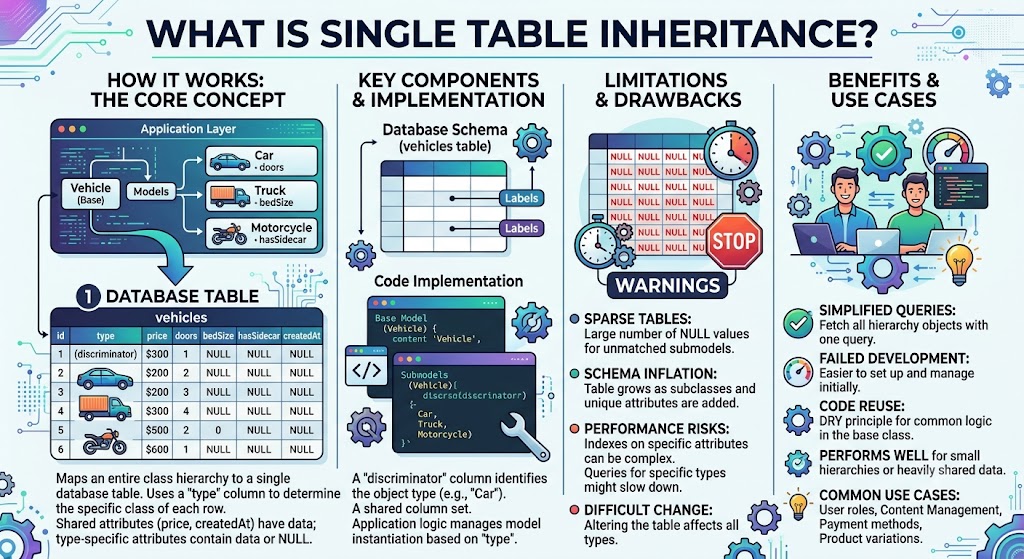
What is single table inheritance? It is a database design pattern that maps an object-oriented class hierarchy into a single database table. Instead of creating separate tables for every subclass, all shared attributes and specialised fields are combined into one structure. A dedicated column, often called a type or discriminator column, identifies the specific subclass represented by each row.
Developers use this approach in object-relational mapping (ORM) systems because it creates a straightforward connection between programming models and database structures. Frameworks such as Ruby on Rails, Hibernate, and Entity Framework support similar inheritance strategies, allowing developers to represent complex relationships without managing multiple connected tables.
The main attraction of STI is simplicity. A developer can retrieve related objects using one query because all records exist in the same location. However, this convenience comes with trade-offs. As applications grow, large tables containing many unused columns can become harder to manage.
Understanding this pattern helps software architects decide whether STI is suitable for their application or whether alternatives such as Class Table Inheritance or Concrete Table Inheritance would provide better long-term performance.
How Single Table Inheritance Works
Single Table Inheritance stores parent and child classes together. The database contains columns for every possible attribute across the entire inheritance hierarchy.
For example, imagine an application with different types of employees:
- Employee (base class)
- Developer (subclass)
- Manager (subclass)
- Designer (subclass)
Instead of creating separate tables, STI creates one employee table.
| ID | Name | Role Type | Programming Language | Team Size | Design Tool |
| 1 | Sarah | Developer | Python | NULL | NULL |
| 2 | James | Manager | NULL | 12 | NULL |
| 3 | Emma | Designer | NULL | NULL | Figma |
The “Role Type” column acts as the discriminator. The application reads this value and determines which class should be created.
This design reduces database joins because information is already stored together. For systems where subclasses share many characteristics, this can provide efficient data retrieval.
Why Developers Use Single Table Inheritance
The popularity of this approach comes from its practical advantages.
Simpler Database Structure
With fewer tables, developers spend less time managing complex relationships. Database migrations can also become easier because changes happen in one location.
Faster Queries
Because related records exist in the same table, applications often need fewer joins. This can improve performance for common read operations.
Natural Object Mapping
Programming languages often use inheritance models. STI creates a direct relationship between these classes and database records, making ORM configuration easier.
A real-world example can be seen in content management platforms. Different content types, such as articles, videos, and announcements, may share common fields like titles, authors, and publishing dates. STI can allow these different objects to exist within one unified structure.
Single Table Inheritance Compared With Other Database Patterns
Choosing the right inheritance model depends on application requirements.
| Pattern | Database Structure | Advantages | Limitations |
| Single Table Inheritance | One table for all classes | Simple design and fewer joins | Large tables and unused columns |
| Class Table Inheritance | Separate table for each class | Better normalisation | More joins required |
| Concrete Table Inheritance | Separate table for every subclass | Independent structures | Duplicate fields |
STI works best when subclasses are closely related and have many shared attributes. It becomes less effective when each subclass requires many unique fields.
Benefits and Limitations of STI in Modern Applications
The biggest advantage of this pattern is development speed. Teams can create features quickly because the database model remains relatively simple.
However, scalability introduces challenges.
A growing application may accumulate hundreds of columns, many of which contain empty values. This increases maintenance difficulty and can affect database indexing strategies.
Another concern is data validation. Since multiple object types share one table, developers must ensure that only relevant fields are populated for each subclass.
For example, a vehicle database containing cars, bicycles, and aircraft could become inefficient if every possible feature is placed into one table. A car record may have engine specifications, while a bicycle record leaves those fields empty.
The decision depends on the relationship between classes, expected growth, and reporting requirements.
Practical Considerations Before Implementing STI
Before adopting this pattern, development teams should evaluate several factors:
Database Size
Small and medium-sized applications often benefit most from STI. Large enterprise systems may require more specialised structures.
Future Expansion
If new subclasses are likely to introduce many unique attributes, STI may create unnecessary complexity.
Query Behaviour
Applications that frequently retrieve all related objects can benefit from STI. Systems requiring highly specialised queries may perform better with separate tables.
A useful design principle is to choose STI because it matches the data model, not simply because it reduces initial development effort.
The Future of Single Table Inheritance in 2027
By 2027, STI is expected to remain a useful technique within ORM-based software development, particularly for applications prioritising rapid development and straightforward data models.
Modern cloud databases continue improving their ability to handle large tables through better indexing, partitioning, and query optimisation. These improvements may extend the practical lifespan of STI-based architectures.
However, software teams are increasingly focusing on flexible database designs, especially for systems involving artificial intelligence, analytics, and large-scale user data. These environments often require more specialised storage strategies.
The future role of STI will likely depend on balance. Developers will continue using it where simplicity provides value while selecting alternative inheritance strategies for highly complex systems.
Key Takeaways
- STI combines multiple related classes into one database table.
- A discriminator column identifies each subclass.
- The pattern reduces joins and simplifies ORM mapping.
- Large inheritance structures can create performance and maintenance issues.
- Database design decisions should consider future growth, not only current requirements.
- STI remains valuable for applications with closely connected object relationships.
Conclusion
Single Table Inheritance remains an important database design pattern for developers working with object-oriented applications. Its ability to represent class hierarchies using one table provides simplicity, easier maintenance, and efficient queries in many situations.
However, the approach is not suitable for every project. Large systems with many specialised subclasses may experience problems related to unused columns, complex validation, and database growth.
The strongest implementations occur when teams carefully analyse their data relationships before choosing an inheritance strategy. STI is not a universal solution, but it remains a practical tool when simplicity and shared structures are the main priorities.
Frequently Asked Questions
What is single table inheritance in database design?
Single Table Inheritance is a method of storing multiple related object classes in one database table. A discriminator column identifies which subclass each record belongs to.
How does single table inheritance work in ORM frameworks?
ORM frameworks use a special type column to determine which class should be created when retrieving database records. The framework automatically maps rows to the correct object type.
What are the advantages of using STI?
The main benefits include simpler database structures, fewer joins, easier object mapping, and faster development for related classes.
What are the disadvantages of single table inheritance?
Common disadvantages include large tables, unused columns, complicated validation rules, and possible performance issues as applications expand.
When should developers avoid STI?
Developers should consider alternatives when subclasses have very different attributes or when the database is expected to grow significantly.
What is the difference between STI and class table inheritance?
STI stores all classes in one table, while class table inheritance creates separate tables for each class. STI prioritises simplicity, whereas class table inheritance focuses on database normalisation.
Methodology
This article was prepared using established software engineering concepts, database design documentation, and recognised ORM practices. Information was validated against technical references from database architecture literature and framework documentation.
The analysis focuses on general principles rather than one specific programming framework. Because database requirements vary between projects, recommendations should always be evaluated against application size, performance needs, and future development plans.
References
Fowler, M. (2003). Patterns of Enterprise Application Architecture. Addison-Wesley.
Hibernate Documentation. (2025). Inheritance Mapping Strategies. Hibernate ORM Documentation.
Microsoft. (2025). Entity Framework Core Inheritance Mapping. Microsoft Learn.
Ruby on Rails Guides. (2025). Active Record Associations and Inheritance Concepts. Ruby on Rails Documentation.