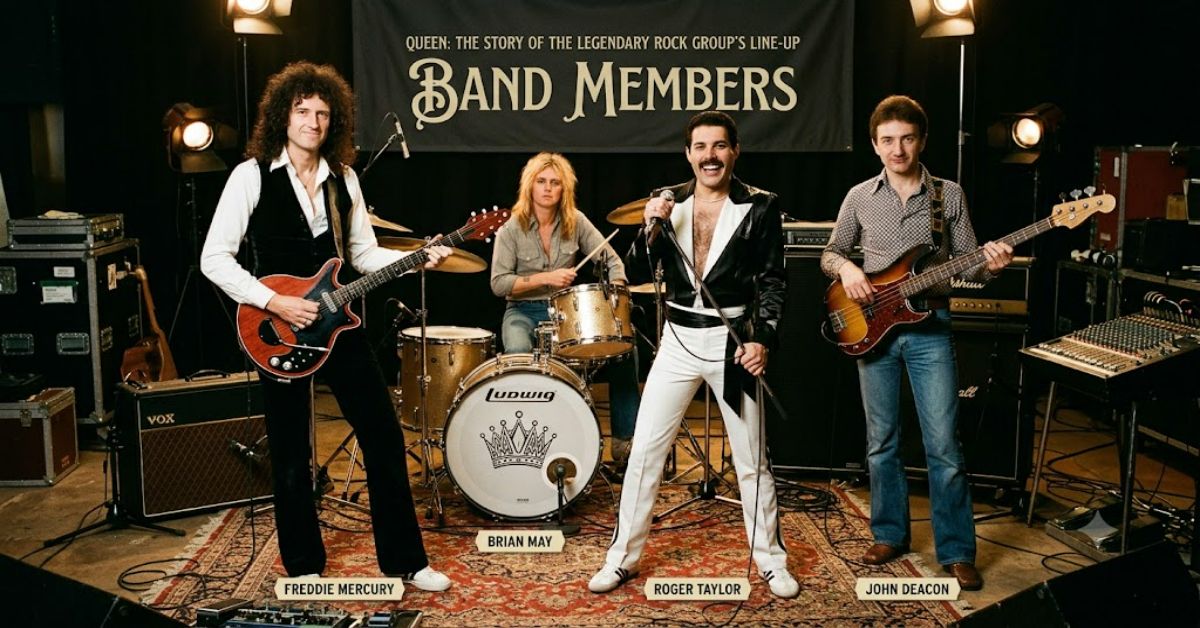
The story of the band members for Queen is one of the most remarkable journeys in rock music history. Formed in London in 1970, Queen developed a unique identity by combining powerful vocals, complex arrangements, theatrical performances, and innovative production techniques.
The original line-up consisted of Freddie Mercury as lead vocalist and pianist, Brian May as guitarist, Roger Taylor as drummer, and John Deacon as bassist. Together, they created some of the most recognisable songs in popular music, including “Bohemian Rhapsody”, “We Will Rock You”, “Another One Bites the Dust”, and “Somebody to Love”.
Following Freddie Mercury’s death on 24 November 1991 due to complications related to AIDS, Queen entered a new chapter. John Deacon later retired from public music activity in 1997, leaving Brian May and Roger Taylor as the active members carrying the band forward. Since 2011, they have performed globally with American singer Adam Lambert under the name Queen + Adam Lambert.
Understanding Queen’s members means looking beyond individual musicians. Their success came from the creative balance between four personalities, each contributing a different musical strength.
The Original Members Who Built Queen’s Legacy
The foundation of Queen was created by four musicians with very different styles and backgrounds.
| Member | Role | Main Contribution |
| Freddie Mercury | Lead vocals, piano | Powerful vocals, songwriting, stage presence |
| Brian May | Guitar, vocals | Distinctive guitar tone and musical arrangements |
| Roger Taylor | Drums, vocals | Energetic rhythms and songwriting |
| John Deacon | Bass guitar | Melodic bass lines and commercial songwriting |
Freddie Mercury became the face of Queen through his extraordinary vocal range and theatrical approach. His ability to connect with audiences transformed concerts into large-scale performances rather than simple music events.
Brian May’s guitar work gave Queen a unique sonic identity. His use of the homemade “Red Special” guitar created a layered sound that became central to tracks such as “We Will Rock You” and “Brighton Rock”.
Roger Taylor brought a powerful drumming style influenced by hard rock and progressive music. He also wrote several successful songs, including “Radio Ga Ga”.
John Deacon provided a quieter but equally important contribution. His songwriting produced major hits such as “Another One Bites the Dust”, which became one of Queen’s biggest international successes.
How Each Member Shaped Queen’s Sound
Queen’s music succeeded because the members brought different creative approaches.
Freddie Mercury focused on dramatic melodies and emotional storytelling. His songwriting often combined rock with opera, classical influences, and theatrical elements.
Brian May contributed sophisticated guitar arrangements. Unlike many traditional rock guitarists, May often created harmonised guitar parts that sounded closer to orchestral arrangements.
Roger Taylor introduced energetic rock influences while also exploring electronic sounds. His song “Radio Ga Ga” became a global anthem and demonstrated his ability to write beyond traditional rock structures.
John Deacon’s style was more understated. His bass playing supported the band’s arrangements while leaving space for vocals and guitars. His songwriting ability showed that his role extended far beyond rhythm.
This creative balance became one of Queen’s greatest strengths. Each member contributed something different, allowing the band to move between heavy rock, pop, progressive music, and experimental sounds.
Queen After Freddie Mercury’s Death
Freddie Mercury’s death changed the future of the group. The remaining members faced the challenge of preserving Queen’s identity while respecting its history.
Brian May and Roger Taylor continued musical projects, including the 1992 Freddie Mercury Tribute Concert held at Wembley Stadium. The event brought together major artists to celebrate Mercury’s life and raise awareness about HIV/AIDS.
John Deacon gradually stepped away from public performances, officially retiring from active music involvement in 1997. Unlike many musicians who continued under the same name, Deacon chose not to participate in later Queen projects.
The modern version of Queen focuses on May and Taylor’s performances. Since 2011, they have toured with Adam Lambert, whose vocal ability allows the band to perform Queen’s catalogue while bringing a different interpretation to Mercury’s original parts.
Queen + Adam Lambert: A New Era
The partnership between Queen and Adam Lambert began after their appearance together on American Idol in 2009. Their first major performance as Queen + Adam Lambert took place in 2011.
| Era | Active Members | Key Characteristics |
| 1970–1991 | Mercury, May, Taylor, Deacon | Original creative era |
| 1991–1997 | May, Taylor, Deacon | Transition period |
| 2011–Present | May, Taylor, Lambert | Global touring era |
Adam Lambert does not replace Freddie Mercury. Instead, he performs Queen’s catalogue while bringing his own vocal style and stage presence.
This approach has allowed Queen’s music to reach newer generations. Their tours have demonstrated that classic rock bands can maintain relevance by adapting without removing their historical foundations.
Cultural Impact and Lasting Influence
Queen’s influence extends beyond music. Their performances helped redefine stadium concerts, with events such as the 1985 Live Aid appearance becoming historic moments in popular culture.
The band’s ability to combine technical musicianship with audience connection created a model that many later artists followed.
A key lesson from Queen’s history is that successful bands are not only built around individual talent. They depend on chemistry, creative disagreement, and shared ambition.
The Future of Queen in 2027
By 2027, Queen’s legacy is expected to continue through recordings, documentaries, digital platforms, and possible live projects.
The music industry has increasingly embraced catalogue-based experiences, with classic artists reaching audiences through streaming services, restored concert footage, and immersive technologies.
However, Queen’s future performances will depend on practical factors, including the health and availability of Brian May and Roger Taylor. The band’s continued activity will likely focus on preserving its history rather than attempting to recreate the original era.
Queen’s greatest strength remains its timeless music. New generations continue discovering the band through films, streaming platforms, and cultural references, ensuring that its influence remains significant.
Key Takeaways
- Queen’s original line-up consisted of Freddie Mercury, Brian May, Roger Taylor, and John Deacon.
- Each member contributed a unique musical style that shaped the band’s identity.
- Freddie Mercury’s death in 1991 marked a major turning point.
- John Deacon retired from public music activity in 1997.
- Brian May and Roger Taylor continue performing with Adam Lambert.
- Queen’s catalogue remains influential across generations.
Conclusion
The history of Queen is defined by remarkable musicianship, creative ambition, and unforgettable performances. The original members created a sound that crossed musical boundaries and established one of the most successful rock bands ever formed.
While Freddie Mercury’s voice and stage presence remain central to Queen’s identity, Brian May, Roger Taylor, and John Deacon each played essential roles in building the band’s legacy.
Today, Queen continues through the partnership of May, Taylor, and Adam Lambert, demonstrating that powerful music can survive major changes. The band’s story reflects both the importance of individual talent and the strength of collaboration.
Frequently Asked Questions
Who are the original band members for Queen?
The original members were Freddie Mercury, Brian May, Roger Taylor, and John Deacon. They formed Queen in London in 1970 and created the band’s classic sound.
Which band members for Queen are still performing?
Brian May and Roger Taylor remain active members of Queen. They currently perform with singer Adam Lambert under the name Queen + Adam Lambert.
Why did John Deacon leave band members for Queen?
John Deacon retired from public music activity in 1997. He chose not to participate in later Queen projects after stepping away from the industry.
Who replaced Freddie Mercury in Queen?
No singer officially replaced Freddie Mercury. Adam Lambert performs Queen songs with Brian May and Roger Taylor while bringing his own vocal style.
What made Queen’s original members successful?
Their success came from combining different talents, including Mercury’s vocals, May’s guitar work, Taylor’s rhythm and songwriting, and Deacon’s bass and composition skills.
Methodology
This article band members for Queen was prepared using established music history sources, official band information, and documented historical records. Information about Queen’s membership changes, performances, and timeline was cross-checked against recognised music archives and official publications.
The band members for Queen analysis focuses on the evolution of Queen’s line-up rather than ranking individual contributions. Interpretations of artistic influence may vary among fans and music historians.
References
Queen Online. (2025). Queen official history and band information. QueenOnline.com.
BBC Music. (2024). Queen: The story of one of Britain’s most influential rock bands. BBC.
Blake, M. (2016). Is This the Real Life? The Untold Story of Queen. Aurum Press.