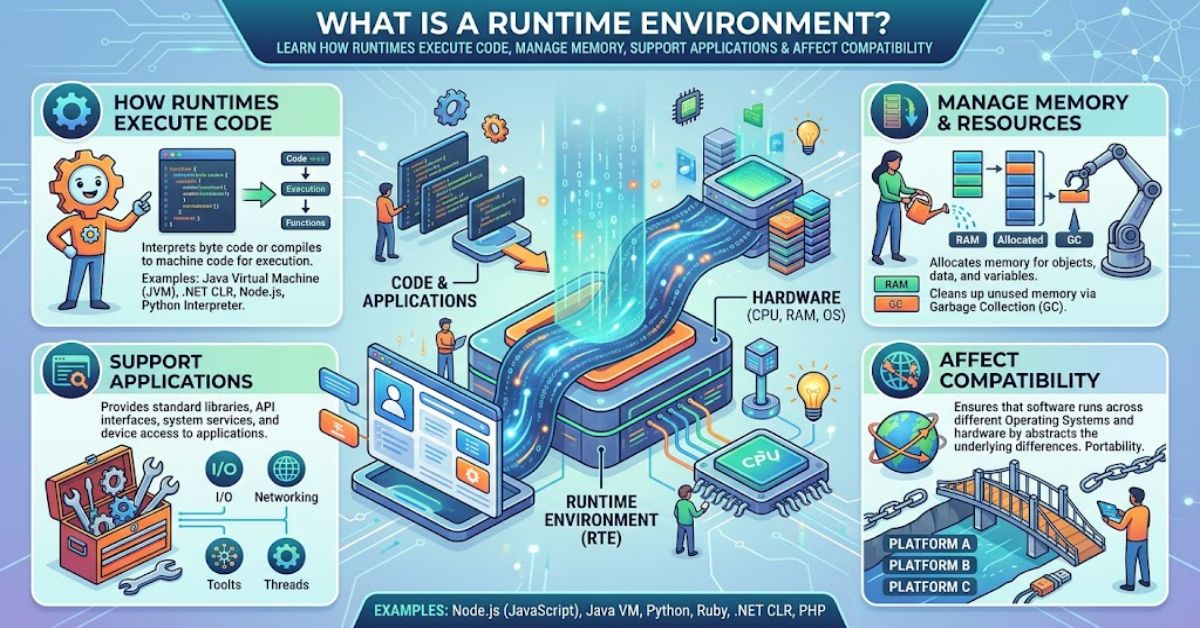
What is a runtime environment? It is the software layer and collection of resources a computer program needs to execute while it is running. Depending on the technology, it may provide a virtual machine, language interpreter, libraries, memory management, system interfaces and other execution services.
Writing code is only one stage of software development. A computer must also have a suitable environment in which to execute that code. For example, Java applications commonly run on the Java Virtual Machine (JVM), while JavaScript applications can use Node.js outside a web browser. Python programs typically depend on a Python interpreter and the libraries required by the application.
These environments do more than launch a program. They help manage how instructions are executed, how memory is used and how software accesses operating-system services. Some also provide features such as garbage collection, asynchronous input and output, and error handling.
The term can describe different levels of software. A runtime might be a language-specific execution engine, a managed framework or a container environment that supplies the application with its required dependencies. These meanings overlap, but they are not interchangeable.
Understanding the distinction is useful for developers, IT students, system administrators and businesses choosing how to deploy software. A program that works on one computer may fail on another because the runtime version, installed libraries, operating system or configuration differs.
The central principle is simple: application code depends on more than its source files. A compatible runtime provides the conditions in which that code can execute predictably.
How a runtime environment works
A runtime environment acts as a bridge between application code and the resources needed to execute it. Its exact responsibilities depend on the programming language and platform, but the process usually follows several stages.
1. Application code
Source code or compiled instructions
2. Runtime services
Execution, libraries, memory and error handling
3. Operating system and hardware
Files, network, processor and memory resources
First, the runtime loads the program and checks the components needed to start it. Depending on the platform, it may interpret instructions, execute bytecode or use just-in-time compilation to translate code into machine instructions.
Next, the runtime manages execution. It may allocate memory, load libraries, schedule asynchronous tasks and handle exceptions. When the program requests a file or network connection, the runtime or its libraries help it interact with the operating system.
Finally, the application continues running until it finishes, encounters an unrecoverable error or is stopped. Some runtimes also perform cleanup as objects become unnecessary.
The Java Virtual Machine specification documents structures such as runtime data areas, stacks, heaps and class loading. These details show why a runtime is more than a simple launch command (Oracle, 2026).
Main types of runtime environments
Different languages use different execution models. The following examples illustrate common approaches.
| Runtime | Main purpose | Typical use |
| Java Virtual Machine (JVM) | Executes Java bytecode and supports managed execution | Enterprise applications and backend services |
| Node.js | Runs JavaScript outside the browser using the V8 engine and system APIs | APIs, web servers and development tools |
| Python interpreter | Executes Python code and provides access to standard and installed libraries | Automation, data analysis and scripting |
| .NET runtime | Executes managed .NET code and provides services such as garbage collection | Business software, web services and desktop applications |
| Browser runtime | Provides JavaScript execution and web APIs | Interactive websites and web applications |
These environments are not direct substitutes. Their capabilities, supported languages and deployment requirements differ.
For example, Node.js is designed around asynchronous input and output, making it useful for applications handling many network connections. However, CPU-intensive work can block its main event loop if it is not managed appropriately.
The .NET runtime uses automatic memory management for managed objects, but developers must still handle certain resources, such as file handles and network connections, correctly. Microsoft’s documentation explains that garbage collection does not replace explicit disposal of unmanaged resources.
Python offers another useful distinction: its virtual environments isolate project dependencies, but they are not separate operating systems or complete application runtimes. The official Python documentation describes them as lightweight environments built on an existing Python installation.
Runtime environment versus development environment
These terms are related but serve different purposes.
| Feature | Runtime environment | Development environment |
| Main goal | Execute software | Create, test and debug software |
| Common components | Runtime engine, required libraries and configuration | Code editor, compiler, debugger and build tools |
| Typical user | Application or service running in production | Developer writing and testing code |
| Required for deployment | Usually, in some form | Not always |
| Example | A Java runtime used to run an application | An IDE configured for Java development |
A development environment may include a runtime, but it usually contains additional tools. A production server may need only the runtime and application dependencies, not a full code editor.
This distinction can reduce deployment complexity. Installing unnecessary development tools on production systems may increase maintenance demands and expand the number of components that require security updates.
Why runtime environments matter
The runtime affects whether software starts correctly, how it performs and how easily teams can maintain it. Three practical considerations deserve particular attention.
Compatibility: Applications may require a specific runtime version or library. A program developed with one version can behave differently or fail when deployed with another. Pinning supported versions and testing upgrades reduces this risk.
Performance: Just-in-time compilation, garbage collection and asynchronous execution can influence response times and resource use. These features are not automatically beneficial in every situation. Performance depends on the application workload, runtime configuration and available hardware.
Security: Older runtimes may contain known vulnerabilities or lack current security fixes. Organisations should track supported versions, apply updates and avoid exposing unnecessary services. Dependency isolation also helps prevent one project’s packages from disrupting another.
A further consideration is reproducibility. If a developer’s machine contains libraries that are missing from the production server, the application may fail despite having correct source code. Lockfiles, dependency manifests and deployment containers help make these differences visible and manageable.
The Future of Runtime Environments in 2027
Runtime development is likely to remain focused on compatibility, security, efficient resource use and cloud deployment. Containers already help teams package applications with their dependencies, while managed platforms reduce the amount of runtime infrastructure developers need to maintain directly.
However, containers do not eliminate every compatibility problem. The host operating system, processor architecture, permissions and external services can still affect execution. Similarly, serverless platforms manage much of the runtime infrastructure but impose their own limits and configuration requirements.
In 2027, teams should expect continued development across Java, .NET, Python and JavaScript runtimes. The practical choice will depend on supported versions, workload requirements and the maintenance policies of each ecosystem. Specific performance improvements should be assessed through testing rather than assumed from release announcements.
Key takeaways
- A runtime is part of the execution system, not simply the application itself.
- Different languages rely on different execution models and runtime services.
- Matching runtime versions across development and production reduces deployment failures.
- Garbage collection does not remove the need to manage every external resource.
- Containers can improve consistency but cannot guarantee identical behaviour in every environment.
- Security updates and lifecycle planning should form part of runtime maintenance.
Conclusion
A runtime environment provides the software services a program needs to execute. Depending on the platform, these services can include code execution, memory management, libraries, exception handling and access to operating-system features.
The distinction matters because working source code does not guarantee a working application. The runtime version, dependencies, configuration and deployment platform all influence the result. Understanding these factors helps developers diagnose errors, choose suitable technologies and deliver more reliable software.
There is no single runtime that suits every application. Java, Node.js, Python and .NET each provide different capabilities and trade-offs. The sensible choice depends on the language, workload, security requirements and available expertise.
For organisations, runtime management should be treated as an ongoing operational responsibility. Keeping versions supported, isolating dependencies and testing changes can prevent avoidable failures. A well-managed runtime makes software easier to deploy and maintain without removing the need for sound application design.
Frequently asked questions
1. What is a runtime environment in simple terms?
It is the software a program needs while it runs. It may provide an execution engine, libraries, memory management and access to system resources.
2. Is a runtime environment the same as an operating system?
No. The operating system manages hardware and system resources. A runtime provides additional services that help a particular program execute.
3. What is the difference between a runtime and a compiler?
A compiler translates source code into another form, such as machine code or bytecode. A runtime provides the services needed to execute the resulting program, although some runtimes also compile code during execution.
4. Is Node.js a runtime environment?
Yes. Node.js allows JavaScript to run outside a web browser and provides APIs for tasks such as file access and networking.
5. Why does a runtime version matter?
Different versions can support different features, dependencies and security fixes. An incompatible version may cause errors or unexpected behaviour.
6. Does Python have a runtime environment?
Yes. Python code is executed by a Python implementation, commonly CPython, alongside the libraries and dependencies required by the application.
References
Oracle. (2026). The Java Virtual Machine Specification, Java SE 26 Edition. Oracle.
Python Software Foundation. (n.d.). venv — Creation of virtual environments. Python documentation.
Microsoft. (n.d.). Fundamentals of garbage collection. Microsoft Learn.
Methodology
This article uses official technical documentation from Oracle, the Python Software Foundation and Microsoft to explain runtime concepts and compare common execution models. No hands-on benchmarks or independent runtime tests were conducted, so no measured performance claims are made. Runtime behaviour varies by version, operating system and configuration; readers should consult the documentation for their chosen platform before deployment.
The article was drafted with AI assistance and requires human editorial review. References, technical claims and author credentials should be verified before publication.