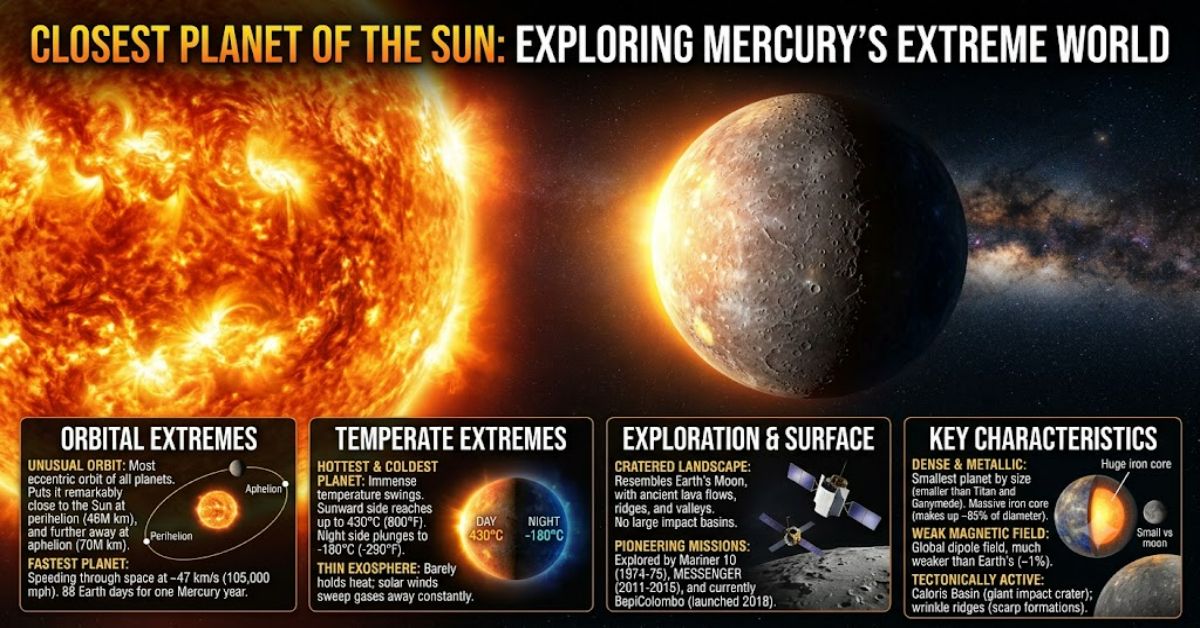
The closest planet of the sun is Mercury, a small rocky planet located approximately 58 million kilometres from the Sun on average. As the innermost planet in our solar system, Mercury experiences some of the most extreme environmental conditions known among the planets. It has a surface covered with impact craters, temperatures that swing dramatically between day and night, and an unusually large metallic core compared with its overall size.
Mercury completes an orbit around the Sun in just 88 Earth days, making its year the shortest of any planet. However, its close position to the Sun does not mean it is the hottest planet. That distinction belongs to Venus because of its thick carbon dioxide atmosphere and powerful greenhouse effect.
Understanding Mercury helps scientists study how rocky planets formed and evolved near their parent stars.
Mercury’s Position in the Solar System
Mercury sits inside Earth’s orbit and is the first planet from the Sun. Its average distance is about 36 million miles (58 million kilometres), although this changes because Mercury follows an elliptical orbit.
| Planet | Average Distance from Sun | Orbital Period |
| Mercury | 58 million km | 88 Earth days |
| Venus | 108 million km | 225 Earth days |
| Earth | 150 million km | 365 days |
| Mars | 228 million km | 687 Earth days |
This close solar position exposes Mercury to intense radiation and makes spacecraft missions particularly challenging.
The Physical Characteristics of Mercury
Mercury is the smallest planet in the solar system, with a diameter of approximately 4,879 kilometres. Despite its size, it has a surprisingly large iron core, which makes up a significant portion of its interior structure.
Scientists believe Mercury’s unusual composition may have resulted from early collisions in the solar system or intense solar conditions that removed lighter materials.
Key Facts About Mercury
| Feature | Details |
| Diameter | 4,879 km |
| Surface type | Rocky and heavily cratered |
| Atmosphere | Extremely thin exosphere |
| Moons | None |
| Rotation period | About 59 Earth days |
Its lack of a thick atmosphere means Mercury cannot retain heat effectively, leading to extreme temperature changes.
Extreme Temperatures and Surface Conditions
Mercury has one of the most dramatic temperature variations among planets.
During the daytime, temperatures can reach around 430°C. At night, they can fall below -180°C because the planet lacks a substantial atmosphere to distribute heat.
The surface contains:
- Large impact craters
- Mountain ranges
- Ancient volcanic plains
- Long cliffs created by planetary contraction
These features reveal that Mercury has experienced billions of years of geological change.
Space Exploration and Scientific Discoveries
Studying Mercury has always been difficult because spacecraft travelling close to the Sun must withstand intense heat and gravitational forces.
NASA’s MESSENGER spacecraft became the first mission to orbit Mercury in 2011. It operated until 2015 and provided detailed information about the planet’s surface composition, magnetic field, and geological history.
The European Space Agency (ESA) and Japan Aerospace Exploration Agency (JAXA) launched BepiColombo in 2018. The mission aims to study Mercury’s structure, magnetic environment, and relationship with the Sun.
These missions demonstrate how advanced engineering is required to explore planets located near our star.
Why Mercury Matters to Science
Although Mercury is small, it plays an important role in planetary research.
Scientists study Mercury to better understand:
- How rocky planets develop
- How planets interact with their stars
- The formation of planetary cores
- The effects of solar radiation
One important discovery from MESSENGER was evidence of water ice inside permanently shadowed craters near Mercury’s poles. Despite the planet’s high daytime temperatures, these dark regions remain cold enough to preserve ice.
Risks and Challenges of Studying Mercury
Exploring Mercury involves several technical challenges.
| Challenge | Impact on Missions |
| Extreme solar heat | Requires advanced thermal protection |
| Strong solar gravity | Makes spacecraft navigation difficult |
| Limited communication distance | Requires careful mission planning |
| Harsh radiation environment | Can damage instruments |
These challenges make Mercury one of the most difficult planets to investigate.
The Future of Mercury Research in 2027
By 2027, the BepiColombo mission is expected to provide further scientific data after entering Mercury’s orbit. The mission’s observations may improve understanding of the planet’s magnetic field, internal structure, and surface chemistry.
Future research will likely focus on comparing Mercury with other rocky planets, including Earth and Mars. Such comparisons help scientists understand why planets formed differently despite sharing similar origins.
While Mercury is unlikely to become a destination for human exploration, its scientific value will continue growing through robotic missions and improved planetary models.
Key Takeaways
- Mercury is the closest planet of the sun and the smallest planet in our solar system.
- Its short 88-day orbit creates a unique environment for planetary research.
- A large iron core makes Mercury different from other rocky planets.
- Extreme temperatures result from its thin exosphere and slow rotation.
- Space missions have revealed important information about its geology and history.
- Mercury research helps explain how planets form around stars.
Conclusion
Mercury’s position as the closest planet of the sun makes it one of the most fascinating worlds in our solar system. Although it appears small and simple from Earth, scientific missions have revealed a complex planet shaped by extreme heat, ancient impacts, and unusual internal structures.
Its study provides valuable insight into planetary formation and the relationship between stars and their surrounding worlds. From the discoveries of NASA’s MESSENGER mission to the ongoing BepiColombo exploration programme, Mercury continues to challenge scientists and expand knowledge about our cosmic neighbourhood.
The planet closest to the Sun remains a reminder that even the smallest worlds can hold some of the biggest scientific questions.
FAQ
What is the closest planet of the sun?
Mercury is the closest planet to the Sun. It orbits at an average distance of about 58 million kilometres and completes one solar orbit in 88 Earth days.
Why is Mercury the closest planet to the Sun?
Mercury formed in the inner region of the early solar system, where material closest to the Sun combined to create the smallest rocky planet.
Is Mercury the hottest planet in the solar system?
No. Although Mercury receives the most direct sunlight, Venus is hotter because its thick atmosphere traps heat through an intense greenhouse effect.
Does Mercury have any moons?
No. Mercury has no natural satellites due to its small size and its close position to the Sun.
Can humans live on Mercury?
Human settlement on Mercury would be extremely difficult because of extreme temperatures, radiation exposure, and lack of a breathable atmosphere.
Methodology
This article was prepared using information from recognised astronomical organisations, including NASA and the European Space Agency. Scientific details were based on established planetary research and publicly available mission data. Limitations include the fact that Mercury remains less explored than some other planets, meaning future missions may refine current understanding.
Editorial Disclosure: This article was drafted with AI assistance and should be reviewed by a human editor before publication. All scientific claims should be independently verified before final release.
References (APA)
European Space Agency. (2024). BepiColombo mission: Exploring Mercury. ESA.
NASA. (2024). Mercury: Facts and information. NASA Solar System Exploration.
NASA. (2023). MESSENGER mission overview and discoveries. NASA.
National Aeronautics and Space Administration. (2024). Solar system exploration resources. NASA.