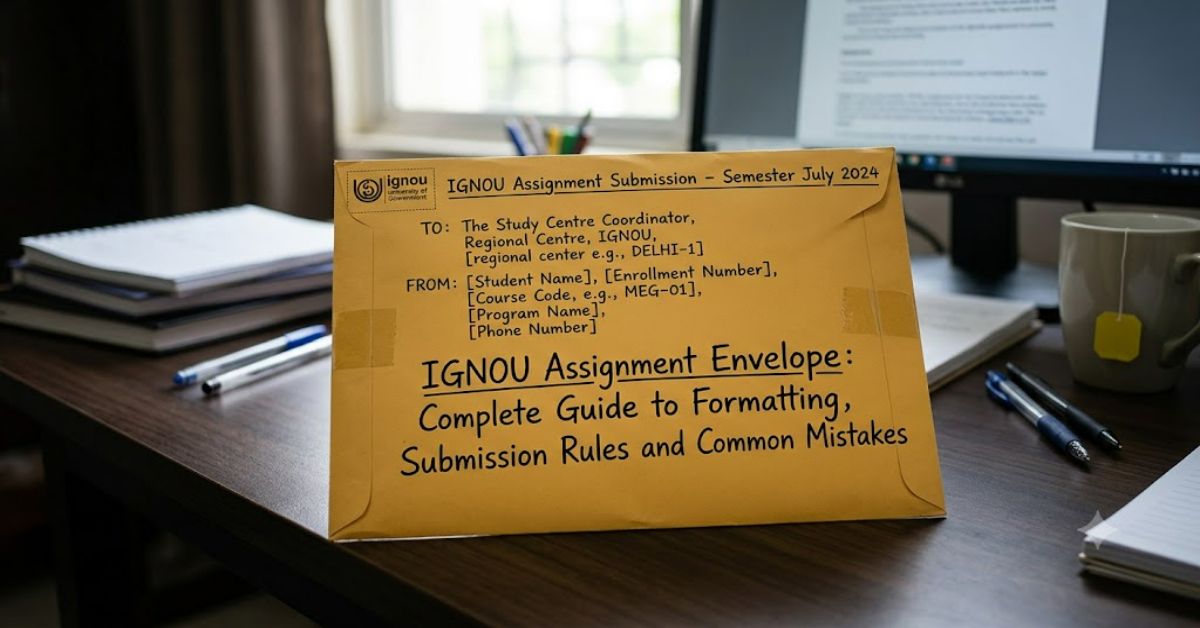
The IGNOU assignment envelope is an important part of the assignment submission process for students enrolled at the Indira Gandhi National Open University (IGNOU). When assignments are sent by post, the envelope acts as the first verification point for the university or study centre. A properly prepared envelope ensures that assignments reach the correct department and are linked with the right student record.
IGNOU, established in 1985 under the Indira Gandhi National Open University Act, serves millions of learners across India and abroad. Because of its distance-learning structure, accurate document handling is essential. Students often focus only on writing assignments but overlook packaging, labelling, and submission procedures.
A correctly organised envelope should include necessary details such as the learner’s name, enrolment number, programme code, course codes, study centre information, and sender details. Missing information can make identification difficult and may lead to delays during evaluation.
This guide explains the correct preparation process, common mistakes, practical considerations, and future changes that may influence assignment submission methods.
Understanding the Purpose of an IGNOU Assignment Envelope
An assignment envelope is not simply a container for documents. It provides essential administrative information that helps IGNOU staff process thousands of submissions efficiently.
Distance education depends heavily on accurate documentation because students are distributed across different regions. Unlike traditional universities where students submit assignments directly to departments, IGNOU manages assignments through regional centres and study centres.
The envelope helps establish:
| Requirement | Purpose |
| Student name | Identifies the learner |
| Enrolment number | Connects assignments with academic records |
| Programme code | Directs evaluation to the correct course structure |
| Course codes | Helps organise individual assignments |
| Contact details | Enables communication if problems occur |
Students should always check the latest instructions issued by their regional centre because submission procedures may vary.
How to Prepare the Envelope Correctly
Preparing an IGNOU assignment envelope requires attention to detail. Before sealing the package, students should confirm that every assignment contains their required personal information.
The front side of the envelope should generally include:
- Student name
- Enrolment number
- Programme name and code
- Study centre code
- Regional centre details
- Contact information
The sender’s address should be written clearly on the top-left section, while the receiver’s address should appear prominently in the centre.
Inside the envelope, assignments should be arranged systematically. Students should avoid mixing different course papers because this increases the possibility of incorrect evaluation.
Comparison of Common Submission Methods
| Submission Method | Advantages | Possible Issues |
| Physical post | Useful where online facilities are limited | Delivery delays possible |
| Regional centre submission | Direct acknowledgement available | Requires travel |
| Online submission portals | Faster digital processing | Technical issues may occur |
The best method depends on the instructions provided by the concerned IGNOU regional centre.
Common Mistakes Students Should Avoid
Many assignment-related problems happen because of small administrative errors rather than poor academic work.
Missing Identification Details
A common mistake is failing to write the enrolment number or programme code. Without these details, staff may struggle to connect assignments with student records.
Incorrect Address Information
Students sometimes send assignments to outdated addresses. Regional centres may change procedures, so checking official notifications before posting is essential.
Poor Document Organisation
Loose papers, missing covers, or incorrectly arranged assignments can create processing difficulties. A simple checklist before submission can prevent most issues.
Ignoring Submission Deadlines
Postal delays remain a major risk. Students should consider delivery time when selecting a submission method.
Practical Insights for Better Assignment Submission
A useful approach is to treat assignment submission like a document management process rather than a simple mailing task.
One overlooked issue is keeping proof of submission. Students should maintain:
- Postal receipts
- Tracking details
- Assignment copies
- Submission acknowledgements
These records become valuable if disputes occur regarding delivery or evaluation status.
Another practical improvement is creating a digital backup of every assignment before sending physical copies. Cloud storage or scanned documents provide additional protection against unexpected losses.
The Future of IGNOU Assignment Submission in 2027
The future of assignment submission is likely to become increasingly digital. Educational institutions across India are adopting online learning management systems, digital records, and electronic document verification.
However, physical submission may continue for certain programmes or learners because IGNOU serves students with different levels of technological access. Infrastructure limitations, internet availability, and regional differences mean a complete shift away from physical assignments may take time.
By 2027, hybrid systems combining online uploads with traditional submission options may become more common. Digital tracking, automated verification, and improved student portals could reduce administrative delays.
Data Insights: Assignment Preparation Checklist
| Checkpoint | Recommended Action |
| Personal details | Verify name and enrolment number |
| Course information | Match every assignment with correct code |
| Packaging | Use secure envelope protection |
| Proof | Save receipts and digital copies |
| Deadline | Submit with sufficient delivery time |
Key Takeaways
- Correct envelope preparation supports faster assignment processing.
- Student identification details are the most important information on submissions.
- Keeping digital copies reduces the risk of lost documents.
- Regional centre instructions should always be checked before posting.
- Proof of submission provides protection against delivery disputes.
Methodology
This article was prepared using publicly available information about IGNOU assignment procedures, distance-learning practices, and general document submission standards. Official university guidance should always be checked before final submission because regional centres may issue updated instructions. The article focuses on practical student experience while recognising that procedures can change over time.
Frequently Asked Questions
What information should be written on an IGNOU assignment envelope?
Students should include their name, enrolment number, programme code, course details, study centre information, and sender address.
Can IGNOU assignments be submitted without an envelope?
Submission requirements depend on the current instructions from IGNOU and the concerned regional centre. Students should follow the latest official guidelines.
Why is correct labelling important for assignment submission?
Proper labelling helps university staff identify students and organise assignments for evaluation.
Should students keep a copy of submitted assignments?
Yes. Keeping scanned copies and postal proof is recommended in case delivery or record issues occur.
Does IGNOU allow online assignment submission?
Some programmes and regional centres may provide online submission options. Students should confirm availability before choosing this method.
What happens if assignment details are missing?
Incorrect or incomplete details may delay processing because staff may be unable to identify the submission correctly.
References
Indira Gandhi National Open University. (2025). Student support and assignment guidelines. IGNOU.
Ministry of Education, Government of India. (2024). Digital education initiatives and higher education development. Government of India.