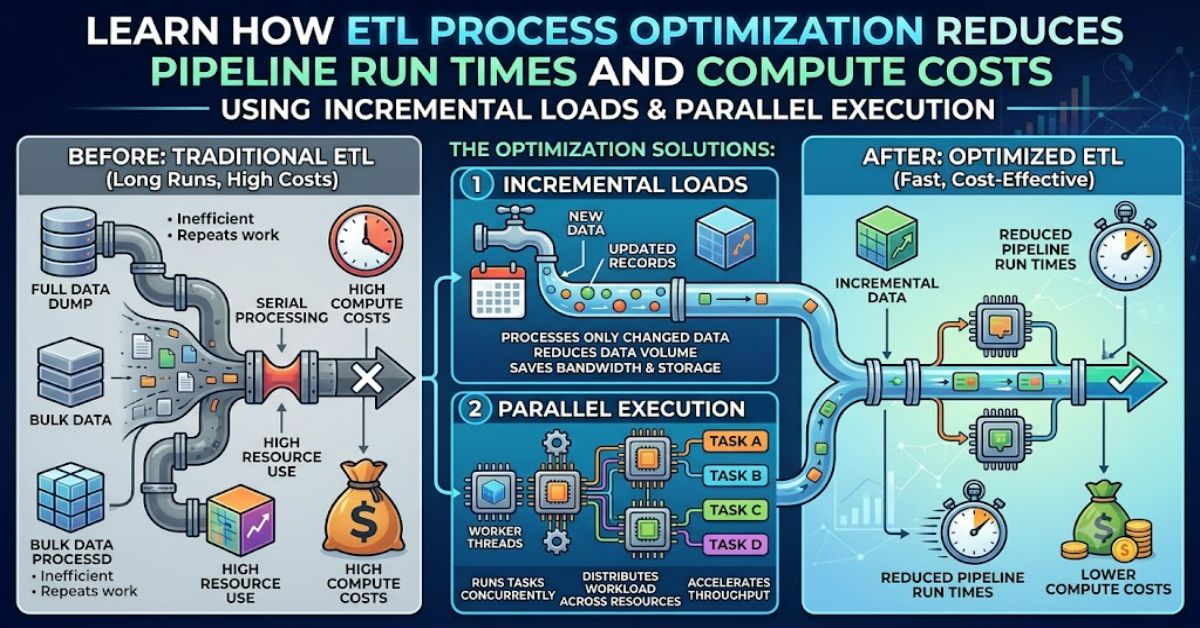
ETL process optimization is the practice of improving data extraction, transformation and loading workflows so they complete faster, use fewer resources and fail less often. The most effective approach is not simply adding more compute. It starts by reducing the amount of data that needs to move and transform in the first place.
Modern data platforms provide several ways to achieve this. Incremental loading can replace repeated full-table processing, predicate pushdown can move filtering closer to the source, and parallel processing can divide suitable workloads across multiple workers. Columnar formats, partition pruning, query optimisation and better monitoring can provide additional gains.
The central principle is simple: process less data, process it closer to where it lives, and process independent workloads concurrently.
That principle applies whether a pipeline uses a traditional data warehouse, cloud object storage, a managed integration service or a distributed processing framework.
Why ETL Pipelines Become Slow
An ETL pipeline can become a bottleneck for several different reasons. The problem may be the source database, network transfer, transformation logic, destination warehouse or the orchestration layer.
A common mistake is to treat every slow pipeline as a compute problem. If a job spends most of its time reading unnecessary rows, doubling the number of workers does not address the underlying inefficiency.
| Bottleneck | Typical Cause | Optimisation Approach |
| Extraction | Full-table scans | Incremental extraction |
| Network | Excessive data movement | Filtering and projection |
| Transformation | Row-by-row processing | Set-based operations |
| Storage | Poor file organisation | Partitioning and columnar formats |
| Compute | Insufficient parallelism | Controlled concurrency |
| Loading | Small or inefficient writes | Batching and bulk loading |
| Reliability | Weak recovery design | Checkpoints and idempotent loads |
Microsoft’s current data-integration guidance similarly recommends examining the individual stages of a copy operation rather than assuming that increasing compute will solve every performance problem.
Start With Incremental Loading
One of the highest-impact improvements is replacing repeated full loads with incremental processing.
Suppose a customer table contains 500 million rows but only 500,000 records changed since the previous run. Reprocessing all 500 million rows creates unnecessary database reads, network traffic and transformation work.
An incremental pipeline identifies only new or changed records.
A common method is a watermark. The pipeline stores a value such as the latest modification timestamp or increasing ID from the previous successful run. The next execution retrieves records beyond that point.
Microsoft’s Fabric documentation describes this pattern using a watermark column and a stored value representing the previous processing position.
Databricks also documents incremental ETL patterns that process new and changed records instead of repeatedly rebuilding an entire dataset. Its current guidance includes change-data-capture workflows for handling inserts, updates and deletes.
The important trade-off is complexity. Incremental processing requires careful handling of late-arriving records, updates, deletes and failed runs.
A badly designed incremental pipeline can be faster but less trustworthy.
Push Transformation Logic Towards the Data
Another major optimisation is pushdown processing.
Instead of extracting a large dataset and filtering it inside the ETL engine, the pipeline can often send filtering or projection logic to the source system.
For example, this approach:
SELECT * FROM orders
followed by filtering inside the ETL engine is usually less efficient than asking the source for only the required columns and rows.
AWS describes pushdown as moving retrieval logic closer to the data source, reducing data transferred to the processing engine. Its Glue documentation also explains how partition and predicate pushdown can reduce the amount of data scanned.
This is particularly valuable when the source database has strong SQL execution capabilities.
ETL or ELT?
The same principle explains why ELT architectures have become popular.
Traditional ETL performs transformations before loading data into the target system. ELT loads the data first and uses the analytical platform’s own processing engine for transformations.
Neither model is universally superior. The better choice depends on source limitations, data governance, warehouse capabilities and transformation complexity.
The useful optimisation question is not simply “ETL or ELT?” It is:
Where can this operation be executed most efficiently without compromising data quality or governance?
Replace Row-by-Row Logic With Set-Based Operations
Row-by-row processing is another common performance problem.
A loop that retrieves and transforms one record at a time can create substantial overhead when millions of records are involved. Relational databases are generally designed to operate efficiently on sets of records.
Set-based SQL operations can allow the database engine to optimise execution through query planning, indexing, parallel execution and other mechanisms.
The same principle applies to distributed processing. Operations that can be expressed through native engine functions are generally preferable to unnecessary custom processing.
This does not mean every transformation should be pushed into SQL. Complex business rules, specialised parsing or external services may require application-level processing. The objective is to avoid expensive procedural logic when the platform already provides an efficient set-based alternative.
Use Partitioning Carefully
Partitioning can significantly reduce the amount of data an ETL job needs to scan.
A large dataset might be divided by date, region or another appropriate attribute. When a pipeline only needs records from a particular period, partition pruning allows the processing engine to skip irrelevant data.
AWS specifically recommends partitioning data according to how it will be queried and notes that partition pruning can reduce scanning and improve processing efficiency.
However, partitioning is not automatically beneficial.
Creating too many partitions can create management overhead and small-file problems. AWS warns against inappropriate high-cardinality partition choices because they can create excessive numbers of small partitions.
This creates an important optimisation rule:
A good partitioning strategy reflects access patterns, not simply the number of columns available.
Introduce Controlled Parallel Processing
Parallelism can dramatically improve throughput when the workload can safely be divided into independent tasks.
For example, a pipeline processing twelve months of independent historical data might divide the work into separate partitions rather than processing everything sequentially.
Cloud data platforms increasingly provide automatic parallelisation. Google Cloud Dataflow, for example, distributes work across workers and automatically manages aspects of parallel processing and resource allocation.
Microsoft Fabric Data Factory likewise supports parallel copy operations and scalable data movement across source and destination systems.
But more parallelism does not always mean better performance.
If ten workers simultaneously overload the source database, the pipeline can become slower rather than faster. Microsoft explicitly warns that excessive parallel copies can hurt performance when the source or destination becomes overloaded.
| Optimisation | Potential Benefit | Primary Risk |
| Incremental loads | Less data processed | Missed changes |
| Pushdown | Lower transfer volume | Source-system load |
| Set-based logic | Faster transformations | Complex SQL |
| Partitioning | Less scanning | Too many partitions |
| Parallel processing | Higher throughput | Resource contention |
| Columnar storage | Efficient analytical reads | Conversion overhead |
| Larger batches | Better I/O efficiency | Higher memory use |
Optimise Storage and File Layout
Storage design can have a direct impact on pipeline performance.
Columnar formats such as Parquet and ORC are widely used for analytical workloads because they can reduce unnecessary data reads and support efficient compression. AWS recommends efficient columnar storage formats for ETL workloads and notes their ability to support parallel reads.
File size also matters.
A dataset containing thousands of tiny files can create substantial metadata and scheduling overhead. Conversely, extremely large files can reduce opportunities for parallel processing.
Google’s Dataflow guidance illustrates this balance by recommending appropriately sized output shards and warning that writing many small records to a large number of files can reduce efficiency.
The practical lesson is that storage optimisation is not just about compression. File layout is part of pipeline performance.
Monitor the Pipeline Before Changing It
Performance tuning should begin with measurement.
Useful metrics include:
- Total pipeline duration
- Extraction time
- Transformation time
- Loading time
- Rows processed
- Rows changed
- Bytes transferred
- CPU utilisation
- Memory utilisation
- I/O throughput
- Shuffle volume
- Failed records
- Retry frequency
- Cost per successful run
A pipeline that takes 40 minutes is not necessarily poorly optimised if its source system takes 38 minutes and cannot safely handle more concurrency. Conversely, a 40-minute pipeline that spends 30 minutes processing data that could have been filtered at source has an obvious optimisation opportunity.
AWS recommends using job metrics and Spark monitoring to identify whether a workload is constrained by memory, compute or another bottleneck.
Google Cloud also recommends defining measurable service-level objectives when planning data pipelines rather than treating performance as an undefined goal.
Three Less Obvious Lessons About ETL Optimisation
Faster processing can increase source-system risk
An optimisation that reduces ETL runtime can still be harmful if it puts excessive pressure on an operational database. Performance should therefore be measured across the entire data flow, not just inside the ETL engine.
Incremental loading moves complexity rather than eliminating it
A full load is inefficient, but it is conceptually simple. Incremental processing requires reliable change detection, watermark management, retry handling and reconciliation.
Parallelism has a ceiling
Every pipeline eventually reaches a constraint imposed by CPU, memory, network bandwidth, source I/O, destination throughput or concurrency limits. The goal is to find that ceiling rather than blindly increasing worker counts.
These points are supported by current cloud-platform guidance, which repeatedly emphasises measuring bottlenecks and balancing parallelism against source and destination capacity.
The Future of ETL Process Optimization in 2027
By 2027, more data platforms are likely to automate parts of pipeline optimisation.
Current services already provide automatic resource allocation, recommendations, parallelisation and query optimisation. Google Dataflow, for example, provides recommendations for performance, cost and troubleshooting, while Databricks provides automatic optimisation features for many lakehouse workloads.
The likely direction is therefore not simply larger clusters. It is greater use of adaptive systems that respond to workload characteristics.
Incremental processing, automatic partitioning and managed execution can reduce manual tuning, but they will not eliminate architectural decisions. Data quality, schema evolution, security, governance and recovery still require deliberate engineering.
The strongest pipelines in 2027 are likely to be those that combine automated optimisation with clear performance objectives and strong observability.
Key Takeaways
- Reduce data first: Processing fewer rows is often more effective than adding compute.
- Use incremental loads: Process new and changed records instead of rebuilding complete datasets.
- Push work closer to data: Source-side filtering and projection can reduce network and compute costs.
- Prefer set-based operations: Avoid unnecessary row-by-row transformations.
- Partition intelligently: Partition according to real access patterns and avoid excessive fragmentation.
- Control parallelism: More workers can improve throughput but can also overwhelm databases and storage.
- Measure before tuning: Bottleneck identification should guide every optimisation decision.
Conclusion
Effective ETL process optimization is less about applying a single performance trick and more about removing unnecessary work from the entire pipeline. Incremental loading reduces repeated processing, pushdown operations reduce data movement, set-based transformations improve execution efficiency and partitioning can reduce the volume of data scanned.
Parallel processing provides another major opportunity, but it must be controlled. A pipeline that overwhelms its source or destination can become less reliable even if individual stages appear faster.
The most useful approach is therefore systematic. Measure each stage, identify the actual bottleneck, make one targeted change and compare the result against a defined performance objective.
Modern cloud platforms increasingly automate parts of this process, but automation does not replace sound architecture. Reliable watermarks, appropriate partitioning, efficient storage, sensible concurrency and strong monitoring remain fundamental.
A well-optimised pipeline should not merely finish faster. It should deliver the right data consistently, recover safely from failures and use resources in proportion to the value of the workload.
Frequently Asked Questions
What is ETL process optimization?
ETL process optimization means improving extraction, transformation and loading workflows so they process data more efficiently. Common techniques include incremental loading, pushdown processing, partitioning, set-based transformations, efficient storage and controlled parallelism.
How can incremental loading improve ETL process optimization?
Incremental loading processes only new or changed records instead of repeatedly processing the complete source dataset. This can reduce database reads, network traffic, transformation work and destination writes.
What is pushdown ETL process optimization?
Pushdown optimisation moves filtering, projection or other supported operations closer to the data source. Instead of transferring unnecessary data to the ETL engine, the source performs part of the work before the data is transferred.
Does parallel processing always make ETL faster?
No. Parallelism can improve throughput when workloads are independent, but excessive concurrency can overload databases, networks, storage or processing workers. Current Microsoft guidance specifically recommends tuning parallel copies carefully because too much concurrency can reduce performance.
Is ETL or ELT better for performance?
Neither is universally better. ELT can be efficient when a modern analytical platform can perform transformations close to the stored data. Traditional ETL may remain appropriate when transformations must happen before loading or when source and target capabilities impose specific constraints.
How do you measure ETL process optimization?
Useful measurements include pipeline duration, rows processed, bytes transferred, extraction time, transformation time, loading time, resource utilisation, error rates, retries and cost. These metrics help identify the actual bottleneck rather than relying on total runtime alone.
Methodology
This article was developed by comparing current technical guidance from AWS, Microsoft and Google Cloud with established ETL engineering principles. Documentation covering incremental loading, pushdown processing, partitioning, parallelism, storage formats, monitoring and performance troubleshooting was used to validate the technical discussion.
No firsthand pipeline benchmark or independent performance test was conducted for this article. Accordingly, no invented runtime improvements or cost reductions are presented as original test results.
The main limitation is that ETL performance is highly dependent on architecture. Source databases, network conditions, data volume, transformation complexity, storage formats and cloud pricing can all change the outcome of an optimisation.
The recommendations should therefore be treated as engineering principles rather than guaranteed performance improvements for every environment.
Editorial Disclosure: This article was drafted with AI assistance and requires human editorial verification before publication. Technical claims, platform capabilities and documentation references should be checked against the current product documentation before publication.
References
Amazon Web Services. (2026). Best practices for AWS Glue. AWS Prescriptive Guidance.
Amazon Web Services. (2026). Improving performance for AWS Glue for Apache Spark jobs. AWS Glue Documentation.
Amazon Web Services. (2026). Optimizing reads with pushdown in AWS Glue ETL. AWS Glue Documentation.
Databricks. (2026). ETL in Databricks SQL. Databricks Documentation.
Databricks. (2026). Optimization recommendations on Databricks. Databricks Documentation.
Google Cloud. (2026). Plan your Dataflow pipeline. Google Cloud Documentation.
Google Cloud. (2026). Best practices for Dataflow pipeline performance and cost. Google Cloud Documentation.
Microsoft. (2025). Incrementally load data from Data Warehouse to Lakehouse. Microsoft Learn.
Microsoft. (2026). Copy Activity Performance and Scalability Guide. Microsoft Learn.
Microsoft. (2025). Troubleshoot copy activity performance. Microsoft Learn.