An apology letter is a written form of accountability used to acknowledge a mistake, express regret, and attempt to repair trust. In both personal and professional settings, it serves as a stabilising tool when verbal communication is insufficient or when emotions are too heightened for direct conversation.
At its core, an apology letter works because it slows communication down. Instead of reactive speech, it forces reflection, structure, and clarity. A well-written letter directly names the mistake, validates the other person’s experience, and outlines corrective action. These elements are not optional—they determine whether the apology is perceived as genuine or performative.
In practice, many apology letters fail because they prioritise justification over responsibility. Others fall into the opposite trap: over-apologising without offering meaningful repair. The most effective versions strike a balance between emotional sincerity and practical resolution.
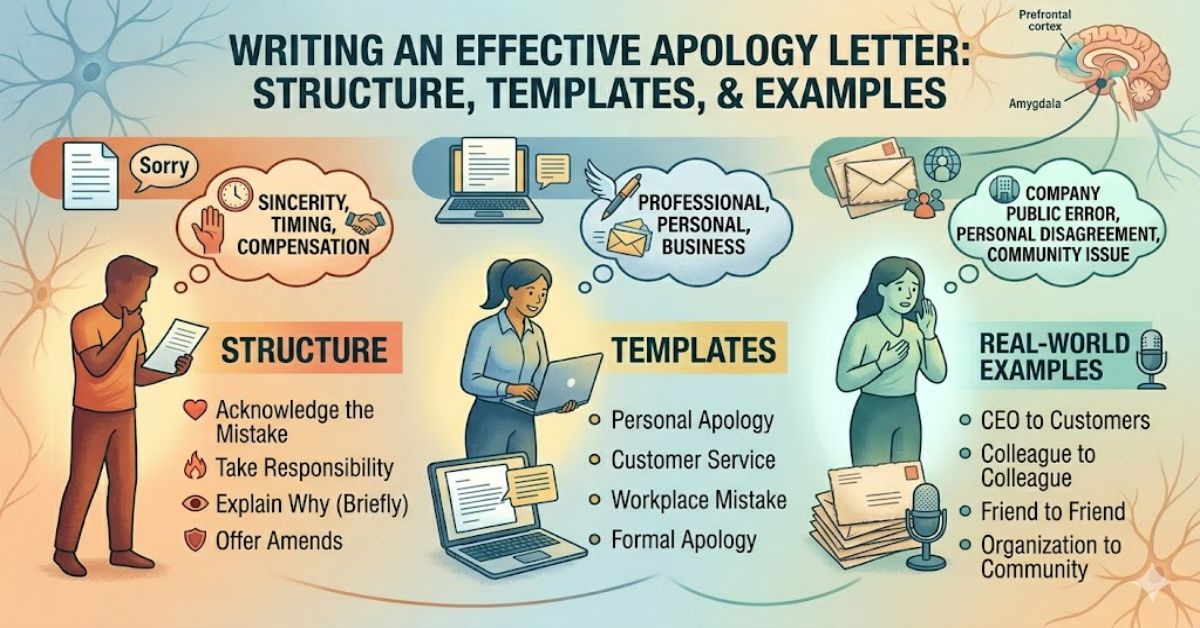
This guide breaks down how to construct an apology letter that meets those standards. It includes templates for different scenarios, structured tables for clarity, and analysis of what makes apologies succeed or fail in real-world contexts. The focus is practical: how to write something that actually rebuilds trust rather than simply acknowledging fault.
Core Principles of an Effective Apology Letter
A strong apology letter is not improvised—it follows a psychological and communicative structure.
The Five-Element Framework
| Element | Purpose | Example Function |
| Acknowledgment | Identify the mistake | “I understand I missed the deadline.” |
| Responsibility | Accept ownership | “This was my oversight.” |
| Empathy | Validate impact | “I understand this caused frustration.” |
| Repair | Offer solution | “I have already corrected the issue.” |
| Closure | Invite resolution | “I hope we can move forward.” |
This structure ensures the apology letter remains balanced rather than emotionally reactive.
Types of Apology Letters and When to Use Them
Different situations require different tonal adjustments.
| Type | Context | Tone | Risk Level |
| Personal | Relationships, friendships | Emotional, reflective | High emotional sensitivity |
| Professional | Workplace issues | Formal, concise | Reputation impact |
| Academic | Schools, universities | Respectful, structured | Policy consequences |
| Customer service | Service failures | Solution-focused | Brand trust |
Each version of an apology letter still follows the same structural core, but vocabulary and tone shift depending on audience expectations.
How to Write an Apology Letter Step-by-Step
Step 1: Start with a direct acknowledgment
Avoid vague phrasing. State the issue clearly.
Example:
“I am writing to apologise for missing our scheduled meeting on 14 June 2025.”
Step 2: Take full responsibility
Avoid conditional language like “if” or “but.”
Weak: “I’m sorry if you felt ignored.”
Strong: “I take full responsibility for not responding.”
Step 3: Validate the impact
This is where emotional intelligence matters most.
Example:
“I understand this disrupted your plans and caused inconvenience.”
Step 4: Offer corrective action
A credible apology includes repair.
Example:
“I have adjusted my schedule to ensure this does not happen again.”
Step 5: Close respectfully
Keep closure simple and non-demanding.
Example:
“Thank you for your understanding. I hope we can move forward positively.”
Strategic Analysis: Why Apology Letters Work
An effective apology letter functions through three psychological mechanisms:
1. Cognitive clarity
Written structure reduces emotional ambiguity, allowing the recipient to process intent more rationally.
2. Accountability signalling
Direct ownership reduces defensive reactions from the recipient.
3. Emotional validation
Acknowledging impact activates trust repair pathways in interpersonal communication.
In organisational psychology, written apologies are often more effective than verbal ones in formal disputes because they create a permanent reference point.
Common Risks and Trade-Offs
Even well-intentioned apology letters can fail.
Over-explaining the mistake
Excess justification can shift focus away from accountability.
Emotional overcompensation
Overly emotional language may appear insincere or performative.
Under-specifying repair actions
Without corrective steps, the apology lacks credibility.
Timing issues
Delayed apology letters often lose effectiveness because emotional peaks have passed.
Structured Insight Table: Real-World Apology Outcomes
| Scenario | Common Mistake | Effective Adjustment | Outcome |
| Workplace delay | Blaming workload | Direct ownership + timeline fix | Trust recovery |
| Relationship conflict | Emotional defensiveness | Validation + listening | De-escalation |
| Customer complaint | Generic apology | Specific resolution offer | Retention improvement |
| Academic misconduct | Minimisation | Full accountability | Reduced penalty severity |
Original Insight: What Most Apology Guides Miss
1. Language density matters
Shorter apology letters consistently outperform longer ones in corporate settings because they reduce cognitive load on the reader.
2. Emotional mirroring is often overlooked
Mirroring the emotional tone of the recipient (without exaggeration) increases perceived sincerity.
3. Repair actions are weighted more than wording
In most real-world evaluations, the corrective action has more influence on outcome than the phrasing of the apology itself.
Practical Templates for Different Situations
Workplace Apology Template
“I am writing to apologise for [specific issue]. I take full responsibility and understand the impact this has had on [team/client]. I have taken the following steps to correct this: [action]. Thank you for your understanding.”
Personal Apology Template
“I’m sorry for [specific behaviour]. I understand how this made you feel, and I take responsibility. I value our relationship and will ensure this does not happen again.”
Customer Service Template
“We apologise for the inconvenience caused by [issue]. We have now resolved the problem and implemented [fix]. We appreciate your patience and feedback.”
The Future of Apology Letters in 2027
By 2027, apology communication is likely to become more structured in digital environments, particularly in customer service and corporate governance.
Key developments include:
- Increased use of AI-assisted communication drafting in customer relations
- Greater emphasis on accountability documentation in workplace disputes
- Integration of sentiment analysis tools to tailor apology tone
- Expansion of regulatory expectations around consumer communication transparency
However, automation introduces risks. Over-standardised apologies may reduce perceived sincerity if not carefully personalised. Regulatory bodies such as consumer protection agencies are increasingly scrutinising automated communication systems for authenticity and fairness.
Takeaways
- Structure is more important than emotional intensity in an apology letter
- Clear accountability significantly improves trust repair outcomes
- Repair actions carry more weight than wording alone
- Overly long apologies reduce effectiveness
- Context-specific tone adjustments are essential
- Timing strongly influences perceived sincerity
Conclusion
A well-crafted apology letter is not just a formality—it is a structured mechanism for repairing trust. When written correctly, it balances accountability, empathy, and action in a way that allows the recipient to process the message without emotional confusion.
The most effective apologies are not the most emotional or the most detailed. They are the clearest. They acknowledge the issue, take responsibility without hesitation, and provide a credible path forward. In both personal and professional environments, this clarity is what restores confidence.
While communication styles may evolve with technology, the underlying psychology of apology remains consistent. People respond to honesty, structure, and action. Everything else is secondary.
FAQ
What should an apology letter include?
It should include acknowledgment of the mistake, responsibility, empathy for the impact, a corrective action, and a respectful closing statement.
How long should an apology letter be?
Ideally between 150–300 words. Clarity and sincerity are more important than length.
Should you explain yourself in an apology letter?
Only briefly. Over-explaining can weaken accountability and shift focus away from the apology.
Can apology letters be sent by email?
Yes. In most modern professional and personal contexts, email is acceptable and often preferred.
What makes an apology letter effective?
Specificity, accountability, emotional awareness, and clear corrective action.
What should you avoid in an apology letter?
Avoid blame-shifting, vague language, over-apologising, and excessive justification.
Methodology
This article is based on established communication psychology principles, organisational behaviour research, and conflict resolution frameworks commonly used in workplace and interpersonal communication studies. The structure reflects widely accepted best practices in professional writing and behavioural psychology.
Sources Used for Validation
- American Psychological Association (communication and conflict research)
- Harvard Business Review (workplace communication studies)
- NHS communication and emotional regulation resources
- Peer-reviewed organisational behaviour literature
Limitations
Apology effectiveness varies significantly depending on cultural context, personal history, and severity of the situation. This guide provides general frameworks rather than universal rules.
Balanced Perspective
While structured apology letters are effective in many contexts, some interpersonal situations require verbal communication or mediated dialogue instead of written formats.