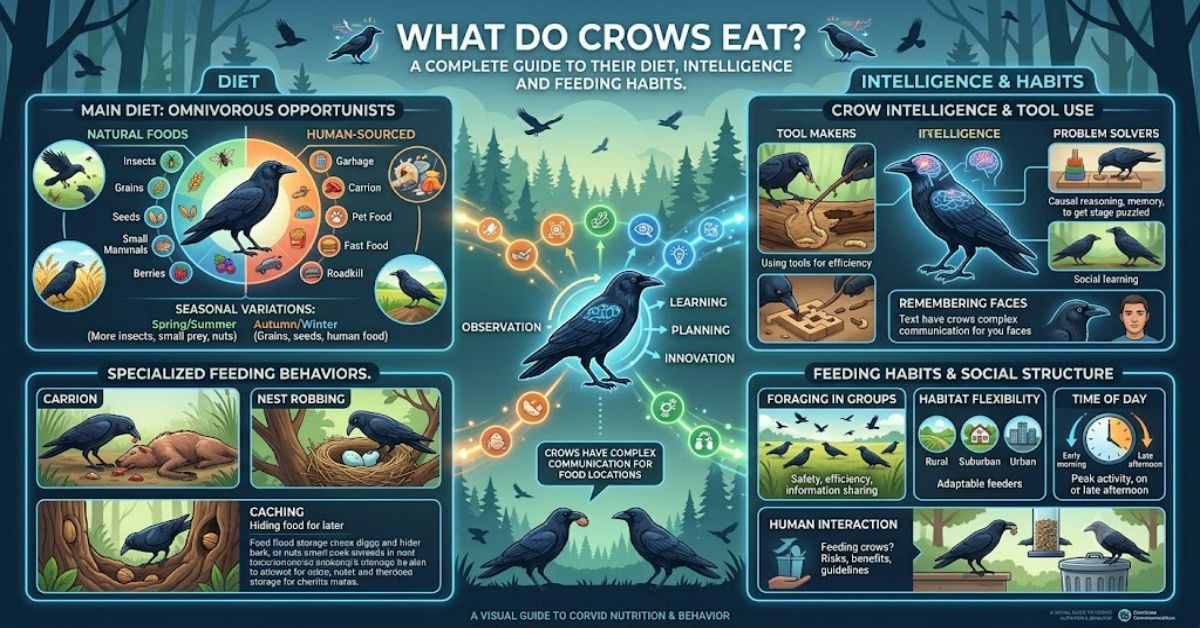
What do crows eat? Crows are smart omnivores that consume an impressive range of foods, from insects and seeds to fruit, small animals, roadkill, and human waste. Their ability to adapt their diet is one of the main reasons they have successfully occupied environments ranging from rural landscapes to crowded cities.
Unlike birds that depend on one specific food source, crows are opportunistic feeders. They analyse their surroundings and adjust their behaviour based on availability. A crow living near farmland may feed on insects and grains, while an urban crow may rely more heavily on discarded food, insects, and small prey.
Crows belong to the Corvidae family, which includes ravens, magpies, and jays. Members of this group are recognised for advanced problem-solving skills, memory, and social learning. Their intelligence directly influences how they find and use food.
Researchers have documented crows using tools, remembering human faces, and planning actions to access food sources. These abilities make their feeding habits particularly interesting for scientists studying animal behaviour.
This guide explores the diet of crows, their feeding strategies, environmental impact, and the relationship between intelligence and survival.
The Diverse Diet of Crows
Crows are classified as omnivores, meaning they eat both plant and animal matter. Their digestive systems and behavioural flexibility allow them to exploit many different food sources.
A typical crow diet may include:
- Insects and larvae
- Seeds and grains
- Fruits and berries
- Eggs and small animals
- Carrion
- Food scraps
- Marine organisms near coastal areas
This dietary flexibility is a major evolutionary advantage. When one food source becomes unavailable, crows can quickly switch to another.
| Food Category | Examples | Importance |
| Animal sources | Insects, mice, eggs, worms | Protein and energy |
| Plant sources | Seeds, nuts, fruit | Seasonal nutrition |
| Human-related sources | Waste, leftovers | Reliable urban food |
| Natural remains | Roadkill, dead animals | Easy access to nutrients |
Do Crows Hunt Other Animals?
Although many people associate crows with scavenging, they are also active hunters.
They may capture:
- Small rodents
- Insects
- Frogs
- Small reptiles
- Young birds
However, hunting behaviour depends on species, location, and available resources.
For example, a crow living near agricultural land may reduce pest populations by consuming insects and rodents. At the same time, crows can sometimes affect smaller bird populations by eating eggs or young chicks.
This creates an ecological balance. Crows provide benefits through pest control and waste removal, but their feeding behaviour can also create challenges for some species.
Why Crows Eat Human Food Waste
Urban environments have created new feeding opportunities for crows. Rubbish bins, food leftovers, and discarded products provide easily accessible calories.
Cities often support larger crow populations because:
- Food is available throughout the year.
- Buildings provide nesting locations.
- Human activity reduces some natural threats.
However, relying heavily on processed human food can create health risks. Foods high in salt, sugar, or artificial ingredients are not ideal for wildlife.
A practical observation from urban wildlife studies is that animals that adapt successfully to cities often trade natural diets for convenience. This can increase survival while changing normal behaviour patterns.
How Intelligence Shapes Crow Feeding Behaviour
One reason crows are successful feeders is their advanced cognitive ability.
Studies have shown that crows can:
- Remember locations of food.
- Use objects as tools.
- Learn from other crows.
- Recognise individual humans.
A famous example comes from research by John Marzluff and colleagues, who demonstrated that American crows could remember human faces associated with threats.
This intelligence changes how crows approach feeding. They do not simply search randomly; they learn patterns in their environment.
For example, a crow may remember:
- Which garden regularly contains food.
- Which rubbish collection day provides opportunities.
- Which humans are safe or dangerous.
Comparing Crow Diets Across Environments
| Environment | Common Foods | Feeding Strategy |
| Urban areas | Waste, insects, leftovers | Opportunistic scavenging |
| Forests | Seeds, insects, eggs | Natural foraging |
| Farmland | Crops, insects, rodents | Mixed feeding |
| Coastal regions | Marine animals, shellfish | Shoreline exploration |
The ability to change diets explains why crows exist across many continents.
Seasonal Changes in Crow Feeding
Crow diets change throughout the year.
During spring and summer, insects become more available, providing valuable protein. Breeding adults often need higher-energy foods to support themselves and their young.
In autumn, crows may consume more:
- Seeds
- Nuts
- Fruits
- Agricultural crops
During winter, when insects and plants become limited, they often rely more on:
- Carrion
- Stored food sources
- Human-associated waste
This seasonal flexibility is one reason crows survive harsh conditions.
The Ecological Role of Crows
Crows influence ecosystems in several ways.
Natural Clean-Up
By eating dead animals, crows help remove organic material from the environment.
Seed Distribution
When crows eat fruit and seeds, they may contribute to plant dispersal.
Population Control
Their consumption of insects and small animals can influence local species populations.
However, their intelligence and adaptability can sometimes create conflicts with humans, especially in areas where large populations gather.
Risks and Challenges of Crow Feeding Habits
Although crows are impressive survivors, their flexible diet creates some problems.
| Risk | Impact |
| Human waste consumption | Exposure to harmful substances |
| Overpopulation in cities | Increased conflicts with people |
| Predation | Pressure on smaller wildlife |
| Dependence on artificial food | Behavioural changes |
One overlooked issue is that urban food availability can change natural selection pressures. Birds that depend heavily on human environments may become less connected to traditional feeding behaviours.
The Future of Crow Diet Studies in 2027
By 2027, research into crow behaviour is likely to continue using advanced tracking technology, artificial intelligence analysis, and ecological monitoring.
Scientists are increasingly interested in how urban wildlife adapts to human environments. Crows provide a valuable case study because they demonstrate how intelligence can influence survival.
Future conservation efforts may focus on managing human-wildlife interactions rather than simply controlling populations.
Understanding feeding behaviour can help communities create healthier relationships with urban wildlife.
Key Takeaways
- Crows eat a wide variety of foods because they are highly adaptable omnivores.
- Their diet includes insects, fruit, seeds, small animals, carrion, and human waste.
- Intelligence plays a major role in how crows locate and remember food sources.
- Urban environments provide opportunities but also create health risks.
- Crows contribute to ecosystems through scavenging and population control.
- Their feeding behaviour demonstrates the connection between intelligence and survival.
Conclusion
Crows are among the most adaptable birds on Earth because they combine intelligence with dietary flexibility. Their ability to eat different foods allows them to survive across forests, farms, coastlines, and cities.
Their diet reflects their remarkable problem-solving abilities. A crow does not simply consume whatever is nearby; it learns, remembers, and adjusts its behaviour according to circumstances.
While their relationship with humans can sometimes create challenges, crows also provide important ecological benefits. They help clean environments, control certain populations, and demonstrate the complexity of wildlife adaptation.
Studying what crows eat offers a wider understanding of how animals respond to changing environments. Their success is not only about finding food but about using intelligence to make the most of available opportunities.
Frequently Asked Questions
What do crows eat in the wild?
Wild crows eat insects, seeds, fruits, small animals, eggs, and carrion depending on what is available in their environment.
Do crows eat meat?
Yes. Crows eat small animals and scavenged meat, including remains of dead animals.
Can crows eat human food?
Crows can eat many human foods, but processed foods are not healthy for them and should not become their main diet.
Do crows eat other birds?
Crows may eat eggs or young birds, although this behaviour depends on location and food availability.
Why are crows successful in cities?
Their intelligence, memory, and ability to adapt their diet help them survive in urban environments.
Do crows store food for later?
Yes. Some crow species hide food and remember storage locations for future use.
Methodology
This article was developed using established ornithology research, wildlife studies, and behavioural science sources. Information was gathered from recognised scientific organisations and academic research examining crow intelligence and feeding behaviour.
Limitations include differences between crow species and regional environments. A crow’s diet varies significantly depending on habitat, season, and human influence.
This article was drafted with AI assistance and requires human editorial review to verify scientific claims and references before publication.
References (APA Style)
Marzluff, J. M., & Angell, T. (2023). Gifts of the Crow: How Perception, Emotion, and Thought Allow Smart Birds to Behave Like Humans. Simon & Schuster.
National Audubon Society. (2024). American Crow: Behaviour, habitat and ecology. Audubon.
Royal Society for the Protection of Birds. (2024). Crows and other corvids: Behaviour and identification. RSPB.
Internal Linking Note: Relevant RubbleMagazine.co.uk internal links should be added after checking live wildlife and nature-related articles on the website.