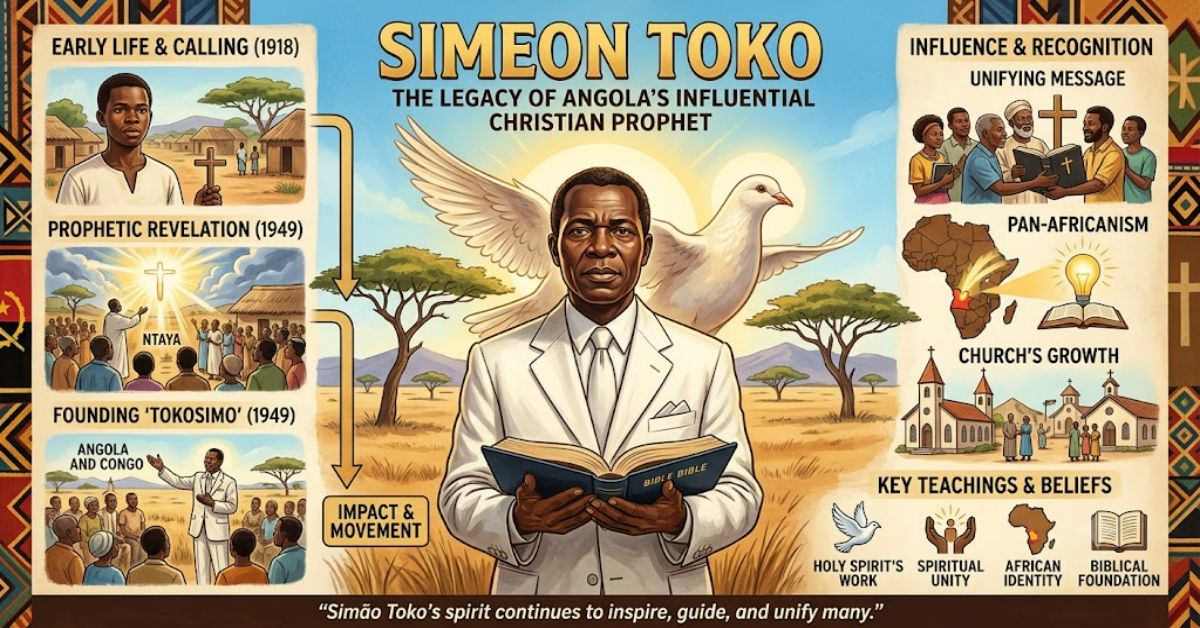
Simeon Toko, born Simão Gonçalves Toko, remains one of the most respected religious figures in Angola’s history. Known as a Christian prophet, healer, and socio-religious leader, he established the Tokoist movement, officially known as the Church of Christ in Angola (Igreja de Cristo em Angola). His message of faith, peace, and spiritual renewal inspired thousands during a difficult period marked by Portuguese colonial rule.
Unlike political revolutionaries, Toko encouraged spiritual transformation as the foundation for social change. His followers believed that religious identity could strengthen communities facing discrimination and injustice. Today, decades after his death, his influence continues through churches, annual commemorations, and historical research that recognises his contribution to Angola’s cultural identity.
Early Life and Religious Background
Simão Gonçalves Toko was born on 24 February 1918 in northern Angola. He grew up during a period when Portuguese colonial authorities exercised strict political and cultural control over the region.
As a young man, he became involved with Protestant Christian communities, where he developed a deep understanding of the Bible and Christian teachings. His faith soon became closely connected with the belief that African Christians could build independent churches while maintaining biblical principles.
This conviction would later become the foundation of the movement that bears his name.
The Birth of the Tokoist Movement
The Tokoist movement began in the late 1940s after Toko and his followers experienced what they described as a powerful spiritual awakening.
His preaching focused on:
- Prayer and repentance
- Spiritual healing
- Christian unity
- Peaceful worship
- Hope during oppression
Thousands of believers gathered around his message, seeing it as both a spiritual revival and an affirmation of Angolan dignity.
The movement quickly attracted attention from colonial authorities, who viewed any large independent African organisation with suspicion.
Simeon Toko Under Portuguese Colonial Rule
Portuguese officials closely monitored independent religious groups throughout Angola.
Although Toko promoted peaceful worship rather than armed resistance, colonial authorities feared that his growing influence could encourage broader demands for social and political change.
As a result, he experienced surveillance, restrictions, and periods of exile.
Many historians argue that these actions unintentionally strengthened the movement. Followers viewed Toko’s perseverance as evidence of his commitment to faith and justice.
| Area | Impact of Simeon Toko |
| Religion | Founded an independent Christian movement |
| Society | Encouraged unity and moral renewal |
| Culture | Strengthened Angolan identity |
| History | Became a symbol of peaceful resistance |
Core Teachings
The popularity of Simeon Toko came largely from his practical approach to Christianity.
His central teachings included:
- Faith supported by daily action.
- Forgiveness instead of violence.
- Prayer as a source of healing.
- Respect for community and family.
- Spiritual equality before God.
His followers believed genuine faith should improve both personal character and community relationships.
The Growth of the Tokoist Church
Despite official restrictions, the church continued expanding throughout Angola and neighbouring countries.
After Angola gained independence in 1975, the Tokoist Church gradually became more visible.
Today it has congregations across:
| Region | Presence |
| Angola | Strong national membership |
| Portugal | Active diaspora communities |
| Democratic Republic of Congo | Regional congregations |
| Other African countries | Smaller church communities |
The church remains one of Angola’s recognised Christian denominations.
Cultural and Historical Importance
Simeon Toko’s legacy extends beyond religion.
Many scholars describe the movement as an important expression of African Christianity because it demonstrated that local leadership could establish enduring Christian institutions while respecting African cultural identity.
His influence also helped preserve community traditions during a period when colonial policies often discouraged indigenous cultural expression.
Today, museums, documentaries, academic conferences, and church celebrations continue to examine his contribution to Angola’s history.
Challenges and Different Perspectives
Like many influential religious leaders, Toko’s legacy has been interpreted in different ways.
Supporters see him primarily as:
- A prophet.
- A healer.
- A defender of peaceful faith.
- A promoter of national dignity.
Some historians focus more on the movement’s social impact than its spiritual claims, examining how independent churches contributed to emerging national consciousness.
These differing interpretations demonstrate the complexity of his historical importance.
The Future of Simeon Toko’s Legacy in 2027
Interest in African religious history continues to grow among universities, historians, and cultural organisations.
By 2027, digital archives, academic research, and heritage projects are expected to make more historical documents relating to Simeon Toko available to international audiences.
The Tokoist Church is also likely to continue expanding educational initiatives that preserve its history while engaging younger generations through digital communication and community outreach.
Although interpretations of his ministry will continue to evolve, his place in Angola’s religious history appears firmly established.
Key Takeaways
- Simeon Toko founded the influential Tokoist movement.
- His teachings promoted peaceful Christian faith and spiritual renewal.
- Colonial authorities viewed the movement with suspicion because of its growing influence.
- The church remains active in Angola and abroad.
- His legacy combines religion, culture, and national identity.
- Academic interest in his life continues to increase.
Conclusion
Simeon Toko occupies a unique place in Angolan history. Through his leadership, he inspired a religious movement that offered hope during colonial rule while encouraging peaceful faith, community unity, and spiritual renewal. Rather than seeking change through violence, he emphasised Christian values, prayer, and moral responsibility.
The Tokoist Church continues to preserve his teachings and remains an important part of Angola’s religious landscape. Historians increasingly recognise his contribution not only as a religious leader but also as a figure who strengthened cultural confidence during a challenging period of African history.
His legacy reminds us that faith can influence society in lasting ways. Whether viewed from a religious, historical, or cultural perspective, Simeon Toko remains one of Angola’s most significant spiritual leaders.
Frequently Asked Questions
Who was Simeon Toko?
Simeon Toko, born Simão Gonçalves Toko, was an Angolan Christian prophet and founder of the Tokoist Church.
What is the Tokoist movement?
It is an independent Christian movement founded by Simeon Toko that emphasises prayer, spiritual healing, peace, and Christian unity.
Why is Simeon Toko important?
He played a major role in strengthening Christian faith and Angolan cultural identity during Portuguese colonial rule.
Is the Tokoist Church still active?
Yes. The church continues to operate in Angola and several other countries with active congregations.
What was Simeon Toko’s message?
His teachings focused on faith in God, repentance, forgiveness, peaceful living, and spiritual renewal.
Methodology
This article is based on established historical information about Simão Gonçalves Toko, scholarly works on African Christianity, and publicly available historical records concerning the Tokoist movement. Interpretations of his religious significance may vary among historians and faith communities.
Editorial Disclosure: This article was drafted with AI assistance and should be fact-checked against primary historical sources before publication.