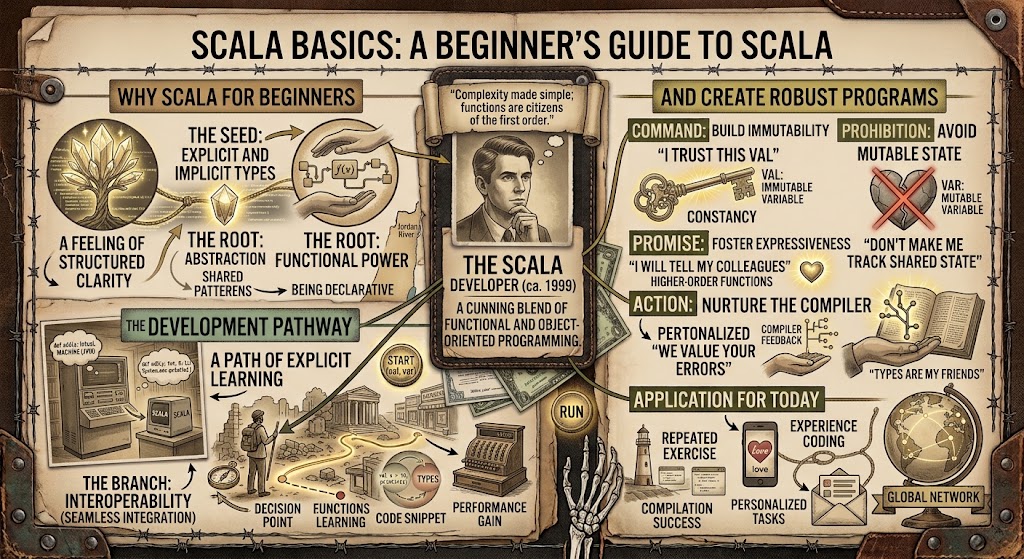
Scala basics start with understanding what makes the language different from more familiar programming languages. Scala, short for Scalable Language, is a modern, statically typed programming language that runs primarily on the Java Virtual Machine (JVM). It combines object-oriented programming (OOP) with functional programming (FP), allowing developers to use classes and objects alongside functions, immutable data, pattern matching and higher-order abstractions. The official Scala documentation describes it as a concise, expressive language that supports both programming paradigms and interoperates with Java.
Scala was created by Martin Odersky and has developed into a language used for server-side applications, distributed systems, data processing and other JVM-based software. Its relationship with Java is particularly important. Scala applications can use Java libraries, while Scala code can coexist with Java code in the same broader ecosystem.
For beginners, however, Scala can initially feel unusual.
Its syntax is compact. Types can often be inferred. Functions can be treated as values. Collections provide functional operations such as map and filter. Pattern matching can replace long chains of conditional logic.
These features make Scala powerful, but they also introduce concepts that beginners must learn properly rather than simply memorising syntax.
The most useful way to approach the language is therefore to understand its underlying model first. Once variables, expressions, types, functions, collections and pattern matching make sense, the more advanced parts of Scala become considerably easier to follow.
What Is Scala?
Scala is a general-purpose programming language designed around a combination of functional and object-oriented programming.
The language was created by Martin Odersky and first released publicly in the early 2000s. Its name comes from “scalable language”, reflecting the idea that the language should support both relatively small programs and large software systems.
Scala’s official documentation identifies several core characteristics:
- Static typing.
- Object-oriented programming.
- Functional programming.
- Concise syntax.
- An expressive type system.
- JVM execution.
- Java interoperability.
- Immutable collection support.
- Higher-order functions.
- Pattern matching.
Scala therefore occupies an interesting position between traditional enterprise programming and functional programming.
Java developers can use familiar object-oriented concepts, while developers interested in functional programming can work with immutable values, pure functions and higher-order functions.
This combination is one of the central ideas behind the language.
Scala Basics: Understanding the Core Syntax
Scala’s syntax is designed to express common programming operations with relatively little code.
A simple Scala program might look like this:
@main def hello(): Unit = println("Hello, Scala!")The syntax differs from Java in several ways.
Scala 3 supports significant indentation, so braces are often unnecessary. The @main annotation provides a straightforward way to define an entry point. The language also allows developers to omit certain pieces of syntax when the compiler can infer them safely.
Variables are commonly defined using val and var.
val name = "Alex"var age = 25A val represents an immutable reference, while a var can be reassigned.
For example:
val country = "United Kingdom"The value associated with country cannot simply be reassigned.
This preference for immutable values is central to functional programming in Scala. It can make code easier to reason about because developers have fewer changing states to track.
Understanding Scala’s Type System
One of the most important Scala basics is the type system.
Scala is statically typed. This means the compiler checks types before a program runs.
For example:
val age: Int = 30val name: String = "Sam"val active: Boolean = trueScala can often infer the type without requiring the programmer to write it explicitly:
val age = 30val name = "Sam"The compiler understands that age is an Int and name is a String.
This provides an important balance.
Developers receive the safety benefits of static typing without having to annotate every expression manually.
The official Scala Tour explains that the type system supports features including generic classes, variance annotations, type bounds and other advanced abstractions.
For beginners, the key lesson is simpler: Scala allows concise code without abandoning compile-time type checking.
Functions Are Central to Scala
Functions are one of the biggest differences beginners encounter.
In Scala, functions are values. They can be stored in variables, passed to other functions and returned from functions.
A basic function can be written as:
def add(a: Int, b: Int): Int = a + bA function can also be assigned to a value:
val double = (x: Int) => x * 2The expression:
x => x * 2is a function literal.
This becomes especially useful with collections.
For example:
val numbers = List(1, 2, 3, 4)val doubled = numbers.map(x => x * 2)Scala also supports a shorter form:
val doubled = numbers.map(_ * 2)The result is:
List(2, 4, 6, 8)The official Scala documentation uses this style to demonstrate how higher-order functions can replace more verbose imperative loops.
Functional Programming in Scala
Functional programming is one of Scala’s defining characteristics.
The approach generally emphasises:
- Immutable data.
- Pure functions.
- Functions as values.
- Expressions that return values.
- Transformations rather than repeated mutation.
- Explicit handling of effects and errors.
Consider a traditional loop that modifies a variable.
A functional approach can instead transform a collection into a new collection.
val numbers = List(1, 2, 3, 4, 5)val evenNumbers = numbers.filter(_ % 2 == 0)The result is:
List(2, 4)Nothing needs to be manually updated inside a loop.
Scala does not force developers to write purely functional programs. It supports object-oriented, functional and hybrid approaches. That flexibility is one reason the language can accommodate different programming styles.
The practical challenge is knowing when each approach is appropriate.
Object-Oriented Programming in Scala
Scala is also strongly object-oriented.
Classes, traits and objects provide ways to model software components and domain concepts.
For example:
class User(val name: String, val age: Int)A more Scala-oriented design might use a case class:
case class User(name: String, age: Int)Case classes are particularly useful for modelling data.
Scala’s object-oriented model also makes extensive use of traits.
A trait can define shared behaviour or an interface:
trait Printable: def printInfo(): UnitA class can then implement the trait.
The Scala documentation identifies traits as an important tool for decomposition and modular design.
This gives Scala developers a useful middle ground between conventional class-based architecture and functional composition.
Pattern Matching
Pattern matching is another feature that belongs high on the list of Scala basics.
It allows a program to compare a value against different patterns.
For example:
val number = 2number match case 1 => "One" case 2 => "Two" case 3 => "Three" case _ => "Other"Pattern matching becomes particularly useful when working with algebraic data types, case classes and structured data.
For example:
case class Customer(name: String, age: Int)def describe(customer: Customer): String = customer match case Customer(name, age) if age >= 18 => s"$name is an adult" case Customer(name, _) => s"$name is under 18"This style can make complex decision logic easier to structure.
It is also closely connected to Scala’s functional programming capabilities.
Scala Collections
Collections are an essential part of everyday Scala programming.
Common collection types include:
| Collection | Typical purpose | Example |
| List | Ordered immutable sequence | List(1, 2, 3) |
| Vector | Indexed immutable sequence | Vector(1, 2, 3) |
| Set | Unique values | Set("A", "B") |
| Map | Key-value associations | Map("UK" -> "London") |
| Array | Mutable indexed data structure | Array(1, 2, 3) |
The standard library provides functional operations such as:
mapfilterflatMapfoldfindexistsThese methods allow developers to describe transformations clearly.
For example:
val prices = List(10, 20, 30)val discounted = prices.map(_ * 0.9)This produces a new collection instead of changing the original list.
The official Scala documentation notes that immutable collections and functional collection methods are important parts of Scala’s functional programming model.
Scala 2 vs Scala 3
One of the most important practical considerations for anyone learning Scala today is the distinction between Scala 2 and Scala 3.
Scala 3 is not merely a cosmetic update. The language received substantial changes to its type system, syntax, contextual abstractions and metaprogramming model. The official documentation describes Scala 3 as a complete overhaul of the language’s foundations.
The current Scala release page lists Scala 3.8.1, released on 22 January 2026.
| Area | Scala 2.13 | Scala 3 |
| Main language generation | Mature Scala 2 line | Current Scala 3 line |
| Type system | Powerful | Redesigned and strengthened |
| Syntax | Traditional Scala syntax | Simplified syntax available |
| Contextual abstractions | Implicits | Given/using model |
| Metaprogramming | Scala 2 macros | New metaprogramming system |
| Migration | Existing projects | Designed to support gradual migration |
| JVM support | Yes | Yes |
The migration is helped by compatibility between Scala 2.13 and Scala 3. Official documentation states that Scala 2.13 and Scala 3 share the same ABI, allowing certain combinations of compiled code to work together.
However, compatibility does not mean that every Scala 2 project can be converted automatically.
Macro-heavy projects can require substantial work because Scala 3 cannot directly expand Scala 2.13 macros.
That is an important practical limitation for organisations maintaining older Scala systems.
Scala and Java: Why JVM Compatibility Matters
Scala’s relationship with Java is one of its strongest practical advantages.
Scala code compiles to JVM-compatible artefacts and can interact with Java libraries. This means organisations do not necessarily need to abandon their existing Java ecosystem when introducing Scala.
The official Scala documentation confirms that Scala applications can use Java classes and libraries and that Scala and Java code can coexist.
This creates several advantages:
- Access to established Java libraries.
- Existing JVM deployment infrastructure.
- Familiar tooling for Java-oriented teams.
- Ability to migrate components gradually.
- Integration with established enterprise systems.
For a development team already operating a large JVM environment, this can substantially reduce the infrastructure barrier to adopting Scala.
The trade-off is that JVM compatibility does not eliminate Scala-specific complexity. Developers still need to understand Scala’s type system, build tools, library versions and ecosystem conventions.
Scala and Apache Spark
One of Scala’s most visible real-world applications is Apache Spark.
Spark is a distributed computing engine used for large-scale data processing, analytics, machine learning and streaming workloads. Its APIs support Scala alongside languages including Java, Python and R.
The connection between Scala and Spark is historically significant because Spark was originally developed in the Scala ecosystem and continues to provide a Scala API.
Current Spark documentation lists Spark 4.2.0 among its stable releases, while the project’s downloads page explains that Spark 4 is pre-built with Scala 2.13.
This creates an important learning opportunity.
Someone studying Scala for data engineering should not treat the language and Spark as completely separate subjects. Understanding collections, functions, transformations and types provides useful conceptual preparation for working with distributed data APIs.
At the same time, local Scala knowledge does not automatically translate into distributed-systems expertise. Spark introduces concepts such as partitions, shuffles, lazy evaluation, cluster execution and fault tolerance.
That distinction is often overlooked by beginners.
Why Scala Can Be Difficult for Beginners
Scala’s strengths can also become learning barriers.
A beginner may start with simple syntax and quickly encounter:
- Generics.
- Higher-order functions.
- Type inference.
- Pattern matching.
- Traits.
- Contextual abstractions.
- Type classes.
- Effect systems.
- Implicits in older Scala code.
- Functional error handling.
- Build configuration.
The language therefore has a relatively shallow surface and a deep underlying model.
This creates an important insight: short Scala code does not necessarily mean simple Scala code.
A five-line expression may rely on type inference, higher-order functions, implicit or contextual parameters and library abstractions that a beginner has never encountered.
The best learning strategy is consequently progressive rather than syntax-first.
A Practical Learning Path for Scala
A sensible progression looks like this:
| Stage | What to learn | Why it matters |
| 1 | Variables and expressions | Basic language structure |
| 2 | Types and type inference | Compile-time safety |
| 3 | Functions | Core Scala programming style |
| 4 | Collections | Everyday data transformation |
| 5 | Pattern matching | Structured decision-making |
| 6 | Case classes and traits | Domain modelling |
| 7 | Error handling | Reliable application behaviour |
| 8 | Build tools and dependencies | Real project development |
| 9 | Concurrency and effects | Production systems |
| 10 | Scala ecosystem | Specialisation and professional work |
This approach avoids one common mistake: attempting advanced functional programming before understanding basic types and functions.
RubbleMagazine’s existing basic coding concepts guide also provides useful groundwork for learners who need to strengthen variables, data types, functions and control structures before moving into a language such as Scala.
Three Practical Insights About Learning Scala
The JVM is an advantage, but it is not the whole story
Scala’s ability to use Java libraries is valuable, particularly for established organisations. However, developers still need to understand Scala-specific dependency management and binary compatibility.
Scala libraries are commonly published for particular Scala versions. The distinction between artefacts such as _2.13 and _3 can become important when managing dependencies.
The official migration documentation shows that Scala 3 can consume many Scala 2.13 artefacts during migration, but it also warns about dependency conflicts and macro limitations.
This means JVM interoperability reduces one barrier but does not remove ecosystem management.
Immutability changes how developers think
A second insight is that learning Scala well requires a shift in problem-solving style.
A beginner familiar with mutable loops may initially ask:
“How do I change this variable repeatedly?”
Scala’s functional style encourages another question:
“How can I transform this value into the result I need?”
That difference becomes significant in larger programs because immutable data can reduce the number of state changes developers must track.
Scala 3 migration is a technical project, not a simple version update
The third insight concerns existing organisations.
Scala’s official migration tools can automate or assist with some syntax, dependency and type changes. The sbt-scala3-migrate workflow includes commands for migrating dependencies, compiler options, syntax and types.
But the existence of migration tooling should not be interpreted as proof that every project migration is easy.
Projects using macros, compiler plugins or older ecosystem dependencies can require additional engineering effort.
The sensible approach is to assess dependencies before setting a migration timetable.
Risks and Trade-Offs
Scala provides considerable expressive power, but that power comes with costs.
Learning curve: Beginners may encounter advanced abstractions earlier than expected.
Build complexity: Large Scala projects can involve significant dependency and build configuration.
Ecosystem versioning: Scala 2 and Scala 3 dependencies must be managed carefully.
Migration cost: Older applications may require work before they can move fully to Scala 3.
Over-abstraction: Developers can write extremely abstract Scala code that is elegant to specialists but difficult for less experienced team members to maintain.
Hiring considerations: Organisations need developers who understand not only Scala syntax but also the libraries, architectural patterns and operational environment surrounding it.
These trade-offs do not make Scala unsuitable. They simply mean that the language tends to reward teams that establish clear coding standards and maintain a strong understanding of their dependencies.
For organisations evaluating other JVM technologies, the key question is therefore not whether Scala can technically perform a task. It is whether its programming model matches the team’s skills, architecture and maintenance requirements.
The Future of Scala Basics in 2027
Scala’s future is likely to remain tied to the broader JVM ecosystem, functional programming, backend development and data-intensive applications.
Scala 3 continues to evolve, while official documentation provides migration paths for organisations moving from Scala 2.13. The language’s compatibility strategy is particularly important because it allows some organisations to migrate applications incrementally rather than treating the process as a complete rewrite.
Apache Spark also remains an important part of the picture. Spark 4.2.0 was released in July 2026, and the current project documentation continues to list Scala as one of its supported programming languages.
The more uncertain question is how widely new application development will choose Scala compared with Java, Kotlin, Python and other languages.
That means the strongest 2027 case for Scala is unlikely to be universal adoption.
Instead, its value is likely to remain concentrated in environments where its combination of static typing, functional programming, JVM access, expressive abstractions and mature data-processing integrations provides a meaningful engineering advantage.
For learners, this makes Scala a specialist skill worth understanding rather than a language that must be treated as the default choice for every project.
Key Takeaways
- Scala combines two programming paradigms. Developers can use functional and object-oriented approaches within the same language.
- Static typing is a core strength. The compiler checks types while type inference keeps many programs concise.
- Functions and immutable collections are central. Learning
map,filter, higher-order functions and immutable values is important for becoming comfortable with Scala. - Scala 3 matters for new learners. Current documentation and releases centre on Scala 3, although Scala 2.13 remains important for existing systems and compatibility.
- Java interoperability reduces migration barriers. Existing JVM libraries and infrastructure can be used from Scala.
- Spark gives Scala practical relevance in data engineering. However, learning Scala alone does not teach distributed computing.
- The biggest challenge is complexity. Concise syntax can conceal sophisticated type-system and abstraction concepts.
Conclusion
Scala is a distinctive programming language because it does not force developers to choose between object-oriented and functional programming. It combines both approaches with static typing, concise syntax and access to the Java ecosystem.
For beginners, the most important Scala basics are not obscure language tricks. They are variables, types, functions, collections, immutability, pattern matching, classes and traits. These concepts establish the foundation needed to understand more advanced Scala applications.
Scala 3 has also changed the language substantially, introducing redesigned contextual abstractions, stronger type-system features and a new metaprogramming approach. Its compatibility with Scala 2.13 provides a practical migration path, although older projects can still face challenges involving macros, plugins and dependencies.
Scala’s role in data processing, particularly through Apache Spark, gives the language continued practical relevance. Its future is less about becoming everyone’s programming language and more about remaining valuable where expressive, typed and functional JVM programming solves genuine engineering problems.
For someone starting today, learning Scala is best approached as learning a programming model rather than simply memorising another syntax.
Frequently Asked Questions
What are Scala basics?
Scala basics are the foundational concepts needed to start programming in Scala. They include variables, types, functions, collections, immutability, classes, traits, pattern matching and basic functional programming.
Is Scala easy for beginners?
Scala can be more challenging than languages designed specifically for beginners because its type system and functional features are powerful. Starting with variables, functions and collections before studying advanced abstractions makes the learning process easier.
Is Scala better than Java?
Neither language is universally better. Scala provides concise syntax and strong functional programming features, while Java offers a large ecosystem and a more familiar object-oriented model for many teams. The right choice depends on the project and development team.
Should I learn Scala 2 or Scala 3?
New learners should generally focus on Scala 3 because it is the current language generation. However, understanding Scala 2.13 remains useful when working with existing applications or libraries because Scala 2.13 continues to appear in production ecosystems and migration scenarios.
Is Scala Basics used for data engineering?
Yes. Scala Basics has a significant relationship with Apache Spark, which provides Scala APIs for distributed data processing, SQL, streaming and machine learning. Current Spark documentation continues to list Scala among its supported languages.
Does Scala Basics run on the JVM?
Yes. Scala code can be compiled for the JVM and can interact with Java classes and libraries. This provides access to a large existing software ecosystem.
How long does it take to learn Scala basics?
The timeframe varies according to previous programming experience. Someone already familiar with Java or another statically typed language may learn the fundamentals relatively quickly, while beginners need additional time to understand functional programming, types and collections.
Methodology
This article was researched using official Scala documentation, the Scala 3 migration documentation, current Scala release information and Apache Spark’s official documentation. These sources were prioritised because they provide primary information about the language, its current releases, compatibility model and ecosystem.
Real-world authority signals were drawn from documented technology projects rather than invented personal testing. Apache Spark provides a named, publicly documented example of Scala’s use in large-scale data processing, while the official Scala migration documentation provides concrete evidence of how Scala 2.13 and Scala 3 can coexist during migration.
The article Scala Basics does not claim personal experience, private benchmarks or hands-on testing that was not conducted. Examples of Scala code are illustrative and are intended to explain language concepts rather than report experimental performance.
A limitation is that the popularity and commercial demand for programming languages can vary significantly by geography, industry and employer. Scala’s continued technical capabilities should therefore not be interpreted as proof of universal market growth.
The article Scala Basics was drafted with AI assistance and requires human editorial verification before publication. Editors should independently confirm current version numbers, technical claims, references and the author’s credentials before publication.
References
Apache Software Foundation. (2026). Apache Spark documentation. Apache Spark.
Apache Software Foundation. (2026). Apache Spark downloads and supported Scala versions. Apache Spark.
Scala Center. (2026). Scala documentation: Learn Scala. Scala Documentation.
Scala Center. (2026). Scala 3 Book: Scala features. Scala Documentation.
Scala Center. (2026). Tour of Scala. Scala Documentation.
Scala Center. (2026). Why Scala 3? Scala Documentation.
Scala Center. (2026). Scala 3 migration guide: Compatibility reference. Scala Documentation.
Scala Center. (2026). Scala 3 migration guide: Runtime compatibility. Scala Documentation.
Scala Center. (2026). Scala 3.8.1. The Scala Programming Language.
Scala Center. (2026). Scala for Java developers. Scala Documentation.
Scala Center. (2026). Functional programming in Scala. Scala Documentation.
Scala Center. (2026). Object-oriented programming and domain modelling in Scala 3. Scala Documentation.