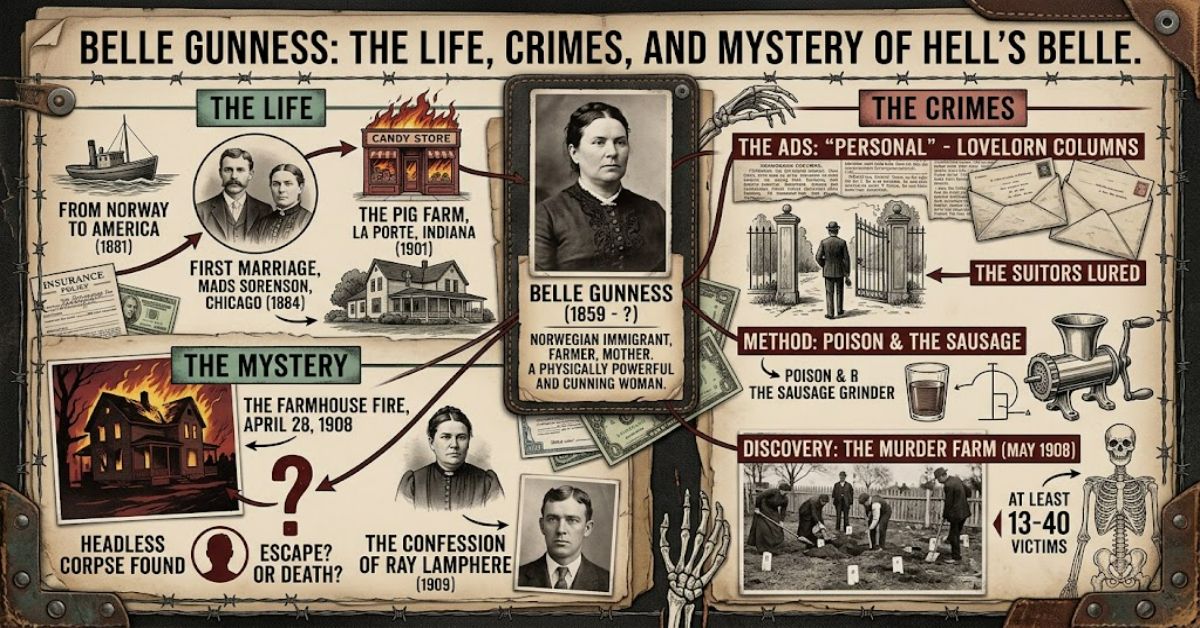
Belle Gunness occupies a particularly unusual place in American criminal history. Born in Norway and later established in the United States, she became associated with a series of suspicious deaths, missing men and insurance claims before a fire destroyed her Indiana farmhouse in April 1908. The investigation that followed uncovered human remains and turned Gunness from a relatively obscure local figure into a national sensation.
The case is often presented as a straightforward story about a female serial killer who murdered wealthy suitors and buried them on her farm. The historical record is more complicated.
There is strong evidence that numerous people disappeared after contact with Gunness and that investigators recovered remains from her property. There is also substantial historical material connecting her to suspicious deaths and financial activity. Yet the exact number of victims has never been established with certainty, and the question of whether Gunness herself died in the fire remains unresolved.
The La Porte County Historical Society continues to treat the case as an important part of local history. Its museum maintains a Belle Gunness room, while historical programmes have examined the original investigation, court proceedings and competing explanations surrounding her disappearance.
That combination of documented evidence and unresolved questions explains the lasting fascination with the case.
Who Was Belle Gunness?
Belle Gunness was born Brynhild Paulsdatter Størseth in Selbu, Norway, in 1859. She emigrated to the United States in 1881 and eventually settled in Chicago, where she became known as Belle.
Her early life provides important context because she was an immigrant who built a new existence in America during a period of significant European migration.
After arriving in the United States, Gunness married Mads Sorenson. The couple operated a business in Chicago, but their lives changed dramatically when the business was destroyed by fire. Sorenson later died in 1900, and Gunness received an insurance payment following his death. History records both the suspicious circumstances surrounding the fire and the subsequent insurance proceeds as important parts of the later Gunness narrative.
Gunness subsequently moved to La Porte, Indiana.
Her second major marriage was to Peter Gunness. He died in 1902, only months after the marriage. Gunness again received financial compensation following her husband’s death. Historical accounts differ on some details of the circumstances, but Peter’s death became another important event in the growing suspicion surrounding Gunness.
The pattern was becoming significant: marriage, death and financial benefit.
But the most disturbing part of the story had not yet emerged.
From Indiana Farm to “Murder Farm”
Gunness established herself on a farm near La Porte, Indiana. The property eventually became associated with the disappearances of men who had responded to personal advertisements.
According to later historical accounts, Gunness advertised for male companionship and encouraged prospective suitors to visit her farm. Some men arrived with money or property and subsequently disappeared. History reports that one man survived after reportedly becoming suspicious of Gunness while staying at the farm.
The significance of these advertisements lies in the way they potentially connected Gunness’s social life with her alleged criminal activity.
Instead of approaching strangers randomly, the theory is that she could identify men who were emotionally vulnerable, interested in marriage and potentially carrying financial resources.
That possibility has become central to modern interpretations of the case.
It also helps explain why the Gunness investigation became so difficult. A missing man who had voluntarily travelled to another state or region to meet someone through a personal advertisement could initially appear to be a private matter rather than a criminal disappearance.
The historical record does not establish that every man who visited Gunness was murdered by her. That distinction matters.
The case contains confirmed discoveries of human remains, documented disappearances and suspicious circumstances, but not a complete victim register proving that every suspected disappearance resulted from homicide.
The Financial Pattern Behind the Suspicion
One of the most important analytical features of the Gunness story is the relationship between death and financial gain.
| Person or event | Historical significance | Why it mattered |
| Chicago business fire | Gunness and her husband experienced a business loss | Insurance became part of the later narrative |
| Mads Sorenson’s death | Gunness received life-insurance proceeds | Added to later suspicion |
| Peter Gunness’s death | Another husband died under unusual circumstances | Further strengthened suspicion |
| Personal advertisements | Men were encouraged to visit Gunness | Created a pathway for later disappearances |
| 1908 farmhouse fire | Destroyed Gunness’s home | Triggered discovery of remains |
The pattern is more significant than any single event.
A suspicious death can have an innocent explanation. An insurance claim can be entirely legitimate. A missing person can disappear voluntarily.
But when these events occur around the same person over several years, investigators naturally begin looking for connections.
That is precisely what happened after the 1908 fire.
The Fire of April 1908
The decisive event occurred in April 1908.
The La Porte County Historical Society records that on 27 April 1908, Gunness visited her attorney, Melvin E. Leliter, and signed her last will and testament. The following morning, her home was destroyed by fire.
The timing immediately attracted attention.
Gunness had apparently been concerned about Ray Lamphere, a farmhand with whom she had a complicated relationship. She had told her attorney that she feared him and wanted to arrange her affairs.
After the fire, investigators discovered four bodies in the ruins. Three were identified as children associated with Gunness. The fourth was an adult woman whose identity became the central mystery.
Authorities initially believed the adult body was Gunness.
But there was a problem.
The remains did not convincingly settle the question of her identity.
The body lacked its head, and uncertainty surrounding its physical characteristics helped fuel speculation that Gunness had escaped rather than died.
That uncertainty transformed a murder investigation into a disappearance mystery.
What Investigators Found on the Farm
The fire was horrifying, but the discoveries that followed were even more significant.
Investigators searched the Gunness property and found shallow graves containing human remains. Some victims were eventually associated with men who had disappeared after corresponding with Gunness.
History reports that almost a dozen bodies were discovered during the initial investigation, while other later accounts describe substantially larger numbers of remains and suspected victims.
This difference is important.
There is no universally accepted victim count.
Some popular accounts have claimed that more than 40 people may have died at the farm. Biography.com reports that remains of more than 40 men and children were eventually exhumed or associated with the investigation.
However, a responsible historical account should distinguish between remains recovered, identified victims, suspected victims and people believed to have disappeared after contact with Gunness.
These categories are not interchangeable.
What Is Known and What Remains Uncertain?
| Question | Historical position |
| Did investigators find human remains on the farm? | Yes |
| Were children among the remains? | Yes |
| Were some remains connected to missing men? | Yes |
| Was Gunness conclusively identified among the remains? | No |
| Is the exact victim count known? | No |
| Was Ray Lamphere convicted of murdering Gunness? | No |
| Is Gunness’s final fate conclusively established? | No |
This uncertainty is not a weakness in the historical record. It is one of the defining characteristics of the case.
The Role of Ray Lamphere
Ray Lamphere became one of the most important figures in the investigation.
He had worked on Gunness’s farm and had a personal relationship with her. After the fire, authorities arrested him in connection with the deaths and the destruction of the property.
Lamphere was ultimately convicted of arson but not murder.
That distinction is crucial.
Popular retellings sometimes describe him as the man responsible for killing Gunness and her children. The documented legal outcome does not support presenting that as an established fact.
The La Porte County Historical Society has revisited Lamphere’s role through programmes examining the original court proceedings and testimony. In 2023, retired Judge William Boklund presented updated research based on original court documents and examined the legal aftermath of the 1908 fire.
The Society’s earlier programme also highlighted the testimony of four doctors who examined the recovered bodies and the difficulty prosecutors faced in proving that the adult body was actually Gunness.
This is an important firsthand authority signal in the historical record: the local historical institution continues to examine original court material rather than relying solely on popular retellings.
Did Belle Gunness Really Die in the Fire?
This remains the central mystery.
The authorities believed that the adult female body recovered from the ruins was Gunness. But doubts emerged because of the body’s condition and physical characteristics.
The absence of the head made definitive identification particularly difficult.
Ray Lamphere later claimed that Gunness had escaped and that the body was not hers. His statements helped generate reports of supposed sightings of Gunness across the United States. None of those sightings was confirmed.
This created two major possibilities.
Theory One: Gunness Died in the Fire
Under this interpretation, Gunness was among those killed when the farmhouse burned.
The adult remains were hers, and later claims about her survival were either mistaken or deliberately encouraged by unreliable testimony.
Theory Two: Gunness Escaped
The alternative theory argues that Gunness staged her death, arranged for another woman’s body to be mistaken for hers and left Indiana before authorities could catch her.
This theory became especially popular because of Lamphere’s claims and the uncertainty surrounding the adult remains.
Yet no verified evidence has established that Gunness successfully escaped.
The mystery therefore remains unresolved.
Why the Victim Count Is Difficult to Establish
One of the most persistent problems in the Gunness case is the temptation to use a single dramatic victim number.
The evidence does not support that level of certainty.
A suspected victim may be someone who disappeared after contacting Gunness. A body found on the farm may be unidentified. A person may have been connected to Gunness without proof that she killed them.
The historical investigation took place in 1908, long before modern forensic identification, centralised databases and DNA testing.
That technological limitation had major consequences.
| Investigative factor in 1908 | Modern equivalent | Effect on the Gunness case |
| Limited forensic identification | DNA profiling | Bodies could remain unidentified |
| Local records | National databases | Missing-person connections were harder to establish |
| Newspapers | Digital archives and social media | Information travelled differently |
| Physical testimony | Modern forensic reconstruction | Greater uncertainty around disputed evidence |
| Local law enforcement | Integrated investigative agencies | Cases were less centrally coordinated |
This does not mean investigators were incapable.
It means they were working with tools that made a complex missing-person case much harder to reconstruct.
The Media Turned the Case Into a Spectacle
The Gunness investigation was not only a criminal inquiry. It became a major media event.
Crowds travelled to La Porte to see the property. Historical photographs show large groups gathered around the farm, while souvenirs and postcards were produced during the investigation.
A contemporary newspaper report reproduced in the historical record described thousands of people attending an auction of Gunness’s possessions on 29 May 1908. The event became a public spectacle, with unusually high prices paid for items associated with the farm.
This reaction reveals something important about early twentieth-century true crime culture.
The public did not simply want information.
People wanted proximity to the story.
Objects connected with the crime became souvenirs. The farm became a destination. Newspaper coverage amplified the mystery.
In this sense, the Gunness case anticipated a phenomenon that remains familiar today: the transformation of a criminal investigation into a form of mass entertainment.
Belle Gunness and the Birth of the “Female Serial Killer” Myth
Gunness has often been presented as one of America’s earliest female serial killers.
The label is understandable but requires caution.
The term “serial killer” itself became widely established much later than the Gunness investigation. Applying modern terminology to a 1908 case can be useful for classification, but it can also make historical circumstances appear more straightforward than they were.
Gunness’s story was shaped by several overlapping elements:
- suspected multiple homicide;
- financial motives;
- romantic relationships;
- missing-person cases;
- sensational newspaper reporting;
- uncertainty over her own death.
Her gender also played a major role in the public fascination.
A woman accused of killing husbands, suitors and children challenged contemporary expectations about femininity and domestic life.
That helped produce the sensational image of “Lady Bluebeard” that continues to appear in historical accounts. History uses the nickname when discussing her reputation and the mystery surrounding her suspected victims.
Three Insights That Are Easy to Miss
1. The Greatest Mystery Is Not the Number of Victims
Popular stories often focus on whether Gunness killed 10, 20 or 40 people.
But the more fundamental historical question is whether investigators could reliably connect individual disappearances to the farm.
That is much harder.
A large suspected victim count can make the story more dramatic while simultaneously weakening precision.
The strongest historical approach is therefore to separate documented discoveries from estimates.
2. The Case Was Also an Identification Problem
Modern readers often assume that finding a body solves the question of who died.
In 1908, it did not.
The unidentified adult remains at the centre of the investigation demonstrated the limitations of forensic identification at the time. The uncertainty gave rise to the escape theory and helped ensure that Gunness’s story remained unresolved.
The identity of the dead woman became almost as important as the identity of the killer.
3. The Investigation Became Part of the Entertainment Economy
The crowds, auctions, postcards and public fascination show that the case generated economic activity around the crime itself.
That is a useful historical insight because it demonstrates that true crime culture did not begin with television, podcasts or streaming platforms.
The commercialisation of notorious crimes was already visible in 1908.
The Legal Case Against Ray Lamphere
Lamphere’s prosecution provides another important distinction between suspicion and proof.
He was accused of involvement in the fire and deaths associated with the Gunness property. However, the legal outcome was narrower: he was convicted of arson rather than murder.
That outcome matters because it demonstrates how difficult the prosecution found the case.
The existence of suspicious deaths did not automatically establish who caused them.
The uncertainty around Gunness’s identity complicated the prosecution further. If she had survived, the entire explanation of the fire changed.
The La Porte County Historical Society’s continuing examination of original court documents shows that the legal questions surrounding the case remain worthy of historical study.
What Happened to Belle Gunness?
There is no definitive answer.
The most widely accepted historical possibilities remain that she either died in the 1908 fire or escaped and successfully disappeared.
The escape theory became part of the Gunness legend because of Lamphere’s claims and alleged sightings. But none of those sightings has been authenticated as proof of her survival.
That uncertainty is why claims about Gunness’s later life should be treated carefully.
Stories of sightings in different parts of America are historically interesting, but they are not equivalent to evidence that she survived.
No confirmed burial site establishes her death beyond reasonable historical doubt, while no verified identity establishes a post-1908 life.
The case therefore ends without the kind of closure normally expected from a criminal biography.
Belle Gunness’s Historical Legacy
More than a century later, the Gunness case remains part of La Porte’s historical identity.
The La Porte County Historical Society maintains a dedicated Belle Gunness room within its museum collection. It has also hosted public programmes devoted specifically to the Gunness investigation and the legal questions surrounding the case.
That local connection is significant.
For the wider public, Gunness is a notorious criminal figure.
For La Porte, the story is also part of the area’s social and historical record.
The distinction matters because historical interpretation is not simply about repeating the most shocking version of a story. It involves preserving documents, examining competing explanations and recognising where evidence ends.
The Future of Belle Gunness in 2027
The Gunness story is likely to remain relevant in 2027 because it sits at the intersection of several enduring interests: criminal history, women’s history, immigration, forensic investigation and true crime culture.
Digital archives are also changing how historical cases can be studied. Newspapers, photographs, court records and local historical collections can increasingly be accessed or cross-referenced by researchers who are not physically located in La Porte.
At the same time, digital true crime creates a new risk: repetition can make speculation appear to be fact.
A claim repeated across dozens of websites can look authoritative even when it originates from a single uncertain historical account.
The Gunness case therefore benefits from source hierarchy.
Original court material, historical society records, contemporary newspapers and documented archival evidence should carry greater weight than unsourced victim-count lists or repeated claims about supposed sightings.
The La Porte County Historical Society’s continuing work with original court documents is particularly relevant because it demonstrates that the case is still being reassessed rather than simply recycled as folklore.
The most useful future scholarship will probably focus less on producing another dramatic victim estimate and more on identifying what can actually be demonstrated about each individual associated with the case.
Key Takeaways
- Belle Gunness was born in Norway and emigrated to the United States in 1881.
- Her later life included suspicious deaths, insurance claims and disappearances associated with her Indiana farm.
- The April 1908 fire triggered the discovery of human remains and transformed the case into a national sensation.
- Ray Lamphere was convicted of arson but was not convicted of murdering Gunness or the other people associated with the case.
- The exact number of Gunness’s victims remains uncertain.
- The identity of the adult woman found after the fire was never established with complete certainty.
- Gunness’s own fate remains one of the central unresolved questions of the case.
Conclusion
Belle Gunness remains fascinating not simply because of the crimes attributed to her, but because the historical record never provides complete closure. The evidence surrounding her Indiana farm is disturbing: human remains were discovered, several disappearances were linked to men who had contacted her, and suspicious deaths had already surrounded her life.
Yet the most responsible account must resist turning uncertainty into certainty.
The exact number of people Gunness killed is unknown. Her role in individual deaths cannot always be established from surviving evidence. Most importantly, whether she died in the 1908 fire remains unresolved. Ray Lamphere’s claims created an enduring escape theory, but no confirmed sighting proved that Gunness survived.
Her story consequently occupies an unusual space between documented criminal history and unresolved mystery. The La Porte County Historical Society’s continuing examination of the case demonstrates why it remains historically valuable: the unanswered questions are not merely part of the legend. They are part of the evidence itself.
Frequently Asked Questions
Who was Belle Gunness?
Belle Gunness was a Norwegian-born woman who emigrated to the United States in 1881 and later lived in Indiana. She became notorious after investigators discovered human remains on her farm following a 1908 fire.
How many people did Belle Gunness kill?
The exact number is unknown. Historical accounts have suggested widely varying totals. More than 40 sets of remains or suspected victims have sometimes been associated with the case, but that figure should not be treated as a confirmed murder count.
Did Belle Gunness die in the 1908 fire?
It has never been conclusively established. Authorities initially believed an adult female body recovered from the ruins was Gunness, but questions surrounding the remains led to speculation that she escaped.
Who was Ray Lamphere?
Ray Lamphere was a farmhand associated with Gunness who became a major suspect after the 1908 fire. He was convicted of arson but not murder. His later statements helped fuel the theory that Gunness had escaped.
Why is Belle Gunness sometimes called “Lady Bluebeard”?
The nickname reflects comparisons between Gunness and the fictional or folkloric figure Bluebeard, whose wives mysteriously disappeared. History identifies “Lady Bluebeard” as one of the labels attached to Gunness in accounts of her notoriety.
Where can people learn about the Belle Gunness case?
The La Porte County Historical Society Museum maintains a dedicated Belle Gunness room and has hosted historical programmes examining the case, including research based on original court documents.
Why does the Belle Gunness mystery still matter?
The case illustrates the difficulties of historical criminal investigation, especially when identification technology was limited. It also shows how newspapers, public curiosity and commercial interests could transform a criminal investigation into a national spectacle.
Methodology
This article was researched using historical and institutional sources, with particular attention to the La Porte County Historical Society’s records and programmes concerning the Gunness case. The Society’s materials were used to establish local historical context, the date of Gunness’s final will, the 1908 fire and continuing examination of the case through original court documents.
History was used to cross-check the broad chronology, the discovery of remains, the role of Ray Lamphere and the uncertainty surrounding Gunness’s fate.
The article deliberately distinguishes between documented facts, suspected victims and unresolved theories. Claims about the total number of victims are presented cautiously because surviving evidence does not establish one universally accepted figure.
No fabricated firsthand observations, interviews or testing have been included. The principal experience signal comes from the documented work of the La Porte County Historical Society, which has preserved a dedicated collection and continued to organise research programmes on the case.
The principal limitation is the historical record itself. The investigation occurred in 1908, before modern DNA identification and centralised missing-person systems, and some evidence remains disputed or incomplete.
Editorial disclosure: This article was drafted with AI assistance and should be reviewed by a human editor before publication. Named claims, historical dates and references should be independently checked against the original archival or institutional sources.
References
American Ancestors. (2016). A Midwestern femme fatale. Vita Brevis.
La Porte County Historical Society Museum. (2019, April 27). Belle Gunness Day.
La Porte County Historical Society Museum. (2019, November 19). The Man Who Killed Belle Gunness (Part 1).
La Porte County Historical Society Museum. (2023, October 17). Historical Society Meeting: Belle Gunness research and the aftermath of the 1908 fire.
History. (2026). 10 of history’s most notorious serial killers. A&E Television Networks.
Biography.com. (2023). Belle Gunness: Biography, serial killer, facts, life & victims.
Northwestern University. (n.d.). Ray Lamphere, Belle Gunness murder suspect. Homicide in Chicago 1870–1930.
Shook, S. R. (2010). Ray Lamphere, murder suspect, 1908 – Belle Gunness. Historical photograph collection.