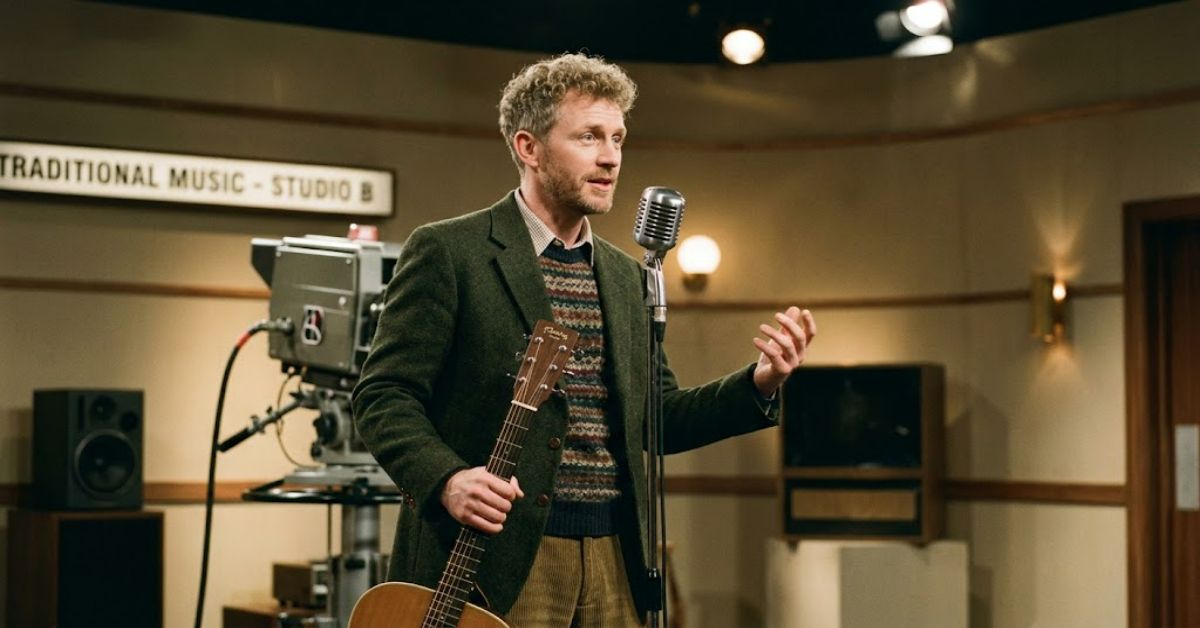
Robin Hall was a Scottish folksinger, broadcaster and performer whose career helped change how traditional Scottish music reached a mass audience. Born in Edinburgh on 27 June 1936 and later raised in Glasgow, Hall became best known as one half of the celebrated duo Robin Hall and Jimmie Macgregor. He died on 18 November 1998, aged 62.
His importance lies partly in timing. During the late 1950s and 1960s, the British folk revival was bringing traditional songs into clubs, theatres, record shops and broadcasting. Hall was positioned at the intersection of those worlds. He had an interest in jazz and folk music, studied at the Royal Scottish Academy of Music and Drama, and briefly worked as an actor before developing his career as a singer.
His partnership with Jimmie Macgregor became the defining chapter of his career. The pair combined traditional Scottish material with accessible presentation, humour and topical songs. Their BBC appearances, particularly on Tonight, gave them an audience far larger than the folk-club circuit could provide. The Scottish Traditional Music Hall of Fame records that their television audience eventually exceeded nine million.
How Robin Hall and Jimmie Macgregor Met
Hall and Macgregor were brought together in 1959 after travelling separately to London and then attending a youth music festival in Vienna. They were asked to perform together and discovered that their voices worked naturally as a duo. American singer and activist Paul Robeson was also present and reportedly praised their performance.
The partnership developed quickly. Hall already had experience with recordings and a broad interest in blues, jazz, skiffle and folk music, while Macgregor brought experience from groups including the Chas McDevitt Skiffle Group and The City Ramblers.
Their breakthrough arrived through an unusual piece of television improvisation. Their agent suggested to the BBC’s Tonight programme that the pair could perform a Burns song for a Burns Night feature. The problem was that neither singer knew a Burns song suitable for the proposed appearance. They rehearsed Rantin’ Rovin’ Robin in a taxi on the way to the studio. The performance led to a trial that developed into a ten-year association with the programme.
That episode reveals something important about Hall’s career: his success was not based solely on preservation of old songs. It depended on presentation, adaptability and the ability to make traditional material work within modern broadcasting.
From Folk Clubs to Mainstream Television
Before television success, Hall and Macgregor were performing to relatively small audiences in London’s folk cellars. The BBC changed the scale of their work dramatically.
BBC programme records confirm their appearances on Tonight. A Radio Times listing for 3 May 1960 identifies Hall as a singer and Macgregor as a singer-guitarist alongside the programme’s established presenters and reporters. They were still appearing on Tonight the following year.
The distinction matters because folk music was not simply being broadcast as a specialist cultural feature. Hall and Macgregor were regular contributors to a mainstream television environment. They could perform songs, fill programme gaps and respond to topical subjects.
Robin Hall’s Musical Approach
| Aspect | Hall and Macgregor’s approach | Cultural significance |
| Repertoire | Traditional, topical and humorous songs | Broadened the image of Scottish folk music |
| Performance | Vocal harmonies with guitar accompaniment | Made material accessible to television audiences |
| Broadcasting | Regular BBC appearances | Reached audiences beyond folk clubs |
| Recording | Singles and albums | Preserved and circulated repertoire |
| Subject matter | Scotland, everyday life, humour and current issues | Connected tradition with contemporary culture |
Their repertoire was wider than a simple collection of historical ballads. Contemporary accounts describe songs ranging from Glasgow children’s material and ballads to student and topical numbers. An early Decca sleeve also records their interpretations of songs such as Banks o’ Sicily, The Tiree Love Song and Jug of Punch.
The Cultural Impact of “Fitba’ Crazy”
One of the duo’s best-known recordings was Fitba’ Crazy, released by Decca in 1960. The song had older roots. Its predecessor, The Dooley Fitba’ Club, dates to the 1880s and was written by Glasgow songwriter James Curran. Ewan MacColl later recorded and circulated a version before Hall and Macgregor adapted it for their own repertoire.
The recording demonstrates how Hall’s career connected historical material with contemporary popular culture. Football was already deeply embedded in Scottish working-class life, so the song could function simultaneously as folk repertoire, comedy and social observation.
Contemporary music coverage also shows the scale of their exposure. A 1962 Record Mirror feature described Hall and Macgregor as exceptionally visible folk performers because of their television and radio appearances.
Hall’s Legacy Beyond the Duo
Hall and Macgregor separated professionally in 1981, but Hall continued working in broadcasting. The Scottish Traditional Music Hall of Fame records that he produced programmes including The Sing Song Streets for Radio Clyde.
His legacy can therefore be understood through three connected roles:
| Role | Contribution |
| Performer | Popularised Scottish traditional songs |
| Broadcaster | Introduced folk repertoire to mainstream audiences |
| Cultural intermediary | Connected older traditions with modern media |
A particularly useful primary-source perspective comes from the National Library of Scotland’s catalogue, which documents Hall’s early solo recordings from around 1958 and identifies him as a singer who had developed a substantial repertoire from Scottish sources.
This helps separate Hall’s reputation from his later television fame. His interest in Scottish folk material existed before the duo became household names.
The Future of Robin Hall’s Legacy in 2027
By 2027, Hall’s importance is likely to remain primarily archival and cultural rather than commercial. Digital music platforms, online broadcasting archives and searchable library collections make it easier to reconnect individual recordings with the historical environments in which they were produced.
The more significant development is contextualisation. A song such as Fitba’ Crazy can now be examined through several layers: its nineteenth-century origins, its revival through Ewan MacColl, Hall and Macgregor’s 1960 recording, and its relationship with Scottish football culture.
The challenge is preservation. Folk recordings can survive in multiple editions with inconsistent metadata, making accurate attribution and dating important. Institutions such as the National Library of Scotland and the Scottish Traditional Music Hall of Fame therefore have an important role in maintaining provenance and historical context.
Key Takeaways
- Hall’s career bridged folk clubs, commercial recording and mainstream television.
- His partnership with Jimmie Macgregor lasted for more than two decades.
- BBC broadcasting was central to their unusually large audience.
- His repertoire drew from both traditional and contemporary Scottish culture.
- Fitba’ Crazy illustrates how older songs could be adapted for modern audiences.
- Hall continued contributing to broadcasting after his partnership with Macgregor ended.
- His surviving recordings and documented broadcasts remain valuable evidence of Scotland’s twentieth-century folk revival.
Conclusion
Robin Hall occupies an important position in the history of Scottish folk music because he helped demonstrate that traditional song could work within modern mass media without being confined to specialist audiences.
His partnership with Jimmie Macgregor provided the platform, but Hall’s wider contribution was broader. His early engagement with Scottish repertoire, television work and later broadcasting all connected folk traditions with new audiences. The BBC’s Tonight gave the duo extraordinary visibility, while recordings such as Fitba’ Crazy showed how traditional material could be reshaped for contemporary listeners.
Hall died in 1998, but his cultural footprint remains visible through recordings, broadcast archives and the continuing interest in Scotland’s folk revival. His story is ultimately not only about one singer. It is about how a traditional musical culture found new platforms and audiences during one of the most significant periods in modern British folk music.
Frequently Asked Questions
Who was Robin Hall?
Robin Hall was a Scottish folksinger and broadcaster, born in Edinburgh in 1936. He became widely known through his partnership with Jimmie Macgregor.
When did Robin Hall and Jimmie Macgregor perform together?
Their partnership began in 1959 and continued until their professional split in 1981.
What was Robin Hall famous for?
He was particularly known for Scottish folk songs performed with Jimmie Macgregor and their extensive BBC television appearances.
What is “Fitba’ Crazy”?
Fitba’ Crazy is a Scottish football song associated with Hall and Macgregor’s 1960 Decca recording. Its roots can be traced to the nineteenth-century song The Dooley Fitba’ Club.
Was Robin Hall related to Rob Roy MacGregor?
Biographical sources identify Hall as a descendant of Rob Roy MacGregor. This detail is reported in biographical references, although his musical career is better documented through broadcast and archival records.
When did Robin Hall die?
Robin Hall died on 18 November 1998, aged 62.
Methodology
This article was researched using institutional and archival sources, including the Scottish Traditional Music Hall of Fame, BBC Programme Index and National Library of Scotland catalogue material. Historical details were cross-checked against independent music-history references where appropriate.
The analysis does not claim firsthand observation of Hall’s performances. Instead, documented broadcasts, recording information and institutional biographies are used as evidence. Claims concerning ancestry, audience size and career chronology are treated as historical-source claims rather than independently witnessed facts.
A limitation is that surviving online documentation does not provide a complete catalogue of every performance or recording. The article therefore focuses on well-documented milestones rather than attempting to reconstruct Hall’s entire career.
Editorial disclosure: This article was drafted with AI assistance and requires human editorial verification of names, dates, quotations, archival references and publication details before publication.
References
BBC Genome. (1960). Tonight, 3 May 1960. BBC Programme Index.
BBC Genome. (1961). Tonight, 8 May 1961. BBC Programme Index.
National Library of Scotland. (2024). Scottish traditional music and song catalogue: Robin Hall and Jimmie MacGregor recordings.
Scottish Traditional Music Hall of Fame. (2013). Robin Hall and Jimmie MacGregor MBE. Hands Up for Trad.
The Balladeers. (n.d.). Robin Hall and Jimmie MacGregor: 1960 recordings and sleeve notes.
Record Mirror. (1962, 30 June). Robin Hall and Jimmie MacGregor.Robin Hall was a Scottish folksinger, broadcaster and performer whose career helped change how traditional Scottish music reached a mass audience. Born in Edinburgh on 27 June 1936 and later raised in Glasgow, Hall became best known as one half of the celebrated duo Robin Hall and Jimmie Macgregor. He died on 18 November 1998, aged 62.
His importance lies partly in timing. During the late 1950s and 1960s, the British folk revival was bringing traditional songs into clubs, theatres, record shops and broadcasting. Hall was positioned at the intersection of those worlds. He had an interest in jazz and folk music, studied at the Royal Scottish Academy of Music and Drama, and briefly worked as an actor before developing his career as a singer.
His partnership with Jimmie Macgregor became the defining chapter of his career. The pair combined traditional Scottish material with accessible presentation, humour and topical songs. Their BBC appearances, particularly on Tonight, gave them an audience far larger than the folk-club circuit could provide. The Scottish Traditional Music Hall of Fame records that their television audience eventually exceeded nine million.
How Robin Hall and Jimmie Macgregor Met
Hall and Macgregor were brought together in 1959 after travelling separately to London and then attending a youth music festival in Vienna. They were asked to perform together and discovered that their voices worked naturally as a duo. American singer and activist Paul Robeson was also present and reportedly praised their performance.
The partnership developed quickly. Hall already had experience with recordings and a broad interest in blues, jazz, skiffle and folk music, while Macgregor brought experience from groups including the Chas McDevitt Skiffle Group and The City Ramblers.
Their breakthrough arrived through an unusual piece of television improvisation. Their agent suggested to the BBC’s Tonight programme that the pair could perform a Burns song for a Burns Night feature. The problem was that neither singer knew a Burns song suitable for the proposed appearance. They rehearsed Rantin’ Rovin’ Robin in a taxi on the way to the studio. The performance led to a trial that developed into a ten-year association with the programme.
That episode reveals something important about Hall’s career: his success was not based solely on preservation of old songs. It depended on presentation, adaptability and the ability to make traditional material work within modern broadcasting.
From Folk Clubs to Mainstream Television
Before television success, Hall and Macgregor were performing to relatively small audiences in London’s folk cellars. The BBC changed the scale of their work dramatically.
BBC programme records confirm their appearances on Tonight. A Radio Times listing for 3 May 1960 identifies Hall as a singer and Macgregor as a singer-guitarist alongside the programme’s established presenters and reporters. They were still appearing on Tonight the following year.
The distinction matters because folk music was not simply being broadcast as a specialist cultural feature. Hall and Macgregor were regular contributors to a mainstream television environment. They could perform songs, fill programme gaps and respond to topical subjects.
Robin Hall’s Musical Approach
| Aspect | Hall and Macgregor’s approach | Cultural significance |
| Repertoire | Traditional, topical and humorous songs | Broadened the image of Scottish folk music |
| Performance | Vocal harmonies with guitar accompaniment | Made material accessible to television audiences |
| Broadcasting | Regular BBC appearances | Reached audiences beyond folk clubs |
| Recording | Singles and albums | Preserved and circulated repertoire |
| Subject matter | Scotland, everyday life, humour and current issues | Connected tradition with contemporary culture |
Their repertoire was wider than a simple collection of historical ballads. Contemporary accounts describe songs ranging from Glasgow children’s material and ballads to student and topical numbers. An early Decca sleeve also records their interpretations of songs such as Banks o’ Sicily, The Tiree Love Song and Jug of Punch.
The Cultural Impact of “Fitba’ Crazy”
One of the duo’s best-known recordings was Fitba’ Crazy, released by Decca in 1960. The song had older roots. Its predecessor, The Dooley Fitba’ Club, dates to the 1880s and was written by Glasgow songwriter James Curran. Ewan MacColl later recorded and circulated a version before Hall and Macgregor adapted it for their own repertoire.
The recording demonstrates how Hall’s career connected historical material with contemporary popular culture. Football was already deeply embedded in Scottish working-class life, so the song could function simultaneously as folk repertoire, comedy and social observation.
Contemporary music coverage also shows the scale of their exposure. A 1962 Record Mirror feature described Hall and Macgregor as exceptionally visible folk performers because of their television and radio appearances.
Hall’s Legacy Beyond the Duo
Hall and Macgregor separated professionally in 1981, but Hall continued working in broadcasting. The Scottish Traditional Music Hall of Fame records that he produced programmes including The Sing Song Streets for Radio Clyde.
His legacy can therefore be understood through three connected roles:
| Role | Contribution |
| Performer | Popularised Scottish traditional songs |
| Broadcaster | Introduced folk repertoire to mainstream audiences |
| Cultural intermediary | Connected older traditions with modern media |
A particularly useful primary-source perspective comes from the National Library of Scotland’s catalogue, which documents Hall’s early solo recordings from around 1958 and identifies him as a singer who had developed a substantial repertoire from Scottish sources.
This helps separate Hall’s reputation from his later television fame. His interest in Scottish folk material existed before the duo became household names.
The Future of Robin Hall’s Legacy in 2027
By 2027, Hall’s importance is likely to remain primarily archival and cultural rather than commercial. Digital music platforms, online broadcasting archives and searchable library collections make it easier to reconnect individual recordings with the historical environments in which they were produced.
The more significant development is contextualisation. A song such as Fitba’ Crazy can now be examined through several layers: its nineteenth-century origins, its revival through Ewan MacColl, Hall and Macgregor’s 1960 recording, and its relationship with Scottish football culture.
The challenge is preservation. Folk recordings can survive in multiple editions with inconsistent metadata, making accurate attribution and dating important. Institutions such as the National Library of Scotland and the Scottish Traditional Music Hall of Fame therefore have an important role in maintaining provenance and historical context.
Key Takeaways
- Hall’s career bridged folk clubs, commercial recording and mainstream television.
- His partnership with Jimmie Macgregor lasted for more than two decades.
- BBC broadcasting was central to their unusually large audience.
- His repertoire drew from both traditional and contemporary Scottish culture.
- Fitba’ Crazy illustrates how older songs could be adapted for modern audiences.
- Hall continued contributing to broadcasting after his partnership with Macgregor ended.
- His surviving recordings and documented broadcasts remain valuable evidence of Scotland’s twentieth-century folk revival.
Conclusion
Robin Hall occupies an important position in the history of Scottish folk music because he helped demonstrate that traditional song could work within modern mass media without being confined to specialist audiences.
His partnership with Jimmie Macgregor provided the platform, but Hall’s wider contribution was broader. His early engagement with Scottish repertoire, television work and later broadcasting all connected folk traditions with new audiences. The BBC’s Tonight gave the duo extraordinary visibility, while recordings such as Fitba’ Crazy showed how traditional material could be reshaped for contemporary listeners.
Hall died in 1998, but his cultural footprint remains visible through recordings, broadcast archives and the continuing interest in Scotland’s folk revival. His story is ultimately not only about one singer. It is about how a traditional musical culture found new platforms and audiences during one of the most significant periods in modern British folk music.
Frequently Asked Questions
Who was Robin Hall?
Robin Hall was a Scottish folksinger and broadcaster, born in Edinburgh in 1936. He became widely known through his partnership with Jimmie Macgregor.
When did Robin Hall and Jimmie Macgregor perform together?
Their partnership began in 1959 and continued until their professional split in 1981.
What was Robin Hall famous for?
He was particularly known for Scottish folk songs performed with Jimmie Macgregor and their extensive BBC television appearances.
What is “Fitba’ Crazy”?
Fitba’ Crazy is a Scottish football song associated with Hall and Macgregor’s 1960 Decca recording. Its roots can be traced to the nineteenth-century song The Dooley Fitba’ Club.
Was Robin Hall related to Rob Roy MacGregor?
Biographical sources identify Hall as a descendant of Rob Roy MacGregor. This detail is reported in biographical references, although his musical career is better documented through broadcast and archival records.
When did Robin Hall die?
Robin Hall died on 18 November 1998, aged 62.
Methodology
This article was researched using institutional and archival sources, including the Scottish Traditional Music Hall of Fame, BBC Programme Index and National Library of Scotland catalogue material. Historical details were cross-checked against independent music-history references where appropriate.
The analysis does not claim firsthand observation of Hall’s performances. Instead, documented broadcasts, recording information and institutional biographies are used as evidence. Claims concerning ancestry, audience size and career chronology are treated as historical-source claims rather than independently witnessed facts.
A limitation is that surviving online documentation does not provide a complete catalogue of every performance or recording. The article therefore focuses on well-documented milestones rather than attempting to reconstruct Hall’s entire career.
Editorial disclosure: This article was drafted with AI assistance and requires human editorial verification of names, dates, quotations, archival references and publication details before publication.
References
BBC Genome. (1960). Tonight, 3 May 1960. BBC Programme Index.
BBC Genome. (1961). Tonight, 8 May 1961. BBC Programme Index.
National Library of Scotland. (2024). Scottish traditional music and song catalogue: Robin Hall and Jimmie MacGregor recordings.
Scottish Traditional Music Hall of Fame. (2013). Robin Hall and Jimmie MacGregor MBE. Hands Up for Trad.
The Balladeers. (n.d.). Robin Hall and Jimmie MacGregor: 1960 recordings and sleeve notes.
Record Mirror. (1962, 30 June). Robin Hall and Jimmie MacGregor.