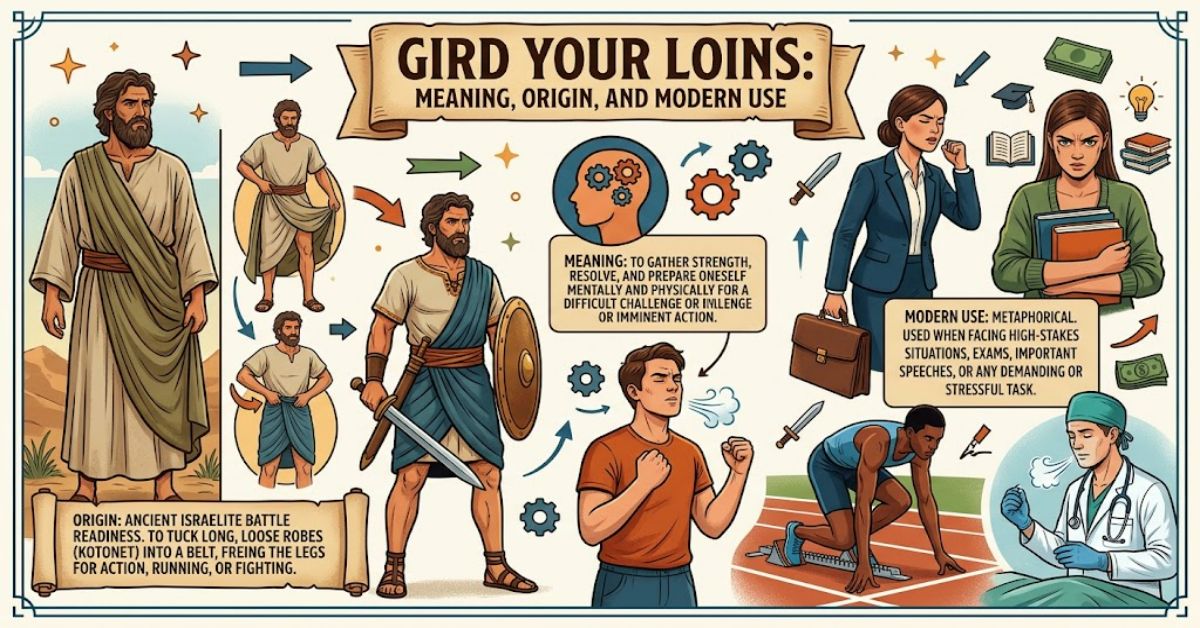
To gird your loins means to prepare yourself for something difficult, demanding or potentially stressful. In modern English, it is usually figurative. Someone might say it before starting a difficult meeting, tackling a demanding task or facing an uncomfortable conversation.
The phrase sounds strange because “loins” is not a word commonly used in everyday speech. Its original meaning becomes clearer when considered in the context of ancient clothing. People often wore long, loose garments that were comfortable for ordinary movement but inconvenient for running, travelling, fighting or physical labour. Before taking action, the garment could be gathered up and secured around the waist.
That physical preparation eventually became a metaphor for mental and practical readiness. Modern dictionary explanations similarly connect “gird” with fastening or preparing and with getting ready for confrontation or difficulty.
The expression therefore has a simple modern equivalent: get ready for what is coming.
Where Did the Expression Come From?
The imagery behind the phrase is much older than modern English. In societies where long garments were normal, securing loose clothing before strenuous activity was a practical necessity. The action allowed greater freedom of movement.
The idea appears repeatedly in biblical writing. Exodus 12:11 describes the Israelites preparing to leave Egypt with their garments secured, footwear on and staffs in hand. The emphasis is on being ready to depart rather than settling into a normal meal.
The same imagery appears in other passages involving work, travel, confrontation and responsibility. In 1 Kings 18:46, for example, Elijah is described as girding himself before running. The Cambridge Bible commentary on Luke 12:35 also connects the expression with readiness for active service in the context of loose Eastern clothing.
This helps explain why the phrase survived as an idiom. It began with an observable physical action but acquired a broader psychological meaning.
Gird Your Loins in the Bible
Biblical usage gives the expression more weight than its humorous modern reputation might suggest.
In Luke 12:35, the King James Version uses the wording “Let your loins be girded about, and your lights burning”. Modern translations often render the same idea as being dressed and ready for action or service.
The context is important. The instruction is associated with servants who need to remain prepared and alert while awaiting their master. The phrase therefore communicates more than physical readiness. It suggests a state of watchfulness in which a person is prepared to respond when necessary.
Similar imagery appears in Job, Jeremiah, Proverbs and the New Testament. Across these contexts, the basic idea remains recognisable: preparation before an important task, confrontation or responsibility.
This creates an interesting distinction between the original and modern meanings.
| Context | Meaning of the expression |
| Ancient practical use | Secure clothing for movement |
| Biblical use | Be ready for action, duty or challenge |
| Traditional figurative use | Prepare yourself for difficulty |
| Modern conversational use | Get ready for something demanding |
| Humorous modern use | Brace yourself for an unpleasant or dramatic event |
Why Does “Gird” Mean Prepare?
The verb “gird” originally relates to fastening something around the body, especially with a belt or band. Dictionary references trace the English word back to Old English and related Germanic forms.
The connection between fastening clothing and preparation is straightforward. Loose clothing could restrict movement. Gathering it up made a person physically ready to work or move quickly.
That physical action became a useful metaphor. People do this kind of preparation in many ways today without using the old terminology. We roll up our sleeves, tighten a belt, put on protective equipment or clear a workspace before beginning a difficult task.
“Gird your loins” belongs to the same family of expressions, but its imagery is much older and more dramatic.
How the Phrase Is Used Today
Modern speakers rarely use the expression literally. Instead, it normally introduces a challenge.
A manager might jokingly tell colleagues to gird their loins before a difficult presentation. A parent could use it before dealing with a chaotic household situation. A writer might use the phrase to build anticipation before describing an unpleasant experience.
Its tone depends heavily on context.
| Modern setting | Likely tone |
| Workplace | Humorous or dramatic |
| Family conversation | Playful |
| Writing | Literary or deliberately old-fashioned |
| Serious discussion | Figurative and motivational |
| Social media | Often ironic or exaggerated |
This flexibility is one reason the expression remains recognisable despite its archaic vocabulary.
The Hidden Strength of the Idiom
One useful feature of the phrase is that it describes preparation rather than victory. To gird your loins does not mean that you will succeed. It means you are making yourself ready to face whatever follows.
That distinction matters.
Preparation can involve gathering information, organising resources, accepting difficulty or simply adjusting your mindset. The phrase captures the moment immediately before action.
A second insight is that the expression combines physical and mental readiness. Its origins are physical, but its modern meaning is psychological. That makes it unusually effective as an idiom: the concrete image gives the abstract idea of preparation more force.
A third point is that its continued use depends partly on contrast. The wording sounds formal and ancient, while the situations in which people use it are often ordinary. That mismatch creates humour and keeps the expression memorable.
The Future of Gird Your Loins in 2027
There is little reason to expect “gird your loins” to disappear completely from English by 2027. It is unlikely to become a common literal expression because modern clothing no longer creates the same practical need.
Its figurative life is different.
Older idioms often survive when they offer a memorable image that modern alternatives cannot quite replace. “Get ready” is clearer and shorter, but “gird your loins” carries historical, biblical and humorous associations that make it distinctive.
Digital communication may also help preserve unusual expressions. Social media, entertainment and online writing routinely revive archaic phrases because their unusual wording makes them effective for jokes, reaction posts and dramatic introductions.
The likely future is therefore continued figurative use rather than a return to its original physical meaning.
Key Insights
- The phrase began with a practical preparation involving clothing.
- Biblical passages helped establish its association with readiness and action.
- “Gird” refers to fastening or securing, which explains the connection with preparation.
- Modern speakers generally use the expression figuratively.
- Humour comes partly from applying an ancient expression to ordinary modern problems.
- The phrase describes readiness rather than guaranteed success.
- Its distinctive imagery gives it staying power even though the literal practice has largely disappeared.
Conclusion
“Gird your loins” may sound peculiar to modern ears, but its meaning is surprisingly straightforward. It means to prepare yourself for something that requires effort, courage, attention or endurance.
The expression developed from a practical habit associated with long garments: securing clothing so that movement was easier. Biblical writers used that physical image in contexts involving travel, service, responsibility and readiness. Over time, the phrase became a broader metaphor for preparing to face difficulty.
Today, it is usually used with a humorous, dramatic or literary tone. Someone telling you to gird your loins is rarely giving clothing advice. They are warning you that something demanding is about to begin.
That combination of ancient imagery and modern flexibility is what has allowed the phrase to remain part of English long after its original practical purpose disappeared.
FAQ
What does “gird your loins” mean?
It means to prepare yourself mentally or physically for a difficult, demanding or stressful situation.
Is “gird your loins” a biblical phrase?
Yes. Similar wording appears in several biblical passages, including Exodus 12:11 and Luke 12:35. The imagery is associated with readiness for movement, service or action.
Why are loins mentioned in the phrase?
The expression refers to the waist or lower body area around which a garment could be secured. Gathering up loose clothing made physical movement easier.
Is “gird your loins” still used today?
Yes. It is mainly figurative and is often used humorously or dramatically before a difficult task or situation.
What is another way to say “gird your loins”?
Depending on the context, alternatives include “get ready”, “prepare yourself”, “brace yourself”, “prepare for action” and “steel yourself”.
Does the phrase mean something sexual?
The word “loins” can have anatomical or reproductive associations in older English, but the idiom itself means preparation or readiness rather than sexual activity.
Methodology
This article treats “gird your loins” as a language and cultural-history topic. The meaning and historical explanation were checked against biblical passages and established commentary on the expression, including its connection with practical preparation in ancient dress. Modern usage was considered separately from its historical and biblical contexts.
The main limitation is that idioms do not have a single fixed meaning across every period or community. Biblical interpretation can also differ between translations and commentators. The article therefore distinguishes the physical origin of the expression from its later figurative meanings rather than treating every use as identical.
References
Barker, R. (2025, 4 March). Gird Your Loins – Meaning, Origin & Usage. History of English.
Bible Gateway. Luke 12:35. Biblical text and translation comparison.
Cambridge Bible for Schools and Colleges. Commentary on Luke 12:35. Public-domain biblical commentary.
Dictionary.com. Gird: Definition, Meaning & Synonyms. Dictionary and etymology reference.
Jerusalem Perspective. Faithful or Faithless Slave. Discussion of Exodus 12:11 and Luke 12:35.
AI Editorial Disclosure: This article was drafted with AI assistance. Historical and textual claims should be independently reviewed against the original sources before publication.