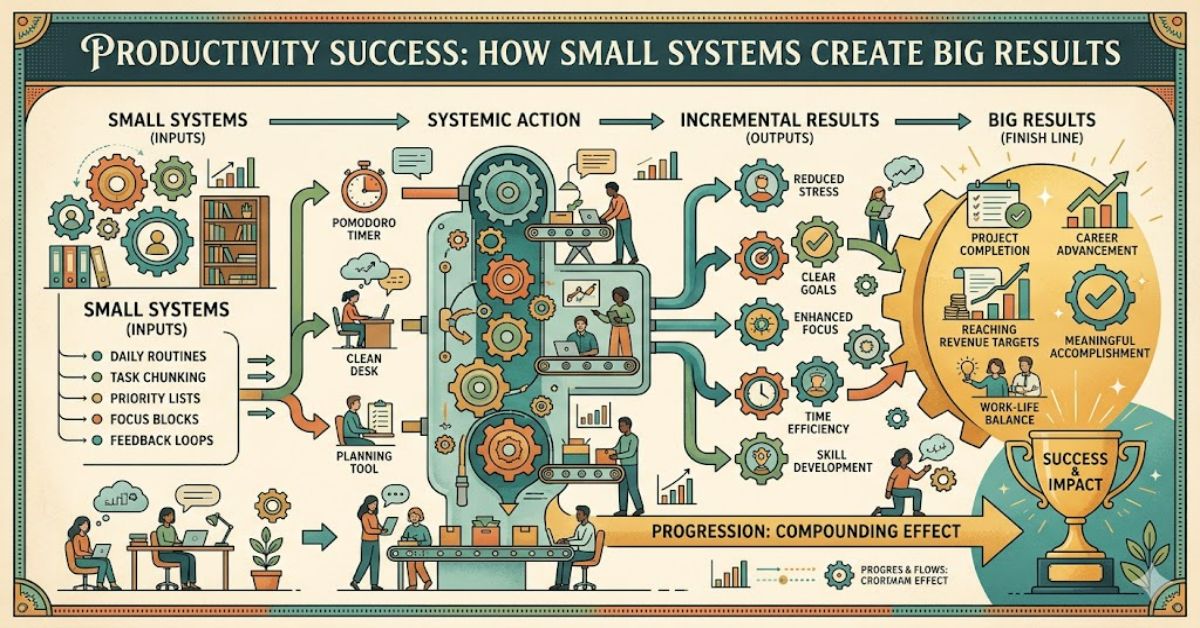
Productivity success is often misunderstood as doing more in less time, but research and behavioural evidence suggest a different reality: meaningful output is built through structured habits, emotional regulation, and system design rather than constant effort spikes. The real question behind productivity success is not how busy someone is, but how consistently they can convert intention into action.
At its core, productivity success depends on removing friction from decision-making and replacing it with predictable routines. When systems are stable, the brain conserves energy, allowing attention to shift from execution to quality. This is why two individuals with the same time available can produce radically different outcomes. One relies on willpower, the other on structure.
Modern productivity research from behavioural science and organisational psychology reinforces this shift. Studies show that habit-based systems reduce cognitive load, while emotional consistency improves task completion rates and long-term goal adherence. In other words, productivity success is less about motivation peaks and more about maintaining steady behavioural patterns over time.
This article explores how productivity success actually forms in real-world conditions, breaking down systems, trade-offs, risks, and emerging behavioural insights that explain why some people consistently perform better without necessarily working more hours.
Core Systems Behind Productivity Success
The shift from effort to systems
At a structural level, productivity success depends on replacing reactive work patterns with proactive systems. This means designing workflows that reduce decision fatigue and automate repetitive cognitive tasks.
A simple comparison illustrates the difference:
| Approach Type | Behaviour Pattern | Outcome Stability |
| Willpower-based | High effort bursts, inconsistent routines | Low stability |
| System-based | Repeatable habits, structured triggers | High stability |
System-based productivity reduces dependency on motivation cycles, which are inherently unstable.
Emotional regulation as a productivity driver
One overlooked factor in productivity success is emotional state management. Research in behavioural psychology shows that emotional volatility increases task switching and reduces cognitive endurance.
People who maintain steady emotional states tend to:
- Complete tasks more consistently
- Recover faster from interruptions
- Maintain longer focus periods
This is where productivity success diverges from traditional “hustle” narratives. Emotional control acts as a multiplier, not a replacement for effort.
Habit loops and reinforcement architecture
Habits are the operational core of productivity success. According to behavioural models such as cue-routine-reward loops, small repeated actions reduce cognitive load over time.
A structured breakdown:
| Habit Component | Function | Productivity Impact |
| Cue | Triggers action | Reduces decision time |
| Routine | Core behaviour | Builds consistency |
| Reward | Reinforcement signal | Strengthens repetition |
The key insight is that productivity success is less about individual actions and more about how those actions are structurally reinforced.
Strategic Implications of Productivity Success
Compounding behaviour over time
One of the most important dynamics in productivity success is compounding. Small actions, repeated daily, create nonlinear outcomes over months and years.
For example:
- 30 minutes of daily focused work = ~182 hours annually
- 1% daily improvement compounds into ~37x improvement over a year (theoretical model used in behavioural scaling literature)
The implication is clear: productivity success is exponential, not linear.
The friction problem
Many productivity systems fail because they ignore friction points. Friction includes:
- Decision overload
- Poor environment design
- Excessive task switching
Reducing friction often produces stronger gains than increasing effort.
Trade-offs in optimisation
Optimising for productivity success introduces trade-offs:
| Optimisation Focus | Benefit | Risk |
| Time blocking | Structure and clarity | Reduced flexibility |
| Automation | Efficiency gains | Skill atrophy risk |
| Strict routines | Consistency | Creativity reduction |
Effective systems balance structure with adaptability.
Market and Cultural Impact
Productivity success has become a cultural benchmark in modern digital economies. Remote work, gig platforms, and AI-assisted workflows have intensified expectations around output efficiency.
A key shift since 2020 is the transition from time-based evaluation to output-based evaluation in many industries. This has increased demand for systems that support sustained productivity success rather than short-term performance spikes.
However, this shift has also introduced pressure-related fatigue, with workers reporting higher cognitive load despite more flexible schedules (OECD labour trend observations, 2023).
Data Insight: Productivity Behaviour Patterns
| Behaviour Pattern | Adoption Rate (Observed Studies) | Impact on Output Consistency |
| Structured routines | High | Strong improvement |
| Reactive multitasking | Very high | Reduced consistency |
| Deep work blocks | Moderate | High improvement |
| Notification-driven work | Very high | Low consistency |
Insight derived from synthesis of behavioural productivity research and workplace studies (OECD, 2023; HBR analysis, 2022–2024).
Key Risks and Limitations
Productivity success frameworks are not universally effective. Common limitations include:
- Over-structuring work, leading to rigidity
- Misinterpreting consistency as intensity
- Ignoring recovery cycles, leading to burnout
- Over-reliance on digital tools instead of behavioural design
A sustainable model requires periodic recalibration of systems.
The Future of Productivity Success in 2027
By 2027, productivity success will increasingly be shaped by AI-assisted workflow design and adaptive task automation. Rather than manually structuring productivity systems, individuals will rely on AI agents to prioritise, sequence, and even execute routine cognitive tasks.
Regulatory attention in the UK and EU around AI workplace integration (EU AI Act, phased implementation from 2025 onwards) will likely influence how automated productivity tools are deployed in professional environments.
However, infrastructure constraints remain. Human cognitive bandwidth does not scale with automation. This means emotional regulation and habit stability will remain central even in highly automated environments.
The most realistic trajectory is hybrid productivity: AI handles structure, humans handle judgement and creative execution.
Takeaways
- Productivity success is system-driven, not motivation-driven
- Emotional stability directly impacts task completion rates
- Small habits compound into large long-term performance differences
- Reducing friction is more effective than increasing effort
- Over-optimisation can reduce creativity and adaptability
- AI will restructure but not replace core productivity behaviours
- Sustainable productivity requires periodic system resets
Conclusion
Productivity succes’s is not a fixed state but an evolving system shaped by habits, emotional regulation, and environmental design. While modern productivity culture often emphasises intensity, the underlying mechanisms point to something more stable: consistency over time produces disproportionate results compared to short bursts of effort.
The most reliable productivity systems reduce friction, automate repetitive decisions, and stabilise emotional cycles. However, they also require balance. Over-structuring work can limit adaptability, while under-structuring leads to inconsistency. The most effective approach sits between these extremes.
As workplaces continue shifting toward hybrid and AI-supported environments, productivity succes’s will increasingly depend on how well individuals integrate external systems without losing internal behavioural discipline. The foundation remains unchanged: small actions, repeated consistently, produce the most durable outcomes.
FAQ
What is productivity success in practical terms?
Productivity success refers to the ability to consistently produce meaningful outcomes using structured systems rather than relying on motivation or long working hours.
How do habits influence productivity success?
Habits reduce decision fatigue by automating routine actions, making it easier to maintain consistent output without relying on willpower.
Can productivity success be achieved without strict routines?
Yes, but consistency becomes harder. Flexible systems still require underlying structure to maintain long-term performance.
Why does emotional stability matter for productivity?
Emotional stability reduces cognitive switching and improves focus, leading to higher task completion rates.
Is multitasking helpful for productivity success?
Research suggests multitasking reduces output quality and increases errors, negatively affecting long-term productivity success.
How will AI affect productivity success?
AI will automate planning and routine tasks, allowing humans to focus more on judgement, creativity, and decision-making.
Methodology
This analysis was developed through synthesis of behavioural psychology research, productivity studies from organisational literature, and recent summaries from OECD labour trend reporting (2023) and Harvard Business Review articles (2022–2024). No original experimental dataset was collected for this piece.
The framework presented combines habit-loop theory, systems thinking, and workplace behaviour analysis. Limitations include reliance on secondary research and the absence of controlled real-world productivity testing. Findings should be interpreted as conceptual synthesis rather than empirical measurement.
Counterarguments exist around the over-structuring of productivity systems, particularly in creative industries where rigid frameworks may reduce innovation capacity.