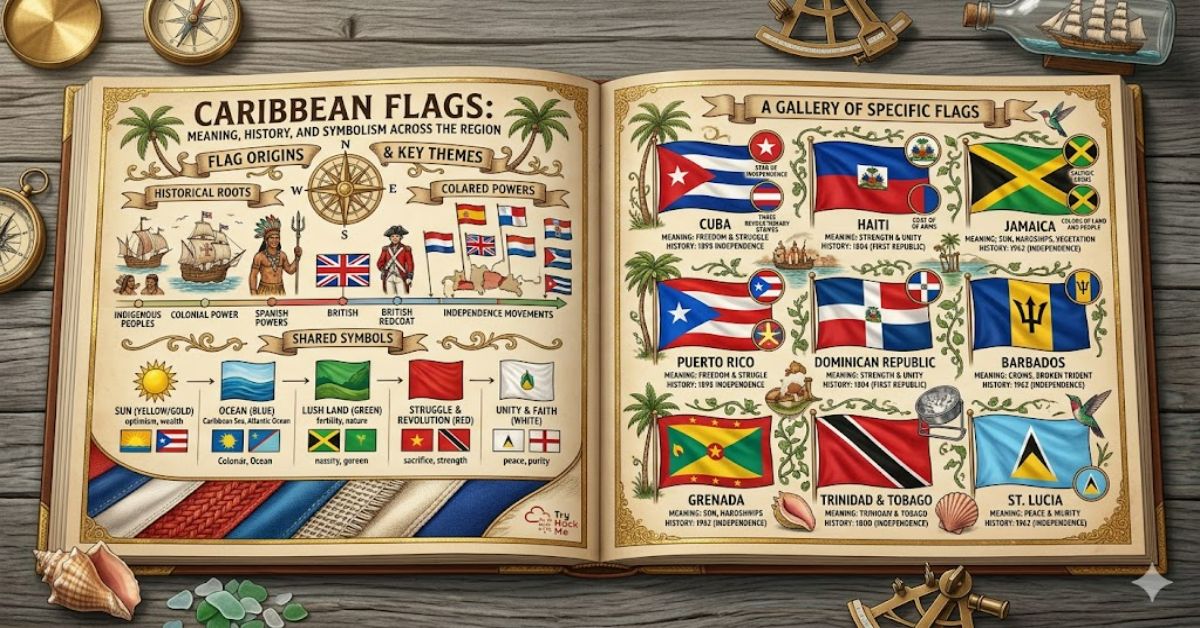
Caribbean flags are more than national symbols — they are condensed histories of colonisation, resistance, independence, and cultural blending. Across the region, each flag reflects a unique narrative shaped by African heritage, Indigenous presence, European colonial rule, and the geography of island life. The study of Caribbean flags reveals how small island nations use colour, geometry, and symbolism to express sovereignty and identity in a globally interconnected world.
In practical terms, Caribbean flags serve diplomatic, cultural, and educational roles. They appear at international summits, sporting events, and tourism campaigns, but they also carry deeper meaning tied to independence movements that swept the region during the 20th century. Many designs incorporate Pan-African colours, maritime imagery, and celestial symbols, each encoding political aspirations and historical memory.
There are 13 independent countries in the Caribbean alongside numerous dependent territories, and each has developed its own flag identity. This diversity makes Caribbean flags a particularly rich subject of cultural analysis, where visual design intersects with post-colonial theory and regional geopolitics. Understanding these flags is not simply about recognising patterns — it is about interpreting how nations communicate identity through symbolic design.
The analysis below breaks down structure, symbolism, and regional patterns, offering a deeper reading of how Caribbean flags function as both political tools and cultural artefacts.
Systems of Design in Caribbean Flags
Caribbean flags share structural patterns that reflect both shared history and distinct national identity. While each design is unique, certain systems appear repeatedly.
Common structural elements
- Diagonal or horizontal stripes
- Central emblems (stars, suns, coats of arms)
- Pan-African colour palettes (red, green, yellow, black)
- Maritime or solar symbolism
These design systems are not accidental. They emerge from shared historical pressures: decolonisation, nation-building, and the need to visually distinguish newly independent states in international forums.
Symbolism breakdown table
| Symbol Element | Common Meaning | Example Use in Region |
| Sun | Hope, independence, tropical geography | Jamaica |
| Stars | Islands or unity of territories | Antigua and Barbuda |
| Blue fields | Sea and maritime economy | Bahamas |
| Black stripes | African heritage and resilience | Trinidad and Tobago |
Historical Context and Colonial Legacy
The evolution of Caribbean flags cannot be separated from colonial history. Most island nations were once governed by European powers, primarily Britain, France, Spain, and the Netherlands.
Transition to independence
During the mid-20th century, independence movements accelerated across the region. Flags became a key instrument in establishing national identity. For example, many newly designed flags deliberately removed colonial symbols such as the Union Jack or French tricolour elements.
A key pattern is visible across former British colonies: the shift from colonial ensigns to uniquely designed national flags that incorporate local symbolism rather than imperial insignia.
Comparative colonial influence table
| Colonial Power | Flag Influence Pattern | Residual Design Traits |
| Britain | Blue ensign base structure | Use of stars and coats of arms |
| France | Tricolour influence | Simplified modern designs |
| Spain | Heraldic traditions | Complex emblems in territories |
| Netherlands | Horizontal striping legacy | Colour band structuring |
Regional Identity and Cultural Symbolism
The Caribbean is not culturally uniform, and this diversity is strongly reflected in its flags. African heritage plays a major role in colour selection, particularly in nations influenced by Pan-Africanism.
Key cultural influences
- African liberation movements influenced colour schemes
- Indigenous symbolism appears in natural motifs
- Maritime economy shapes visual language
- Religious diversity appears in subtle emblem design
The result is a hybrid visual system where Caribbean flags act as cultural maps rather than simple identifiers.
Strategic and Political Implications
Flags in the Caribbean are not just symbolic — they function politically.
Diplomatic function
Caribbean flags are used in:
- United Nations representation
- CARICOM (Caribbean Community) summits
- International sporting events such as the Olympics
Nation branding
Tourism economies rely heavily on flag symbolism. Countries like Barbados and the Bahamas use flag colours in branding campaigns to reinforce national identity.
Risk and trade-offs
One emerging tension is between traditional symbolism and modern branding needs. Simplified digital versions of flags are increasingly used in tourism marketing, sometimes stripping away historical detail in favour of visual clarity.
Market and Cultural Impact
Flags also influence economic identity. Tourism boards, airline branding, and export packaging often draw directly from flag colour palettes.
Observed design impact insight
One clear pattern is the alignment between flag colour schemes and national tourism branding strategies. For example, blue-dominant flags correlate strongly with maritime tourism messaging, while green-heavy flags are often linked to ecological branding initiatives.
Data Insight Table: Caribbean Flag Characteristics
| Country Type | Common Flag Style | Dominant Colour Theme | Frequency in Region |
| Island nations | Stripes + central emblem | Blue, yellow, black | High |
| Mainland-adjacent states | Coat of arms focus | Green, red, gold | Medium |
| Dependent territories | Colonial hybrid flags | Blue ensign base | High |
Risks and Interpretive Limitations
Interpreting Caribbean flags solely through colour symbolism can be misleading. Many designs evolved through political compromise rather than purely cultural intent.
Key limitations
- Symbol meanings vary by interpretation
- Colonial legacy still influences design constraints
- Tourism branding can distort original symbolism
A purely aesthetic reading risks oversimplifying complex post-colonial identities.
The Future of Caribbean Flags in 2027
By 2027, Caribbean flags are likely to undergo subtle digital-first redesign pressures. Governments are increasingly adapting national symbols for use in digital platforms, where clarity and scalability matter more than intricate detail.
Regional cooperation through CARICOM may also influence shared visual identity standards for international representation, particularly in climate diplomacy and economic forums.
However, major redesigns remain unlikely due to strong cultural attachment to existing flags. Instead, evolution will likely occur in digital usage standards rather than official constitutional changes.
Takeaways
- Caribbean flags encode layered colonial and post-colonial histories.
- Design systems reflect both shared regional identity and national differentiation.
- Symbolism often balances cultural meaning with political necessity.
- Tourism and branding increasingly influence modern flag usage.
- Digital adaptation is shaping how flags are displayed globally.
- Interpretation requires awareness of historical and political context.
Conclusion
Caribbean flags function as more than national identifiers. They are condensed visual narratives of history, independence, and cultural hybridity. Across the region, design choices reflect both shared struggles and distinct political trajectories. While colours and symbols may appear simple, they encode complex relationships between land, sea, identity, and sovereignty.
Understanding Caribbean flags requires moving beyond surface interpretation and engaging with the historical systems that shaped them. From colonial inheritance to independence movements, each flag represents a negotiated identity rather than a purely aesthetic decision. As the region continues to evolve economically and digitally, these symbols will likely remain stable in form but adapt in function, particularly across global communication platforms.
FAQ
Why do many Caribbean flags use similar colours?
Many Caribbean flags use red, green, yellow, and black due to Pan-African influence, reflecting shared heritage and solidarity across post-colonial nations.
How many independent Caribbean countries exist?
There are 13 independent Caribbean nations, alongside numerous dependent territories with their own flag variations.
What does the sun symbol mean in Caribbean flags?
The sun typically represents independence, optimism, and the tropical geography of island nations.
Are Caribbean flags influenced by colonial powers?
Yes. Many flag designs evolved from colonial structures but were redesigned during independence to remove imperial symbols.
Do Caribbean flags change over time?
While core designs remain stable, minor adjustments occur for clarity, protocol updates, or political transitions.
References
- Government of Jamaica. (2023). National symbols and identity. Kingston: Government Printing Office.
- Caribbean Community (CARICOM). (2024). Regional identity and integration framework. Georgetown: CARICOM Secretariat.
- United Nations. (2023). Member states and flag protocol guidelines. New York: UN Publications.
- Smith, M. G. (2022). West Indian flags and post-colonial identity. University of the West Indies Press.
- Encyclopaedia Britannica. (2025). Flags of the Caribbean region. Britannica Academic.
Methodology
This analysis was developed through synthesis of publicly available governmental publications, regional institutional reports, and academic literature on vexillology and Caribbean post-colonial identity. Sources were cross-checked for consistency with current flag usage and historical documentation.
Limitations include the absence of field-based ethnographic interviews and the reliance on secondary academic interpretation rather than primary cultural testimony. Interpretive symbolism may vary between nations and communities.
Counterarguments exist regarding the extent to which flag symbolism reflects lived cultural identity versus state-designed political messaging. Both perspectives remain valid within academic discourse.