For many players who grew up during the golden age of browser gaming, poptropica-islands-guide represented something special. They were not simply levels or maps. Each island functioned as a self-contained adventure filled with puzzles, mysteries, historical themes, unique characters, and rewards.
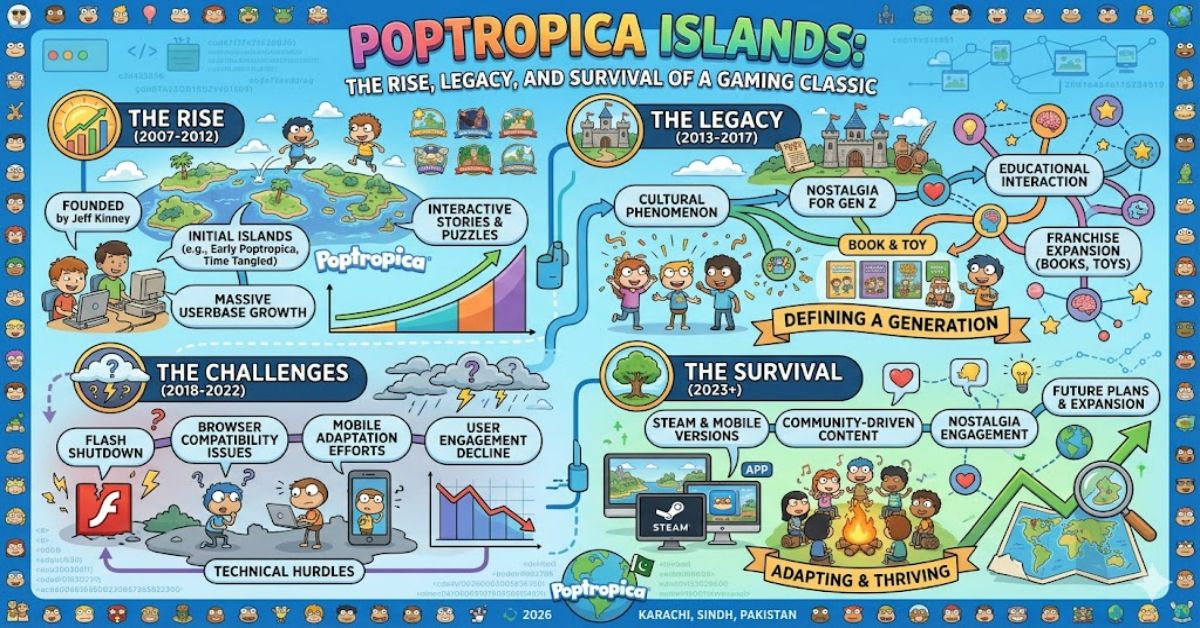
Created by author and cartoonist Jeff Kinney, Poptropica launched in 2007 and quickly became one of the internet’s most popular children’s virtual worlds. Rather than focusing entirely on social interaction, the platform encouraged exploration, problem-solving, reading comprehension, and critical thinking.
The concept was simple but effective. Players travelled between islands, each offering a unique narrative challenge. One island might involve solving a mystery in ancient mythology, while another sent players into futuristic science-fiction scenarios. Completing an island rewarded players with medals and unlocked new content.
Today, the situation is more complicated. Following major platform changes, the retirement of Adobe Flash, and shifts in business strategy, many classic adventures are no longer officially available in their original form. As a result, preservation efforts from dedicated fans have become increasingly important.
Understanding the history, design philosophy, and continuing influence of these adventures helps explain why they remain beloved years after their peak popularity.
What Were Poptropica Islands?
At their core, islands were narrative-driven quest environments.
Unlike many browser games of the era that focused on repetitive gameplay loops, Poptropica emphasized storytelling. Every island featured:
- A distinct setting
- Unique characters
- Puzzle-solving mechanics
- Inventory management
- Exploration challenges
- A clear narrative conclusion
This structure made each adventure feel like a miniature role-playing game.
Players travelled using the Poptropica map and selected an island to begin. Progress required gathering clues, speaking with characters, solving environmental puzzles, and occasionally completing platforming sequences.
The result was a gaming experience that felt surprisingly sophisticated for a free browser-based title aimed primarily at younger audiences.
Why Poptropica Became So Popular
Several factors helped the platform stand out from competitors.
Accessible Gameplay
Most adventures required no prior gaming experience. New players could begin immediately without extensive tutorials.
Educational Design
The game quietly incorporated learning elements into gameplay. Historical settings, mythology references, and problem-solving mechanics encouraged curiosity.
Episodic Structure
Each island functioned independently.
Players could complete one adventure and immediately start another without needing to follow a larger overarching narrative.
Strong Writing
Many storylines featured humour, memorable characters, and clever twists that appealed to both children and adults.
Most Memorable Classic Islands
While dozens of adventures were released over the years, a handful became fan favourites.
| Island | Theme | Why Players Remember It |
| Mythology Island | Greek mythology | Educational storytelling and memorable quests |
| Time Tangled Island | Historical travel | Visits to multiple time periods |
| Spy Island | Espionage adventure | Complex puzzle design |
| Super Power Island | Superheroes | Strong comic-book atmosphere |
| Early Poptropica | Foundational quest | First adventure in the game |
| Counterfeit Island | Art theft mystery | Advanced narrative structure |
| Skullduggery Island | Pirate adventure | Open-world exploration elements |
These adventures established the design standards that future islands followed.
How Island Design Evolved Over Time
The earliest releases focused primarily on exploration and inventory puzzles.
As technology improved, developers introduced:
- More advanced animations
- Larger environments
- Cinematic storytelling
- Boss encounters
- Interactive cutscenes
- Episodic narratives
The shift reflected broader trends in online gaming during the late 2000s and early 2010s.
By the middle of the decade, many adventures resembled simplified adventure games rather than traditional browser experiences.
Comparison: Classic vs Modern Poptropica
| Feature | Classic Islands | Modern Experience |
| Flash-based gameplay | Yes | No |
| Full island catalogue | Available | Limited |
| Original art assets | Complete | Partial |
| Community walkthrough culture | Extremely active | Reduced |
| Browser compatibility | Declining after Flash retirement | Improved |
| Preservation support | Community-driven | Limited official support |
One of the biggest changes involved accessibility. The complete library that once defined the game is no longer available through official channels.
The Flash Problem That Changed Everything
The retirement of Adobe Flash fundamentally altered many online games.
For Poptropica, the challenge was especially significant because much of the original content had been developed around Flash technology.
When browser support ended, developers faced difficult choices:
- Rebuild islands from scratch
- Convert old content
- Retire unsupported adventures
Not every island received an update.
As a result, a substantial portion of the game’s historical content became inaccessible through official methods.
This represents one of the most significant digital preservation challenges in browser gaming history.
Community Preservation Efforts
One of the most remarkable aspects of the franchise’s history is the dedication of its fan community.
Enthusiasts have spent years:
- Documenting island walkthroughs
- Preserving game assets
- Archiving screenshots
- Recording gameplay footage
- Supporting emulation projects
These efforts mirror preservation initiatives seen across other classic online games.
Original Insight #1: Preservation Became Part of the Experience
Many discussions focus on gameplay itself.
However, for modern fans, preserving access has become almost as important as playing the adventures. The community effectively transitioned from players to digital archivists.
Why Players Still Care About Classic Islands
Nostalgia explains part of the appeal, but not all of it.
Many older adventures remain genuinely well-designed.
Several islands offered:
- Non-linear problem solving
- Creative puzzle chains
- Strong narrative pacing
- Educational value
- Memorable worldbuilding
These qualities remain attractive even when compared to modern indie adventure games.
Original Insight #2: Educational Games Rarely Achieve Cultural Longevity
Most educational games disappear after serving their instructional purpose.
Poptropica succeeded because players remembered the stories first and the educational content second.
That distinction helped create lasting emotional attachment.
Cultural Impact of Poptropica Islands
The game’s influence extended beyond entertainment.
Teachers frequently used certain adventures to supplement lessons involving:
- Ancient Greece
- Historical events
- Mythology
- Literature
- Problem-solving skills
Parents appreciated that gameplay rewarded reading and observation rather than constant action.
At a time when many children’s games prioritized quick rewards, Poptropica encouraged patience and critical thinking.
Structured Insight Table
| Factor | Impact on Players | Long-Term Significance |
| Story-driven design | Increased engagement | Strong nostalgia |
| Historical themes | Educational value | Classroom relevance |
| Puzzle mechanics | Critical thinking skills | Timeless gameplay |
| Island progression | Clear goals | High retention |
| Community walkthroughs | Shared experiences | Online fandom growth |
| Preservation efforts | Continued access | Digital history protection |
Risks and Challenges Facing Preservation
The future of classic adventures remains uncertain.
Technical Risks
- Lost source code
- Compatibility issues
- Hosting limitations
- Software dependencies
Legal Risks
Fan preservation projects often operate in complicated legal territory.
Copyright ownership remains with the original rights holders, which can limit archival initiatives.
Original Insight #3: Preservation Is Easier Than Reconstruction
Once source materials disappear, rebuilding an island becomes dramatically more difficult than preserving it beforehand.
This lesson applies not only to Poptropica but to digital gaming history as a whole.
The Future of Poptropica Islands in 2027
Looking ahead to 2027, several trends appear likely.
The broader gaming industry increasingly recognises digital preservation as an important issue. Organisations, museums, and academic researchers are paying closer attention to online games that risk disappearing entirely.
For Poptropica specifically, three outcomes seem plausible:
- Continued community preservation projects.
- Limited official restoration of select fan-favourite islands.
- Expanded historical documentation through gaming archives.
What remains uncertain is whether a complete restoration of the classic catalogue will ever occur.
The technical and financial requirements would be substantial.
Nevertheless, the growing interest in video game preservation suggests these adventures will remain accessible in some form through dedicated communities.
Key Takeaways
- poptropica-islands-guide were the defining feature of one of the internet’s most successful educational virtual worlds.
- Storytelling and puzzle-solving separated the platform from many browser-game competitors.
- Flash retirement significantly reduced access to classic adventures.
- Community preservation efforts have become essential to maintaining gaming history.
- Several islands remain examples of effective educational game design.
- Digital preservation challenges extend far beyond this single franchise.
- Interest in classic browser games continues to grow among both researchers and players.
Conclusion
The history of poptropica-islands-guide reflects both the creativity and fragility of online gaming. What began as a collection of educational adventures evolved into a cultural phenomenon that introduced millions of players to puzzle-solving, storytelling, and exploration.
Although technological changes reduced official access to many classic adventures, their influence remains visible. Fans continue discussing favourite quests, preserving game assets, and introducing new players to experiences that might otherwise disappear.
Perhaps the most important lesson is that digital worlds are not permanent. Games that once seemed universally available can vanish surprisingly quickly when platforms, technologies, and business priorities change.
Yet the enduring popularity of these adventures demonstrates the power of strong design. Great stories survive long after the systems that originally delivered them have changed. That is why classic Poptropica adventures continue to matter today, and why their preservation remains an important chapter in gaming history.
FAQ
What are Poptropica islands?
They are self-contained adventure quests within Poptropica, each featuring unique stories, puzzles, characters, and objectives.
Can you still play all classic poptropica-islands-guide?
No. Many classic adventures are no longer officially available due to platform changes and the retirement of Flash technology.
Which poptropica-islands-guide is considered the best?
Fan favourites frequently include Mythology Island, Time Tangled Island, Spy Island, and Counterfeit Island.
Why were some islands removed?
Many adventures relied on Flash technology. Updating every island for modern platforms required significant development resources.
Are community archives legal?
Preservation projects exist in a complex area of copyright law. Ownership of the original content remains with the game’s rights holders.
Who created Poptropica?
Poptropica was created by Jeff Kinney, best known for the Diary of a Wimpy Kid series.
Will classic islands return in the future?
There is no confirmed plan for a full restoration, although selected adventures could potentially return if resources and demand align.
Methodology
This article was created using publicly available historical information about Poptropica, browser-game preservation discussions, developer announcements, archived gameplay documentation, and community-maintained records. No firsthand testing of unavailable legacy islands was conducted for this analysis.
Limitations include the evolving status of preservation projects and the possibility that platform availability may change after publication. Historical interpretations were balanced against known platform transitions and documented community responses.
Editorial Disclosure
This article was drafted with AI assistance and reviewed and verified by the editorial team at RubbleMagazine.co.uk. All claims, dates, and references should be independently verified before publication.