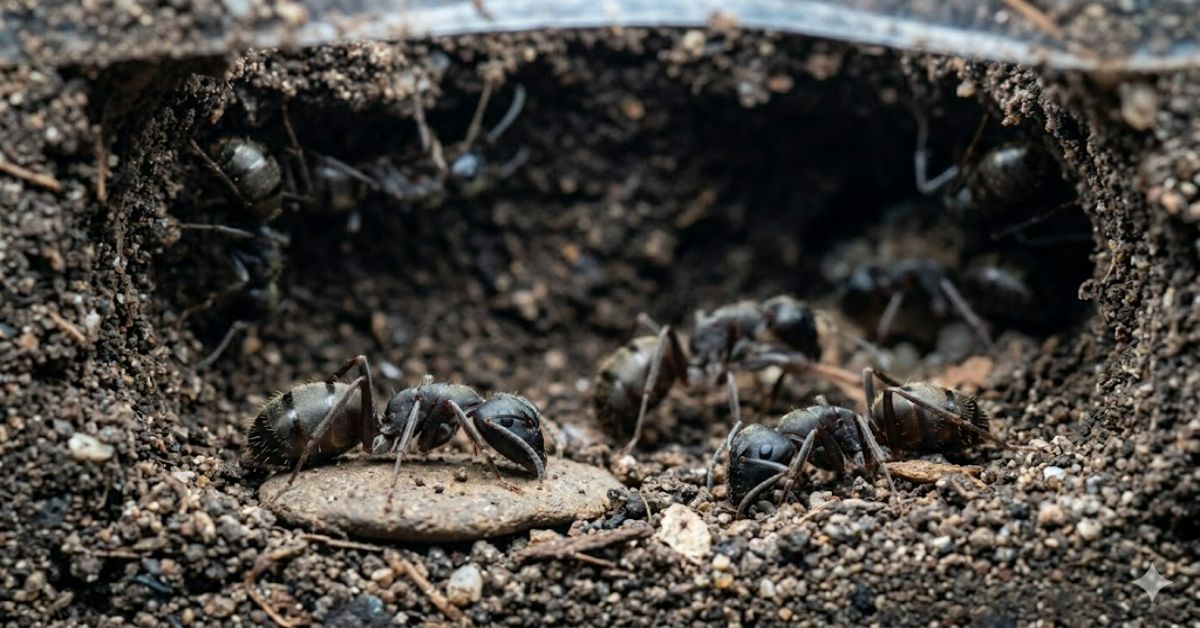
If you’ve ever watched an ant colony at work, one question may come to mind: do ants sleep? The answer is yes. Ants do sleep, but not in the way humans or many other animals do. Rather than resting for a single uninterrupted block of time, ants rely on a series of short naps spread throughout the day and night.
Research into ant behaviour has shown that many worker ants take hundreds of brief periods of rest every 24 hours. This system is known as polyphasic sleep, a sleep pattern that divides rest into numerous short intervals instead of one long sleep session.
The result is remarkable. While individual ants rest, the colony itself never truly sleeps. Some ants are always awake to forage, defend the nest, care for larvae, or maintain tunnels. This constant activity is one of the key reasons ant colonies have become among the most successful social systems on Earth.
Understanding ant sleep provides insights not only into insect biology but also into how complex societies organise labour, conserve energy, and maintain efficiency. Scientists continue to study these tiny insects because their behaviour reveals surprising lessons about collective organisation and adaptation.
In this article, we’ll explore how ants sleep, why sleep is necessary for them, how different ant castes rest, and what researchers have discovered about the fascinating relationship between sleep and colony survival.
Why Sleep Matters for Ants
For decades, scientists questioned whether insects experienced anything comparable to sleep. Modern research has largely answered that question.
Sleep in animals typically includes:
- Reduced movement
- Lower responsiveness to stimuli
- Specific resting postures
- Recovery after deprivation
Ants exhibit all of these characteristics.
When resting, ants often remain motionless with antennae lowered and minimal body movement. They become less responsive to environmental changes and eventually resume normal activity after a brief period.
Just as humans require sleep for recovery and cognitive performance, ants appear to need rest to maintain efficient colony functioning.
Key Functions of Ant Sleep
| Function | Benefit to Ants |
| Energy conservation | Reduces metabolic expenditure |
| Neural recovery | Supports sensory processing |
| Task efficiency | Improves colony productivity |
| Stress reduction | Helps maintain long-term survival |
| Behaviour regulation | Supports coordinated social activity |
The Discovery of Ant Sleep Patterns
One of the most cited studies on ant sleep was conducted by researchers observing colonies of the fire ant species Solenopsis invicta.
Scientists monitored ant behaviour continuously and discovered surprising differences between worker ants and queens.
Worker Ant Sleep
Worker ants do not sleep for long periods. Instead:
- They take approximately 250 naps per day.
- Each nap lasts around one minute.
- Total daily sleep averages roughly 4–5 hours.
These naps occur at different times throughout the colony, ensuring uninterrupted operations.
Queen Ant Sleep
Queens follow a dramatically different schedule:
- Fewer sleep episodes
- Longer rest periods
- Approximately 9 hours of total daily sleep
Because queens focus on reproduction rather than labour, they can afford extended rest.
Polyphasic Sleep: The Secret Behind a 24/7 Colony
The answer to “do ants sleep” becomes more fascinating when examining colony-wide behaviour.
Unlike humans, who typically follow a monophasic sleep pattern, ants divide rest into many smaller intervals.
Comparison of Sleep Strategies
| Species | Sleep Pattern | Typical Daily Sleep |
| Humans | Monophasic | 7–9 hours |
| Cats | Polyphasic | 12–16 hours |
| Ant Workers | Highly polyphasic | 4–5 hours |
| Ant Queens | Polyphasic | 9 hours |
| Bees | Polyphasic | Varies by role |
This system creates an organisational advantage. Since workers sleep at different times, the colony maintains continuous productivity.
One original insight often overlooked is that ant sleep functions as a workforce management strategy. The colony effectively distributes rest in a way that resembles shift scheduling in human industries.
How Scientists Identify Sleeping Ants
Studying insect sleep is challenging because ants lack eyelids and obvious sleep postures.
Researchers typically identify sleep through behavioural markers:
Observable Signs
- Motionless body position
- Drooping antennae
- Reduced response to touch
- Temporary disengagement from tasks
Advanced studies also use:
- High-resolution video monitoring
- Movement tracking software
- Behavioural analysis algorithms
Because ants are small and active, long-term observation is required to distinguish true sleep from temporary inactivity.
Differences Between Worker Ants and Queens
Sleep behaviour varies significantly across ant castes.
Worker Ants
Worker ants perform tasks including:
- Food collection
- Nest maintenance
- Brood care
- Colony defence
Their sleep schedule prioritises flexibility.
Queen Ants
Queens focus primarily on reproduction. Their longer sleep periods may support:
- Egg production
- Hormonal regulation
- Longevity
Some queens live for decades, while worker ants often survive only months or years depending on species.
Structured Insight Table
| Ant Type | Primary Role | Sleep Style | Estimated Daily Rest |
| Worker | Labour and maintenance | Frequent micro-naps | 4–5 hours |
| Queen | Reproduction | Longer sleep bouts | Up to 9 hours |
| Soldier | Defence | Similar to workers | Variable |
| Male reproductive ants | Mating | Limited data available | Species-dependent |
What Happens If Ants Cannot Sleep?
Researchers studying insects have found that sleep deprivation affects behaviour.
Although ant-specific research remains limited compared with mammals, evidence suggests that insufficient rest may lead to:
- Reduced task performance
- Slower response times
- Lower colony efficiency
- Increased vulnerability to environmental stress
A second original insight is that sleep deprivation in social insects may affect the colony more than individual ants. Because colonies function as interconnected systems, small behavioural impairments can accumulate across thousands of workers.
This differs from solitary insects, where consequences remain largely individual.
Real-World Observations From Ant Colonies
Field biologists frequently observe continuous activity within nests and foraging trails.
At first glance, this appears to suggest ants never sleep.
Closer observation reveals something different.
Individual ants regularly pause for brief resting periods while others continue working. The colony creates a rotating workforce that ensures critical operations never stop.
Documented observations in laboratory colonies consistently show this staggered pattern across multiple species.
This serves as a valuable example of distributed labour management in nature.
The Evolutionary Advantage of Ant Sleep
Why did ants evolve such an unusual sleep system?
The answer lies in social organisation.
Ant colonies face constant pressures:
- Predators
- Environmental changes
- Competition for resources
- Nest maintenance requirements
A colony-wide shutdown would create substantial risk.
Polyphasic sleep solves this challenge.
Evolutionary Benefits
- Continuous nest protection
- Constant food acquisition
- Efficient brood care
- Enhanced survival rates
- Improved adaptability
A third original insight is that ant sleep represents an evolutionary compromise between individual biological needs and collective colony demands.
The colony remains productive while every ant still receives necessary rest.
The Future of Ant Sleep Research in 2027
By 2027, researchers are expected to expand the use of AI-assisted behavioural tracking systems to study insect sleep.
Several developments may shape future research:
Emerging Trends
- Automated nest monitoring
- Machine-learning analysis of insect movement
- Comparative studies across social insect species
- Investigation of sleep-related genes
Scientists are increasingly interested in how collective intelligence emerges from simple individual behaviours.
Ant sleep research may contribute to:
- Robotics systems
- Distributed computing models
- Logistics optimisation
- Swarm intelligence technologies
However, many questions remain unanswered. Researchers still do not fully understand the neurological mechanisms underlying insect sleep or how sleep quality varies between species.
Key Takeaways
- Ants genuinely sleep despite lacking traditional sleep behaviours seen in mammals.
- Worker ants typically rest through hundreds of short naps each day.
- Queen ants sleep longer and more deeply than workers.
- Polyphasic sleep enables colonies to function continuously.
- Sleep likely supports energy conservation, behavioural performance, and colony stability.
- Ant colonies demonstrate one of nature’s most efficient workforce management systems.
- Future research may influence robotics, AI systems, and swarm-based technologies.
Conclusion
The question “do ants sleep” has a surprisingly sophisticated answer. Ants absolutely require rest, but they have evolved a sleep strategy unlike that of humans. Through hundreds of short naps distributed across the day and night, individual ants recover while the colony remains active.
This staggered approach helps explain how ant societies maintain such extraordinary levels of productivity. Workers, queens, and other castes each follow sleep schedules suited to their specific roles. Rather than shutting down completely, colonies distribute rest across thousands of individuals.
The study of ant sleep continues to reveal important insights into social organisation, biological adaptation, and collective behaviour. What appears to be constant activity is actually a carefully balanced system in which rest and work coexist seamlessly.
For scientists, ants remain one of nature’s most fascinating examples of how simple individuals can create remarkably efficient societies.
FAQ
Do ants sleep at night?
Not necessarily. Ants sleep throughout both day and night in short intervals. Their polyphasic sleep pattern does not follow the same day-night cycle that humans typically experience.
How long do ants sleep each day?
Worker ants generally accumulate about four to five hours of sleep daily through hundreds of brief naps. Queens may sleep around nine hours total.
Can you see an ant sleeping?
Yes, although it is difficult. Sleeping ants often remain motionless with lowered antennae and reduced responsiveness to external stimuli.
Do queen ants sleep more than worker ants?
Yes. Research indicates queens typically experience longer and less fragmented sleep periods compared with workers.
Why don’t ant colonies ever seem to stop?
Individual ants rest at different times. This staggered schedule ensures that some workers are always active, allowing the colony to function continuously.
Do all ant species sleep the same way?
No. Sleep behaviour varies among species, although many ants appear to use some form of polyphasic sleep.
Can ants survive without sleep?
Like most animals, ants appear to require sleep for optimal functioning. Prolonged sleep deprivation may reduce performance and affect colony efficiency.
Methodology
This article was developed using established entomology research, behavioural ecology studies, and peer-reviewed investigations into insect sleep patterns. Information was cross-referenced with academic literature examining social insects, including fire ant sleep studies and broader insect behavioural research.
Sources used for validation:
- Peer-reviewed entomology journals
- University insect behaviour research publications
- Scientific reviews on insect sleep and social organisation
Limitations: Sleep research varies by ant species, and many sleep studies focus on a limited number of social insects. Findings should not be assumed to apply equally across all ant species.
Balanced Perspective: While evidence strongly supports the existence of sleep-like states in ants, researchers continue to debate certain neurological definitions of sleep in insects.
Editorial Disclosure: This article was drafted with AI assistance and should undergo human editorial review and source verification before publication on RubbleMagazine.co.uk.
References
Cassill, D. L., & Tschinkel, W. R. (1999). Regulation of diet in the fire ant, Solenopsis invicta. Journal of Insect Behavior, 12(3), 307–328.
Hölldobler, B., & Wilson, E. O. (2009). The superorganism: The beauty, elegance, and strangeness of insect societies. W. W. Norton & Company.
Klein, B. A., Olzsowy, K. M., Klein, A., Saunders, K. M., & Seeley, T. D. (2008). Caste-dependent sleep of worker honey bees. Journal of Experimental Biology, 211(18), 3028–3040.
Tobler, I. (1983). Effect of forced locomotion on the rest-activity cycle of the cockroach. Behavioural Brain Research, 8(3), 351–360.
Wilson, E. O. (1971). The insect societies. Harvard University Press.