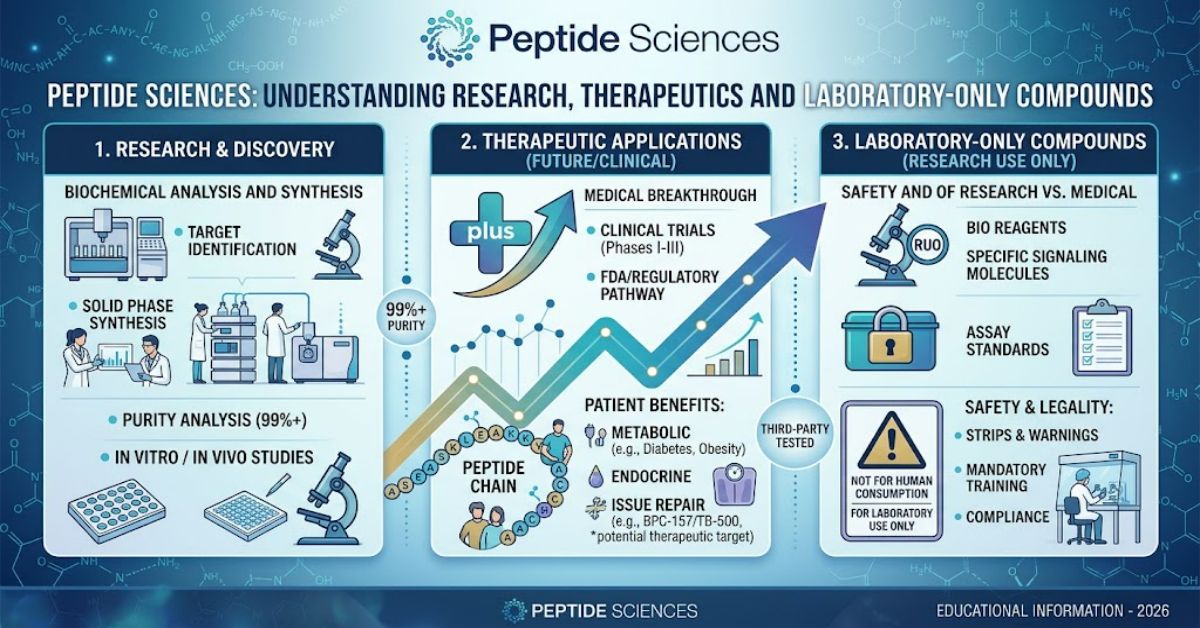
Peptide sciences cover the study, synthesis and application of peptides: short chains of amino acids that can act as signalling molecules and, in some cases, form the basis of approved medicines. The phrase can also appear in commercial contexts, particularly around online suppliers offering compounds labelled for laboratory research rather than human consumption. Those two meanings overlap in terminology but should not be treated as equivalent.
Scientifically, peptides occupy an important position between small-molecule drugs and larger proteins. Their amino-acid sequences can be designed to interact with specific biological targets, including receptors and signalling pathways. This specificity has made peptide-based therapeutics important in areas such as endocrinology, oncology, infectious disease and rare conditions. A 2024 update of the THPdb database identified 85 FDA-approved peptides or polypeptides within its catalogue of approved therapeutic proteins.
Commercial interest, however, has created a second and more complicated market. Some suppliers sell peptides with labels such as “research use only” or “not for human consumption”. Regulatory authorities have repeatedly warned that such wording does not determine a product’s legal status if surrounding marketing establishes an intended human use. FDA warning letters published between 2024 and 2026 illustrate this distinction.
Understanding peptide science therefore requires separating established biomedical research from unapproved commercial products and recognising that a promising biological mechanism is not the same as evidence of safety or clinical effectiveness.
What Are Peptides?
Peptides are molecules made from amino acids joined by peptide bonds. Their length and structure can vary, and their biological activity depends heavily on sequence, conformation, stability and interaction with a molecular target.
In the human body, peptide molecules participate in processes including hormone signalling, immune activity and cell communication. Researchers can also synthesise peptides and modify their chemical structures to improve properties such as stability, receptor selectivity or circulation time.
The central challenge is translation. A peptide may show an interesting effect in a laboratory assay without becoming a useful medicine. It must still survive manufacturing, formulation, pharmacokinetic testing, toxicity assessment and clinical trials.
Peptide Research Versus Approved Medicines
| Stage | Primary Purpose | Level of Human Evidence |
| Basic research | Study biological mechanisms | Often none |
| Preclinical development | Assess activity and safety models | No established clinical benefit |
| Clinical trials | Test safety and effectiveness in people | Controlled human evidence |
| Regulatory approval | Authorised use for defined indications | Evidence assessed by regulators |
| Research-use product | Laboratory investigation | Not equivalent to an approved medicine |
This distinction is one of the most important practical insights in the field. Chemical identity does not establish clinical suitability. Purity, formulation, route of administration, dosage, manufacturing controls and clinical evidence all matter.
How Peptide Therapeutics Are Developed
Modern peptide development combines medicinal chemistry, molecular biology, pharmacology and formulation science. Researchers may begin by identifying a biological target, then design or screen candidate sequences capable of binding to it.
Promising candidates face several recurring limitations. Natural peptides can be degraded by enzymes, cleared quickly from circulation or struggle to reach the intended tissue. Researchers therefore use approaches including amino-acid substitution, cyclisation, conjugation and delivery technologies to improve pharmacokinetic performance. Recent reviews describe advances in peptide design, synthesis and delivery as central to the field’s current progress.
The process is also expensive and selective. Many biologically active compounds never progress beyond early research because laboratory performance does not reliably predict clinical success.
The Practical Importance of Synthesis and Purity
Peptide synthesis is not simply a matter of producing the correct sequence. Researchers must also consider identity, purity, aggregation, degradation products and batch consistency.
A major analytical gap in consumer discussions is the difference between a claimed purity percentage and a complete assessment of product quality. A high headline purity figure may not answer every question about contaminants, peptide-related impurities, sterility or suitability for a particular application.
This matters especially for injectable products. FDA materials discussing several peptide substances identify potential concerns involving immunogenicity, aggregation, peptide-related impurities and limited human safety information.
Research-Use Products and Regulatory Boundaries
The phrase “research use only” is frequently misunderstood. It describes a stated limitation on intended use, but regulators can examine the wider context surrounding a product.
FDA warning letters issued to peptide sellers provide documented examples. In its 26 February 2025 letter to USApeptide.com, the agency stated that products described with phrases including “research use only” and “not for human consumption” were nevertheless considered drugs based on evidence of intended human use found in website and product claims.
A similar regulatory position appeared in warning letters published in 2024, 2025 and 2026 involving other peptide sellers. The analytical lesson is straightforward: a disclaimer cannot be evaluated in isolation from advertising, product presentation and implied use.
Key Risks and Trade-Offs
| Issue | Why It Matters | Practical Implication |
| Biological activity | A compound may affect multiple pathways | Mechanistic promise does not prove benefit |
| Stability | Peptides can degrade or aggregate | Formulation affects research reliability |
| Purity | Impurities may alter results | Independent analytical validation matters |
| Sterility | Especially relevant to injectable products | Chemical purity alone is insufficient |
| Human evidence | Many compounds lack adequate clinical data | Research findings should not be treated as treatment advice |
| Regulation | Intended use affects legal classification | “Research only” is not a universal legal shield |
Three Important Insights Often Missed in Peptide Discussions
First, purity is not the same as pharmaceutical quality. A laboratory certificate reporting chemical purity does not automatically demonstrate sterility, appropriate manufacturing controls or clinical suitability.
Second, the route of administration changes the risk profile. Injectable products bypass some of the body’s normal barriers, which is one reason regulators place particular emphasis on contamination and manufacturing concerns.
Third, scientific plausibility is not clinical proof. A peptide may bind to a receptor or produce measurable effects in cells or animal models without demonstrating that it safely improves outcomes in humans.
These distinctions are particularly important when scientific terminology moves from research papers into consumer marketing.
Market and Real-World Impact
Peptide research has moved beyond a narrow scientific niche. Approved peptide therapeutics now cover a range of medical areas, while research continues into drug delivery, cancer treatment, metabolic conditions and vaccine platforms. A 2024 review described major advances in screening, molecular design and delivery technologies while also highlighting persistent problems such as degradation and rapid clearance.
Documented regulatory action is equally part of the real-world picture. FDA warning letters provide named, verifiable examples of the friction between online peptide marketing and medicines regulation. They also demonstrate why consumers should distinguish established pharmaceutical products from compounds sold for experimental or laboratory purposes.
The Future of Peptide Sciences in 2027
The Future of Peptide Sciences in 2027 will likely be shaped by better molecular design, delivery systems and computational methods, but progress will still depend on conventional evidence standards.
Recent scientific reviews point towards continued work on structural modification, peptide-drug conjugates, targeted delivery and improved formulation. These technologies may help address longstanding limitations involving stability, degradation and tissue delivery.
At the same time, regulatory scrutiny of online products marketed with research disclaimers is unlikely to disappear. Warning letters issued as recently as 2026 show that regulators continue to examine whether product claims and presentation establish an intended human use despite “research only” wording.
The uncertain factor is which experimental compounds will ultimately generate strong clinical evidence. Interest in a biological pathway does not guarantee an approved therapy, and many candidates will fail during development. That limitation is not a weakness of the scientific process; it is part of how experimental findings are separated from clinically established treatments.
Key Takeaways
- Peptides are short amino-acid chains with important roles in biological signalling and pharmaceutical research.
- The field includes basic science, synthetic chemistry, pharmacology, drug delivery and clinical development.
- An approved peptide medicine and a laboratory compound may share terminology while having entirely different evidence and regulatory status.
- Purity claims alone do not establish sterility, manufacturing quality or suitability for human use.
- Recent regulatory action shows that “research use only” language does not automatically prevent a product from being treated as an unapproved drug when marketing indicates human use.
- The next stage of progress is likely to depend on improved stability, targeted delivery and rigorous clinical validation rather than marketing claims alone.
Conclusion
Peptide sciences represent an important area of modern biology and medicine because peptides can act as highly specific signalling molecules and therapeutic tools. Advances in synthesis, molecular design and delivery have expanded the range of questions researchers can investigate, while approved peptide medicines demonstrate that the field can produce clinically valuable treatments.
The growing commercial interest in experimental compounds, however, has made careful distinctions more important. A compound sold for laboratory research is not automatically an approved medicine, and a biological mechanism is not proof of safety or effectiveness. Recent regulatory actions involving online peptide sellers reinforce the importance of examining intended use, manufacturing quality and clinical evidence rather than relying on product labels alone.
The strongest approach to understanding this field is therefore evidence-led. Scientific interest should be separated from established therapeutic benefit, and promising research should be evaluated according to the quality of the data supporting it.
FAQs
What are peptide sciences?
Peptide sciences refer broadly to the study, synthesis and application of peptides, which are short chains of amino acids. The field includes molecular biology, medicinal chemistry, pharmacology, drug delivery and the development of peptide-based therapeutics.
Are peptides the same as proteins?
Both are made from amino acids, but peptides are generally shorter than proteins. The boundary is not always defined by a single universal length, as structure and biological context also matter.
Are research peptides approved medicines?
No. A peptide used or sold for laboratory research is not automatically an approved medicine. Regulatory approval requires evidence supporting safety, quality and effectiveness for a specific medical use.
What does “research use only” mean for peptide products?
It indicates that a supplier states the product is intended for research rather than human consumption. However, regulators may examine the wider marketing and intended use when determining a product’s legal status.
Why is peptide purity important?
Purity can affect experimental reliability, but a purity figure alone does not establish sterility, complete impurity characterisation or pharmaceutical-grade manufacturing. The required quality standard depends on the intended scientific application.
Are peptide-based drugs used in medicine?
Yes. Peptide-based medicines have approved uses across several therapeutic areas. However, each approved product has its own indication, formulation, safety profile and regulatory status.
What are the biggest challenges in peptide drug development?
Common challenges include enzymatic degradation, rapid clearance, limited oral bioavailability, formulation complexity and the need to demonstrate safety and effectiveness through clinical research.
Methodology
This article peptide sciences was developed from recent peer-reviewed reviews indexed through PubMed and regulatory materials published by the US Food and Drug Administration. The scientific sections focus on peptide structure, therapeutic development, formulation and delivery challenges. Regulatory analysis uses documented FDA warning letters and safety assessments as named case studies rather than inferring misconduct from unrelated suppliers.
The analysis does not involve hands-on testing of peptide products, laboratory experiments or clinical evaluation. It also does not assess the quality or legitimacy of any specific commercial supplier. Regulatory examples are included to explain the distinction between laboratory-use claims and products marketed with evidence of intended human use. The principal limitation is that regulatory requirements vary by jurisdiction; the cited FDA actions should therefore not be treated as a complete description of UK law.
This article peptide sciences was drafted with AI assistance and should be reviewed and independently verified by the human editorial team before publication.
References
Jain, S., Gupta, S., Patiyal, S., & Raghava, G. P. S. (2024). THPdb2: Compilation of FDA approved therapeutic peptides and proteins. Drug Discovery Today, 29(7), 104047. https://doi.org/10.1016/j.drudis.2024.104047
U.S. Food and Drug Administration. (2024, 10 December). Summit Research Peptides – 695607 – 12/10/2024.
U.S. Food and Drug Administration. (2025, 26 February). USApeptide.com – 696885 – 02/26/2025.
U.S. Food and Drug Administration. (2026, 31 March). Gram Peptides – 721806 – 03/31/2026.
U.S. Food and Drug Administration. (n.d.). Certain bulk drug substances for use in compounding that may present significant safety risks.
Wang, J., et al. (2024). Advance in peptide-based drug development: Delivery platforms, therapeutics and vaccines. Signal Transduction and Targeted Therapy.