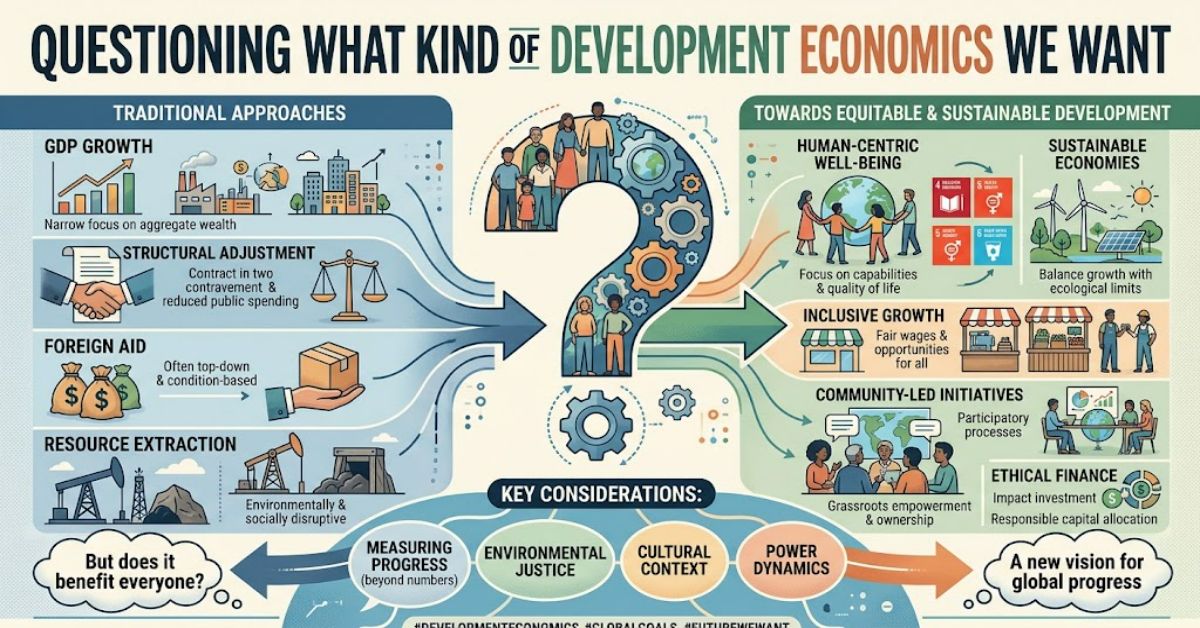
Questioning what kind of development economics we want means asking a deceptively simple question: what should economic development ultimately achieve? Traditional development economics has placed considerable emphasis on economic growth, productivity, employment, investment and poverty reduction. These remain important because people need incomes, productive economies, infrastructure and access to essential services.
The difficulty begins when GDP growth becomes a substitute for development itself.
GDP measures the value of goods and services produced within an economy. It is an important economic indicator, but it does not directly show whether people are healthier, whether income is distributed fairly, whether ecosystems are being degraded or whether economic improvements will remain available to future generations. The UK’s Office for National Statistics describes GDP as a sound but incomplete measure of economic progress because it does not capture all social and environmental effects or how growth is distributed.
This creates a broader question for development economics. Should the discipline primarily ask how economies can grow faster, or should it ask how economic systems can expand people’s capabilities, reduce deprivation, distribute opportunity and remain within environmental limits?
There is no single technical answer. Different countries face different constraints. A low-income country dealing with severe poverty may reasonably prioritise faster growth and employment, while a wealthier country may face stronger questions about inequality, resource consumption and quality of life.
The more useful debate, therefore, is not simply GDP versus everything else. It is about designing a development framework in which economic growth serves clearly defined human and environmental objectives.
What Development Economics Has Traditionally Tried to Solve
Development economics emerged partly from the problem that conventional economic indicators did not adequately explain why some societies remained poor despite changes in production, trade and investment.
Its subject matter covers poverty, labour markets, human capital, structural transformation, institutions, productivity, industrialisation, international trade, infrastructure and access to finance. Development economists have also examined why economic gains are distributed unevenly and why some countries struggle to convert resources into sustained improvements in living standards.
Growth still matters enormously. The World Bank’s 2024 Poverty, Prosperity, and Planet Report shows that poverty reduction has slowed considerably and argues that more inclusive growth, better jobs, education, infrastructure and basic services remain central to reducing poverty.
That evidence creates an important qualification to arguments that simply dismiss growth.
A development model focused on human welfare cannot ignore production. Without productive capacity, governments and households have fewer resources to invest in education, healthcare, housing, infrastructure and social protection.
The question is therefore about what growth is for, rather than whether growth has any value.
| Development objective | Traditional emphasis | Broader interpretation |
| Economic growth | Increase GDP and productivity | Increase productive capacity while examining who benefits |
| Poverty reduction | Raise household income | Reduce monetary and multidimensional deprivation |
| Employment | Create more jobs | Create productive, secure and fairly rewarded work |
| Human capital | Increase education and skills | Improve capabilities, health, learning and opportunity |
| Environment | Treat environmental effects as constraints | Integrate ecological sustainability into development decisions |
| Distribution | Consider inequality alongside growth | Treat access, opportunity and distribution as central outcomes |
Why GDP Cannot Carry the Whole Definition of Progress
GDP has major practical advantages. It is relatively standardised, widely available and useful for comparing changes in economic activity over time. Abandoning it would remove an important source of information.
The problem is that GDP answers a narrower question than the one development economics ultimately needs to answer.
An economy can increase production while experiencing worsening housing affordability, declining environmental quality or highly unequal gains. Conversely, investment in activities that improve long-term social conditions may not immediately generate dramatic GDP increases.
The UK’s current statistical framework illustrates this broader approach. The ONS’s national well-being framework covers economic, environmental, health, education, governance and social measures alongside GDP. Its September 2026 update continues to present GDP per head as one headline indicator among several, rather than as a complete measure of national progress.
This is an important conceptual shift.
The objective is not to replace one single indicator with another single indicator. It is to recognise that development is multidimensional.
Human Well-Being Changes the Question
A well-being-centred approach asks what economic systems enable people to do and experience.
That includes income, but also health, education, personal security, social connection, housing, environmental quality and the ability to participate in economic and civic life.
The OECD’s work on well-being and “Beyond GDP” similarly argues that assessing whether policies improve people’s lives requires economic, social and environmental outcomes to be considered together.
The practical consequence is that development policy can no longer be evaluated solely through aggregate output.
For example, an education programme might be judged not simply by the amount spent or its contribution to employment, but by whether learning outcomes improve and whether disadvantaged groups gain access to better opportunities.
Health spending can be assessed in terms of health outcomes and access rather than only its economic contribution.
Infrastructure can be examined through connectivity, affordability and resilience rather than construction expenditure alone.
This does not make GDP irrelevant. It places GDP in context.
Structural Equity: Who Receives the Gains?
Economic growth is an aggregate measure. Development is experienced by individuals and communities.
This distinction makes distribution important.
If national income increases substantially but most gains accrue to groups that already have high incomes, average growth may give an incomplete picture of changes in economic opportunity. The World Bank’s 2024 work on shared prosperity explicitly examines the distribution of income and argues that average income growth alone is not sufficient to assess development.
Structural equity goes further than simply measuring inequality after the fact. It asks whether institutions and markets provide meaningful access to education, finance, land, infrastructure, technology, employment and political-economic participation.
That matters because inequality can influence future growth itself. Unequal access to education, healthcare and productive assets can prevent people from developing their capabilities and contributing fully to the economy.
Three Indicators That Should Be Read Together
| Indicator | What it tells us | What it can miss |
| GDP per capita | Average economic output relative to population | Distribution, unpaid activity and environmental damage |
| Well-being measures | People’s reported quality of life and lived outcomes | Some structural economic conditions |
| Inequality measures | How income or wealth is distributed | Environmental sustainability and non-income outcomes |
| Environmental indicators | Resource pressure and ecological conditions | Household welfare and economic opportunity |
| Multidimensional poverty | Multiple forms of deprivation | Some macroeconomic constraints |
The insight is straightforward: no single indicator can adequately describe development.
Ecological Sustainability Is Not Separate From Development
Environmental sustainability is sometimes presented as a constraint on development, but that framing can be too narrow.
Environmental damage can directly affect development outcomes through agriculture, health, housing, infrastructure and household incomes. Climate-related shocks can push vulnerable households back into poverty after years of progress.
The World Bank’s 2024 report treats poverty, shared prosperity and a liveable planet as interconnected objectives. It identifies climate risks as a threat to poverty reduction and emphasises the need to manage trade-offs between income growth and emissions.
The UN Development Programme has developed a Planetary Pressures-adjusted Human Development Index, which adjusts human development for carbon dioxide emissions and material footprint. The measure reflects an attempt to consider human development alongside pressure placed on the planet.
This provides a useful analytical lesson. Development should not be judged only by the benefits created today. The resources and environmental conditions required to sustain those benefits also matter.
The Trade-Offs Are Real
A broader development model is not automatically easier to implement.
There can be genuine conflicts between objectives.
A developing country may need industrialisation to create jobs and raise incomes, while low-carbon technologies may initially involve higher capital costs. A government may want to expand infrastructure rapidly but face difficult questions about land, ecosystems and displacement. Social protection can reduce deprivation but requires fiscal capacity.
The World Bank explicitly identifies trade-offs between poverty reduction, shared prosperity and climate objectives rather than presenting them as automatically compatible.
| Policy choice | Potential development benefit | Potential trade-off |
| Industrial expansion | Jobs, exports, productivity | Pollution and resource use |
| Fossil-fuel subsidies | Lower short-term energy costs | Fiscal burden and emissions |
| Rapid infrastructure construction | Connectivity and economic activity | Land and ecological impacts |
| Redistribution | Reduced deprivation and inequality | Fiscal and incentive considerations |
| Green transition | Lower environmental pressure | Transition costs for workers and firms |
| Social investment | Better long-term capabilities | Requires sustained public finance |
This is where development economics remains fundamentally useful. It provides tools for assessing opportunity costs rather than assuming that every desirable objective can be maximised simultaneously.
Three Insights for a Broader Development Model
1. Growth should be treated as an instrument, not the complete objective.
GDP growth can create jobs, tax revenue and investment capacity, but its developmental value depends partly on how those gains translate into living conditions and opportunity.
2. Distribution should be assessed alongside production.
A country can become richer in aggregate while some communities remain excluded from the gains. The World Bank’s shared-prosperity framework demonstrates why distribution needs separate measurement rather than being inferred from average income.
3. Sustainability changes the time horizon of economic policy.
An investment can look beneficial over a five-year period while creating costs that emerge over several decades. Environmental accounting and natural-capital measures can therefore complement conventional national accounts. The ONS’s inclusive income and wealth framework, for example, incorporates unpaid household services, ecosystem services and human-capital depreciation alongside conventional economic measures.
These are not arguments against economics based on growth. They are arguments for a more complete definition of economic performance.
The Future of Questioning What Kind of Development Economics We Want in 2027
By 2027, the most significant change may be less about replacing GDP and more about building better measurement systems around it.
The UK’s ONS is already moving towards a framework that combines a smaller quarterly headline set with a broader annual set of national well-being measures. Its current framework covers 10 areas and includes measures related to the economy, health, education, environment, governance and social capital.
Internationally, the same direction is visible in work on well-being, inclusive prosperity and planetary pressures.
The technical challenge will be comparability. GDP benefits from decades of statistical infrastructure. New well-being and sustainability indicators vary in frequency, methodology and availability. The ONS has itself highlighted differences in data frequency and timing across measures.
That means future development economics is likely to need stronger statistical systems, more detailed household data and better environmental accounting.
The World Bank has also highlighted data gaps as a major obstacle to monitoring poverty and shared prosperity, including limited recent household-survey coverage in many countries.
The likely direction is therefore not “GDP disappears”. It is a more plural measurement architecture in which economic output, distribution, human capability and ecological sustainability are read together.
Key Takeaways
- GDP remains essential: It measures economic activity effectively but cannot represent every dimension of development.
- Growth needs context: The developmental value of growth depends on employment, distribution, public services and resilience.
- Well-being broadens measurement: Health, education, security and life satisfaction can reveal outcomes missed by output statistics.
- Inequality is structural: Distribution affects both present living standards and people’s ability to participate in future economic growth.
- Environmental limits matter: Ecological damage can undermine poverty reduction and long-term economic security.
- Trade-offs cannot be ignored: A broader model requires explicit choices between competing objectives and time horizons.
- Better data is foundational: More comprehensive development economics depends on reliable, comparable and timely measurements.
Conclusion
Questioning what kind of development economics we want is ultimately a question about measurement, priorities and time.
GDP remains one of the most useful indicators available for understanding economic activity. The problem arises when it is treated as a complete definition of progress. Development has wider dimensions: whether people can access education and healthcare, whether work provides reasonable opportunity, whether prosperity is broadly shared and whether economic gains can be maintained without exhausting environmental systems.
Recent work by the ONS, World Bank, OECD and UN Development Programme shows that this broader approach is already moving from academic discussion into practical measurement frameworks.
The strongest version of development economics does not require choosing between growth and human welfare as though they were always opposing objectives. Instead, it asks how productive economies can generate durable improvements in people’s lives while addressing inequality and ecological pressures.
That makes development a question of quality, distribution and durability as well as quantity.
Frequently Asked Questions
What does questioning what kind of development economics we want mean?
It means examining whether economic development should be judged only through GDP growth or through a wider combination of income, well-being, equality, opportunity and environmental sustainability.
Why is GDP not enough to measure development?
GDP measures economic output, but it does not directly measure income distribution, health, life satisfaction, environmental damage, unpaid household work or access to many public services.
What is development economics concerned with?
Development economics studies poverty, economic growth, productivity, employment, inequality, human capital, institutions, infrastructure and structural transformation, particularly in economies undergoing significant economic and social change.
How does well-being fit into development economics?
Well-being provides information about outcomes experienced by people. Measures can include life satisfaction, health, education, security and social conditions alongside conventional economic indicators.
Can economic growth and ecological sustainability coexist?
They can, but the relationship involves trade-offs and depends on technology, energy systems, investment choices, regulation and how transition costs are distributed. The World Bank identifies managing these trade-offs as a central development challenge.
What does structural equity mean in development?
Structural equity concerns whether people and communities have fair access to resources and opportunities such as education, healthcare, finance, infrastructure, productive employment and economic participation.
Methodology
This article was developed using recent material from the Office for National Statistics, World Bank, OECD and United Nations Development Programme, with priority given to institutional and primary sources. The analysis distinguishes between GDP as an established economic measure and broader frameworks designed to assess well-being, distribution and environmental sustainability.
The main limitation is that development outcomes vary substantially between countries. A policy appropriate for a low-income economy facing severe deprivation may not have the same relevance in a high-income economy with different fiscal, environmental and demographic conditions. The article therefore does not present one universal development model.
The evidence also supports a balanced position: faster and more inclusive growth remains important for poverty reduction, while growth alone does not capture every dimension of human welfare or sustainability.
Editorial disclosure: This article was drafted with AI assistance. Named statistics, institutional claims and references should be independently checked by a human editor against the original sources before publication.
References
Office for National Statistics. (2025, 28 May). Measuring progress, well-being and beyond GDP in the UK: May 2025. Office for National Statistics.
Office for National Statistics. (2025, 23 December). Inclusive income and wealth, UK quality and methods guide. Office for National Statistics.
Office for National Statistics. (2026, 18 September). Beyond GDP insights, UK headline measures of national well-being: September 2026. Office for National Statistics.
Office for National Statistics. (2026, 18 September). UK Measures of National Well-being framework user guide. Office for National Statistics.
Organisation for Economic Co-operation and Development. (n.d.). Well-being and beyond GDP. OECD.
United Nations Development Programme. (n.d.). Planetary pressures-adjusted Human Development Index. Human Development Reports.
World Bank. (2024). Poverty, Prosperity, and Planet Report 2024: Pathways out of the polycrisis. World Bank.
World Bank. (2024, 15 October). Ending poverty for half the world could take more than a century. World Bank.