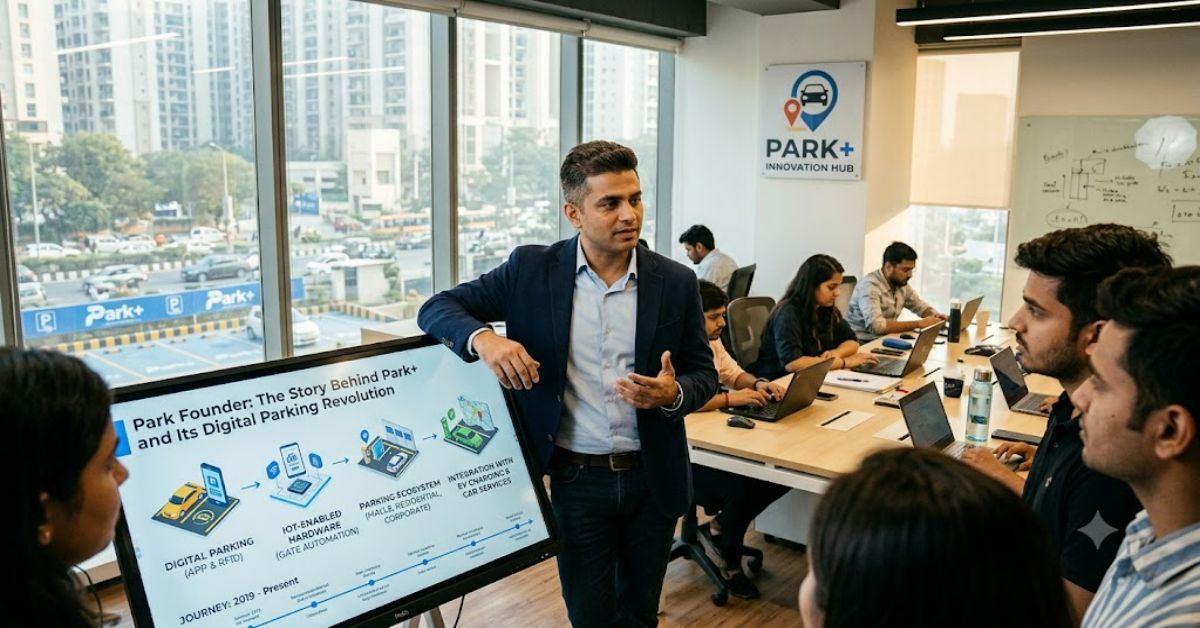
The story behind the park founder journey begins with a simple urban problem: finding parking in crowded cities. Founded in 2019 by Amit Lakhotia, a former Paytm and Tokopedia executive, along with Hitesh Gupta, Park+ was created to address the growing difficulties faced by vehicle owners in India’s expanding urban centres.
Indian cities have experienced rapid increases in private vehicle ownership, creating pressure on parking infrastructure, traffic management, and vehicle services. The founders recognised that parking was not an isolated problem but part of a larger vehicle ownership ecosystem.
Rather than building only a parking marketplace, Park+ developed a broader technology platform combining parking discovery, FASTag management, car-related services, and digital vehicle solutions.
The company’s approach reflects a wider transformation in mobility technology. Modern drivers increasingly expect smartphone-based solutions for tasks that were traditionally offline, from locating parking spaces to managing toll payments.
The Background of Park+ and Its Founding Vision
Amit Lakhotia brought experience from major technology companies, including Paytm and Tokopedia, before launching Park+. His background in digital payments and consumer technology influenced the company’s approach towards solving practical mobility challenges through software.
The second founder, Hitesh Gupta, joined in developing the platform’s technology and business operations. Together, they focused on creating a system where vehicle owners could access multiple services through one digital platform.
The founding idea was based on a key observation: owning a car involves many daily challenges beyond driving.
These include:
- Finding reliable parking spaces
- Paying highway tolls
- Managing vehicle documentation
- Accessing vehicle-related information
- Connecting with automotive service providers
Park+ attempted to combine these fragmented experiences into one connected ecosystem.
| Area | Traditional Challenge | Park+ Approach |
| Parking | Drivers spend time searching for spaces | Digital parking discovery and management |
| Toll payments | Manual payment systems | FASTag-related services |
| Vehicle management | Multiple disconnected services | Centralised digital tools |
| Urban mobility | Limited technology integration | Data-driven solutions |
How Park+ Expanded Beyond Parking
Although parking was the original focus, the company quickly expanded its scope. This reflects a common pattern among mobility technology companies: solving one problem often reveals connected opportunities.
A parking platform naturally collects valuable vehicle-related information. Understanding where vehicles travel, when users need services, and how drivers interact with infrastructure creates opportunities for additional products.
Park+ developed services around:
FASTag Management
FASTag became a major digital infrastructure development in India after the government promoted electronic toll collection through the National Highway Authority of India (NHAI).
Park+ entered this space by helping users manage FASTag-related activities, making toll payments and account management easier.
Vehicle Services
Modern vehicle ownership involves insurance, maintenance, resale decisions, and compliance requirements. Digital platforms can simplify these processes by connecting users with relevant services.
Smart Parking Infrastructure
The company also explored technology-driven parking solutions for businesses, residential communities, and commercial spaces.
This approach places Park+ within the broader smart city movement, where sensors, software, and data analytics improve urban efficiency.
The Technology Model Behind Park+
The strength of Park+ comes from combining consumer applications with mobility infrastructure.
Unlike traditional parking operators, technology-driven platforms rely on several digital components:
- Mobile applications
- Location-based services
- Payment integration
- Data analytics
- Partner networks
- Vehicle databases
This creates a technology ecosystem rather than a single-service product.
A key strategic advantage is network effect. As more drivers use a platform, more businesses and parking providers have incentives to participate.
However, building this network also creates challenges. Parking availability varies significantly between cities, and digital solutions depend on cooperation from property owners, commercial operators, and local authorities.
Strategic Challenges Facing Park+
The vision behind Park+ is ambitious, but smart mobility platforms face several practical limitations.
Infrastructure Dependency
A parking application cannot solve physical shortages of parking spaces. If urban planning does not support organised parking facilities, technology alone has limited impact.
Data Accuracy
Real-time parking information requires accurate data. Outdated availability information can reduce user trust.
Competition
The mobility technology sector includes automotive companies, navigation platforms, payment providers, and government-backed systems. Maintaining differentiation requires continuous innovation.
| Challenge | Impact on Business | Possible Response |
| Limited parking infrastructure | Restricts expansion | Partnerships with property owners |
| User adoption barriers | Slower growth | Better customer experience |
| Competition | Pressure on pricing and features | Wider service ecosystem |
| Data management | Trust issues | Improved analytics systems |
Market Impact of Park+ in India’s Mobility Sector
India’s automotive market has changed significantly over the past decade. Rising vehicle ownership, smartphone adoption, and digital payments have created opportunities for mobility platforms.
According to industry reports, India’s urban population growth is increasing demand for efficient transport solutions. Smart mobility companies are attempting to bridge the gap between physical infrastructure and digital convenience.
Park+ represents a broader industry trend: cars are becoming connected devices rather than standalone machines.
The future vehicle experience is increasingly influenced by software, from payments and navigation to maintenance and ownership records.
The Future of Park+ in 2027
By 2027, Park+ and similar mobility platforms are likely to focus increasingly on connected vehicle ecosystems.
Several developments may influence the sector:
- Expansion of electric vehicle infrastructure
- Greater use of artificial intelligence in mobility services
- Increased integration between vehicles and smart city systems
- More digital management of ownership services
However, growth will depend on practical execution. Smart mobility requires cooperation between technology companies, automobile manufacturers, property developers, and government bodies.
Regulatory frameworks around digital payments, vehicle data, and urban infrastructure will also shape future opportunities.
The strongest platforms will likely be those that move beyond individual services and become complete mobility management systems.
Key Takeaways
- Park founder was created to solve urban parking challenges but expanded into wider vehicle management services.
- The company’s founders identified that car ownership involves multiple connected problems.
- Digital mobility platforms depend on infrastructure partnerships as much as technology.
- FASTag and vehicle services helped Park+ broaden its market relevance.
- Future growth will depend on smart city development and connected vehicle adoption.
Conclusion
The story of the park founder journey reflects a larger transformation happening across urban mobility. Amit Lakhotia and Hitesh Gupta built Park+ around the idea that technology could simplify everyday vehicle ownership challenges.
The company’s evolution from parking discovery to a broader mobility ecosystem demonstrates how digital platforms can address fragmented consumer experiences. However, success depends on more than software. Infrastructure availability, partnerships, data reliability, and user trust remain critical factors.
As cities become more connected, companies like Park+ represent the growing relationship between technology and transportation. The next phase of mobility will likely be defined by platforms that make vehicles easier to manage, cities easier to navigate, and everyday journeys more efficient.
Frequently Asked Questions
Who is the park founder?
The founders of Park+ are Amit Lakhotia and Hitesh Gupta. The company was launched in 2019 to provide digital parking and vehicle management solutions.
When was Park+ founded?
Park+ was founded in 2019 in India with the goal of improving parking access and creating digital tools for vehicle owners.
What services does Park+ provide?
Park+ provides parking discovery, FASTag services, vehicle-related tools, and mobility solutions designed for car owners and businesses.
Is Park+ only a parking application?
No. Although parking was its original focus, Park+ expanded into wider automotive technology services.
Why was Park+ created?
Park+ was created to address problems caused by increasing vehicle ownership, including parking difficulties and fragmented vehicle services.
What is the future of smart parking technology?
Smart parking is expected to become more connected through artificial intelligence, sensors, mobile platforms, and smart city infrastructure.
Methodology
This article Park founder was prepared using publicly available company information, industry reports, and documented information about Park+ and India’s mobility technology sector.
Sources were reviewed for company history, founder background, digital mobility trends, and smart transportation developments. The analysis focuses on publicly available information and does not include private company data or unpublished performance metrics.
Limitations include the lack of publicly available operational data covering every aspect of Park founder internal technology systems and business performance.
References
National Highway Authority of India. (2024). Electronic Toll Collection and FASTag Programme. NHAI.
Government of India Ministry of Road Transport and Highways. (2024). Digital initiatives in road transport and mobility services. Ministry of Road Transport and Highways.
Park+. (2024). Company information and mobility solutions overview. Park+.
NITI Aayog. (2023). Transforming mobility in India through digital innovation. Government of India.