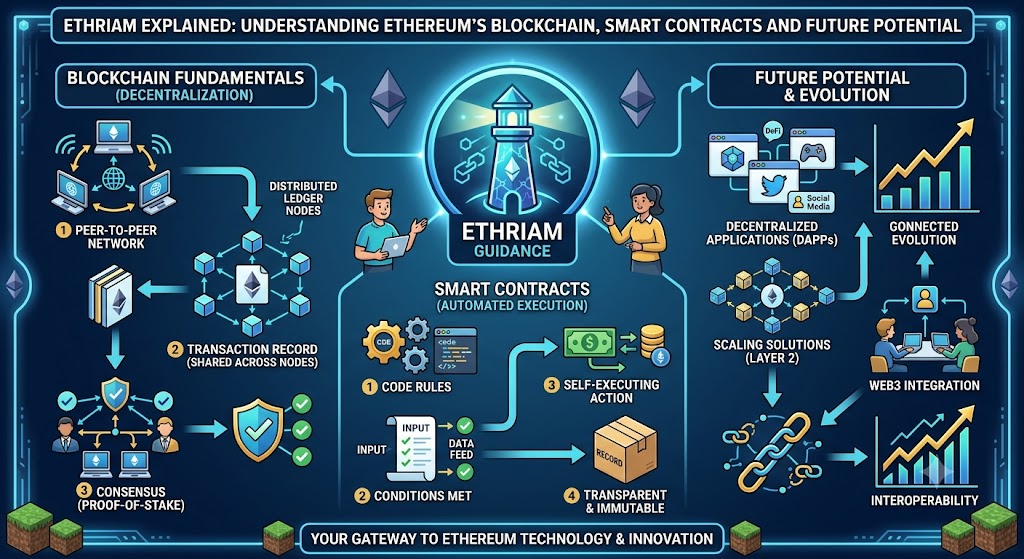
Ethriam is commonly used as a misspelt reference to Ethereum, one of the world’s most recognised blockchain networks. Ethereum is a decentralised, open-source computing platform that allows developers to build smart contracts and decentralised applications (dApps) without relying on traditional intermediaries.
Launched in July 2015, Ethereum expanded the concept of blockchain beyond simple digital payments. While early cryptocurrencies focused mainly on transferring value, Ethereum introduced programmable agreements that could automatically execute transactions when predefined conditions were met.
Powered by its native cryptocurrency Ether (ETH), the network supports a wide range of applications, including decentralised finance (DeFi), non-fungible tokens (NFTs), stablecoins, and tokenised real-world assets.
The importance of Ethereum lies in its role as an infrastructure platform rather than only a digital currency. It provides developers, businesses, and financial institutions with a programmable environment for building blockchain-based services.
How Ethereum Works as a Decentralised Computing Network
Traditional online services usually depend on central servers controlled by companies or governments. Ethereum operates differently through a distributed network of computers called nodes.
These nodes maintain a shared record of transactions known as the blockchain. Instead of a single organisation controlling data, thousands of participants validate and store information across the network.
The core components include:
| Component | Purpose |
| Blockchain | Records transactions and smart contract activity |
| Ether (ETH) | Network currency used for payments and transaction fees |
| Smart contracts | Self-executing programmes stored on the blockchain |
| Nodes | Computers maintaining network security |
| Decentralised applications | Services built on Ethereum infrastructure |
Smart contracts are one of Ethereum’s defining features. They are computer programmes that automatically perform actions when specific conditions are satisfied.
For example, a lending platform can use smart contracts to manage deposits, calculate interest, and process withdrawals without requiring a traditional bank.
Ethereum’s Role in Decentralised Finance and Digital Assets
One of Ethereum’s biggest contributions has been the growth of decentralised finance. DeFi applications allow users to access financial services such as lending, trading, and borrowing through blockchain-based protocols.
Unlike traditional financial systems, many DeFi platforms operate through automated code rather than central institutions.
However, this model introduces both opportunities and risks.
| Opportunity | Challenge |
| Global access to financial tools | Smart contract vulnerabilities |
| Reduced dependence on intermediaries | Regulatory uncertainty |
| Transparent transaction records | Network complexity |
| Programmable financial products | User security responsibilities |
Ethereum has also become a major platform for tokenised assets. Companies and institutions are exploring blockchain-based representations of property, financial instruments, and other real-world assets.
This development has increased interest from businesses looking for more efficient settlement systems and transparent ownership records.
Ethereum’s Major Upgrade: The Move to Proof of Stake
A significant moment in Ethereum’s history occurred on 15 September 2022, when the network completed “The Merge”.
The upgrade changed Ethereum’s consensus mechanism from proof of work to proof of stake. Instead of relying on energy-intensive mining, the network now uses validators who lock up ETH to help secure transactions.
The change reduced Ethereum’s energy consumption significantly and improved the foundation for future scaling improvements.
| Development | Date | Impact |
| Ethereum launch | July 2015 | Introduced programmable blockchain applications |
| The Merge | 15 September 2022 | Transitioned to proof of stake |
| Layer-2 expansion | 2023 onwards | Improved transaction capacity |
| Tokenisation growth | 2024 onwards | Increased institutional interest |
Strategic Importance for Businesses and Developers
Ethereum has become important because it provides a shared infrastructure layer for digital services.
Businesses can use blockchain technology for:
- Automated agreements
- Digital identity systems
- Asset tracking
- Transparent payment systems
- Tokenised ownership models
Developers benefit from Ethereum’s established ecosystem, programming tools, and large community. However, building on blockchain technology requires specialised knowledge of security practices, smart contract development, and network costs.
A key limitation remains transaction efficiency. Although improvements have been made, users may still experience higher fees during periods of heavy network activity.
Risks and Trade-Offs of Ethereum Adoption
Despite its advantages, Ethereum faces several challenges.
Security risks:
Smart contracts are powerful but mistakes in code can lead to financial losses. Unlike traditional systems, blockchain transactions are often irreversible.
Regulatory uncertainty:
Governments worldwide continue developing rules around cryptocurrencies and digital assets. Regulations may influence how businesses use blockchain technology.
Complex user experience:
Wallet management, private keys, and transaction fees can be difficult for newcomers compared with conventional online services.
These factors mean Ethereum adoption requires careful planning, especially for organisations handling significant financial value.
The Future of Ethereum in 2027
By 2027, Ethereum’s development is expected to focus heavily on scalability, efficiency, and institutional adoption.
Layer-2 networks, which process transactions separately while using Ethereum’s security foundation, are likely to remain important. These systems aim to reduce costs and improve transaction speeds.
Regulatory frameworks will also shape Ethereum’s future. Financial authorities, including the UK’s Financial Conduct Authority (FCA), continue monitoring digital asset markets and developing approaches to consumer protection.
Another major trend is tokenisation. Financial institutions are increasingly exploring blockchain-based systems for representing traditional assets digitally.
However, future growth is not guaranteed. Competition from alternative blockchain networks, regulatory changes, and technical challenges could influence Ethereum’s position.
Key Takeaways
- Ethriam is commonly a spelling variation of Ethereum, a major blockchain platform.
- ethriam introduced smart contracts that expanded blockchain use beyond digital payments.
- Ether (ETH) powers transactions and network activity.
- The 2022 proof-of-stake transition improved Ethereum’s energy efficiency.
- Future adoption depends on scalability, regulation, and practical business applications.
Conclusion
Ethereum represents one of the most influential developments in blockchain technology. Its ability to support programmable applications has created an ecosystem extending far beyond cryptocurrency trading.
The platform has enabled innovations in decentralised finance, digital ownership, and automated agreements while also facing challenges involving security, regulation, and usability.
As blockchain technology continues developing, Ethereum’s success will depend on balancing innovation with reliability. Its future will be shaped not only by technical upgrades but also by how effectively businesses, governments, and users integrate decentralised systems into everyday activities.
The coming years will determine whether Ethereum remains the leading foundation for blockchain applications or becomes one of several competing digital infrastructure platforms.
Frequently Asked Questions
What is ethriam?
Ethriam is usually a misspelling of Ethereum, a decentralised blockchain platform designed for smart contracts, digital applications, and cryptocurrency-based systems.
Is Ethereum only a cryptocurrency?
No. Ethereum includes Ether (ETH), but the network itself is a programmable blockchain infrastructure used for applications and digital services.
What are Ethereum smart contracts?
Smart contracts are automated blockchain programmes that execute actions when specific conditions are met, reducing the need for intermediaries.
Why did Ethereum change to proof of stake?
Ethereum moved to proof of stake in 2022 to reduce energy consumption and improve the foundation for future scaling.
Can businesses use Ethereum?
Yes. Businesses use Ethereum for areas such as tokenisation, automated agreements, digital assets, and blockchain-based applications.
Methodology
This article was prepared using publicly available blockchain documentation, Ethereum Foundation resources, regulatory information, and established technology references. The analysis focuses on ethriam technical structure, business applications, and future challenges.
Limitations include the rapidly changing nature of blockchain regulation and technology development. Future outcomes remain dependent on market conditions, adoption patterns, and policy decisions.
References (APA Style)
Ethereum Foundation. (2024). Ethereum documentation and ecosystem resources. Ethereum Foundation.
Financial Conduct Authority. (2024). Cryptoasset regulation and consumer information. FCA.
Nakamoto, S. (2008). Bitcoin: A peer-to-peer electronic cash system.
Buterin, V. (2014). A next-generation smart contract and decentralised application platform. Ethereum Foundation.