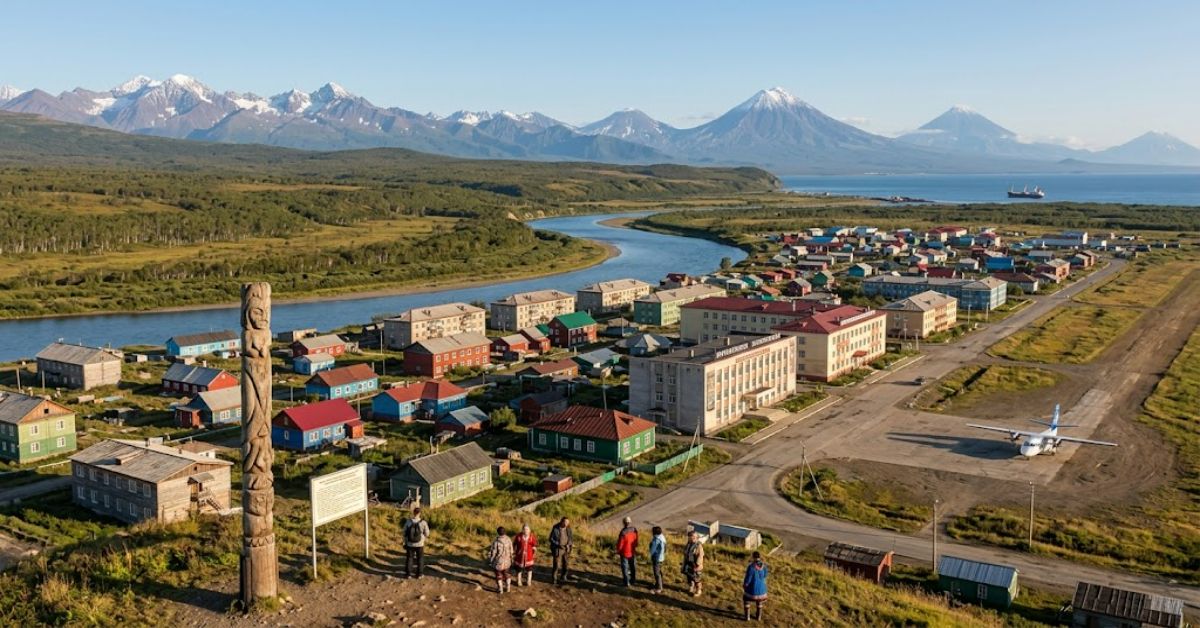
Palana is a remote urban-type settlement in Russia’s Far East and the administrative centre of Koryak Okrug, a special-status administrative area within Kamchatka Krai. Located on the western side of the Kamchatka Peninsula, it is far removed from the region’s main urban centre, Petropavlovsk-Kamchatsky. As of 1 January 2025, the local government recorded a population of 2,625 people.
The settlement is significant because its importance is administrative as much as it is demographic. Palana served as the centre of the former Koryak Autonomous Okrug until 1 July 2007, when the autonomous okrug was merged with Kamchatka Oblast to form modern Kamchatka Krai. Koryak Okrug retained a special administrative status after the merger, with Palana continuing as its centre.
For visitors and researchers, the settlement offers a different perspective on Kamchatka from the volcanic landscapes and wildlife commonly associated with the peninsula. Its story is tied to the geography of northern Kamchatka, Indigenous Koryak culture, local government and the practical challenges of maintaining a community in a remote sub-Arctic environment.
Palana is therefore best understood not as a conventional Russian town, but as a regional administrative and cultural hub whose role is shaped by isolation, geography and history.
Where Is Palana?
Palana lies in the western part of the Kamchatka Peninsula, on the Palana River near the coast of the Sea of Okhotsk. Its position gives it access to surrounding rivers, coastal areas and the wider territory of Koryak Okrug.
The settlement is geographically isolated from Kamchatka’s major southern population centres. This isolation affects almost every aspect of local life, from transportation and food supply to construction and public services.
| Feature | Palana |
| Country | Russia |
| Region | Kamchatka Krai |
| Administrative area | Koryak Okrug |
| Settlement status | Urban-type settlement |
| Population | 2,625 as of 1 January 2025 |
| Municipal area | 4,650 km² |
| Local time | UTC+12 |
| Main airport | Palana Airport |
The local government describes the municipal territory as covering approximately 4,650 square kilometres, despite the settlement itself having a relatively small population.
That contrast is important. Palana’s administrative footprint is much larger than its built-up area, reflecting its role in a sparsely populated northern territory.
The Administrative Role of Palana
Palana’s political importance predates the formation of modern Kamchatka Krai.
Until 2007, the settlement was the administrative centre of the Koryak Autonomous Okrug, which was a separate federal subject of Russia. On 1 July 2007, the Koryak Autonomous Okrug and Kamchatka Oblast were merged into Kamchatka Krai. Palana did not lose its regional importance, however. It became the administrative centre of Koryak Okrug, which retained special status within the new krai.
This arrangement creates an unusual administrative structure. Palana is not the capital of Kamchatka Krai; that role belongs to Petropavlovsk-Kamchatsky. Instead, Palana administers and represents a distinct northern territory within the larger regional system.
The distinction matters because it helps explain why a settlement of only a few thousand people can support government offices, public services and administrative institutions disproportionate to its population.
A Strong Koryak Cultural Connection
Koryak heritage is central to the identity of the wider region. The Koryak people have traditionally occupied parts of northeastern Siberia and the Kamchatka Peninsula, with cultural practices historically linked to fishing, hunting, reindeer herding and coastal life.
Palana developed as an important administrative and cultural centre for Koryak communities. Its institutions continue to operate within this wider cultural context.
This makes the settlement different from many larger Russian cities. Its importance cannot be measured simply through population or economic output. Administrative representation and cultural continuity are equally significant.
For visitors interested in Indigenous cultures, the surrounding region offers a valuable opportunity to understand how geography, traditional livelihoods and modern government intersect.
Transport and Life in a Remote Settlement
Transport is one of Palana’s defining practical challenges.
Palana Airport is located about four kilometres west of the settlement. The airport is a certified Class D airfield and is capable of receiving several types of aircraft and helicopters, including An-28, An-38 and L-410 aircraft, alongside various helicopter models.
| Infrastructure | Practical importance |
| Palana Airport | Passenger and regional air connections |
| River and coastal access | Movement of supplies and local transport |
| Road network | Primarily supports local and regional movement |
| Municipal administration | Public services and local governance |
| Fuel supply system | Essential for heating, transport and electricity |
Air transport is particularly important because conventional road connections across the wider Kamchatka territory are limited. Weather can also affect flights, making logistics more complicated than in densely connected parts of Russia.
The local administration’s 2026 notices illustrate the continuing importance of fuel logistics. A municipal procurement notice published in March 2026 concerned the supply of diesel fuel and petrol for local government needs.
This is more than an administrative detail. In remote northern communities, fuel availability is directly connected to heating, transport, electricity generation and the movement of essential goods.
Climate and Infrastructure Challenges
Palana’s northern location creates a demanding operating environment. Long winters, freezing temperatures and seasonal weather can increase the cost of maintaining buildings, roads, aircraft facilities and utility networks.
Remote communities also face a structural disadvantage: goods that are inexpensive to move in major cities can become costly when they must be transported over long distances.
This creates a practical chain of dependence.
Distance → transport costs → higher supply costs → infrastructure pressure
The effect can extend from household goods to construction materials and fuel. It also means that infrastructure resilience is particularly important.
One useful insight from Palana’s current municipal administration is that local government remains closely involved in practical community issues, including public services, land-use planning, social programmes and employment-related concerns. Recent municipal notices include discussions on land-use and development regulations as well as support programmes for local communities.
Palana Compared with Other Kamchatka Centres
Palana should not be compared directly with Petropavlovsk-Kamchatsky simply on population or economic scale. Their functions are fundamentally different.
| Factor | Palana | Petropavlovsk-Kamchatsky |
| Main role | Koryak regional centre | Capital of Kamchatka Krai |
| Scale | Small | Major regional city |
| Location | Northern/western Kamchatka | Southeastern Kamchatka |
| Administrative importance | Koryak Okrug | Entire Kamchatka Krai |
| Transport environment | Highly remote | Better connected |
| Cultural role | Strong Koryak regional identity | More diverse urban identity |
The comparison highlights Palana’s real significance: it is a specialised regional centre rather than a large commercial city.
What Makes Palana Distinctive?
Three factors make the settlement particularly interesting.
First, its administrative role survived a major territorial reorganisation in 2007. The former autonomous okrug disappeared as a separate federal subject, but Palana continued to function as its centre within the new structure.
Second, its small population does not reflect the scale of the territory it serves. The municipal area is approximately 4,650 square kilometres, while the settlement itself has only a few thousand residents.
Third, its infrastructure reveals the realities of remote northern life. The airport, fuel supply arrangements and public administration are not secondary services; they are essential components of regional resilience.
These factors provide a more useful way of understanding Palana than treating it simply as an obscure point on a map.
The Future of Palana in 2027
By 2027, Palana’s central challenges are likely to remain tied to connectivity, infrastructure, public services and economic resilience.
There is little evidence to suggest that the settlement is about to become a large urban centre, and its geography makes rapid population growth difficult to assume. A more realistic future is continued development as a specialised administrative and service hub for Koryak Okrug.
Current municipal activity shows continued attention to local development, community support and land-use planning. In August 2026, the administration announced public hearings concerning amendments to land-use and development regulations.
The more important question is therefore not whether Palana will become larger, but whether its existing infrastructure can remain reliable and affordable.
For a remote settlement, resilience can be more valuable than rapid expansion. Reliable air links, fuel supplies, public services and community institutions are likely to have a greater practical impact than large-scale urban development.
Key Takeaways
- Palana is the administrative centre of Koryak Okrug within Kamchatka Krai.
- The settlement had 2,625 residents as of 1 January 2025.
- It was the centre of the Koryak Autonomous Okrug before the 2007 regional merger.
- Koryak cultural heritage remains an important part of the area’s identity.
- Air transport is essential because of the settlement’s geographic isolation.
- Fuel and infrastructure logistics have an unusually large influence on local resilience.
- Its future is more likely to centre on maintaining regional services than rapid urban expansion.
Frequently Asked Questions
What is Palana in Russia?
Palana is an urban-type settlement in Kamchatka Krai and the administrative centre of Koryak Okrug. It is located in the northern part of the Kamchatka Peninsula.
Where is Palana located?
Palana is situated in western Kamchatka, near the Sea of Okhotsk and the Palana River. Its remote location places it far from the principal urban centres of southern Kamchatka.
How many people live in Palana?
The local government recorded a population of 2,625 people as of 1 January 2025.
Why is Palana important?
Its importance comes from its administrative and cultural role. It serves as the centre of Koryak Okrug and supports public administration and services across a large, sparsely populated territory.
Is Palana the capital of Kamchatka?
No. Petropavlovsk-Kamchatsky is the administrative centre of Kamchatka Krai. Palana is the administrative centre of Koryak Okrug, which has special administrative status within the krai.
When did Palana become an urban-type settlement?
Palana received urban-type settlement status in 1962. It subsequently became the administrative centre of the Koryak Autonomous Okrug and retained regional administrative importance after the 2007 merger.
Methodology
This article was prepared from current municipal information published by the administration of Palana, regional administrative records and publicly available historical and infrastructure sources. Population, municipal area, administrative status and airport information were cross-checked against institutional material.
No personal visit, interview or firsthand field inspection was conducted. Accordingly, the article does not present invented observations or personal travel experiences as firsthand evidence. Historical and administrative claims are based on documented sources, while discussion of future development is presented as measured analysis rather than prediction.
The article also recognises a limitation: remote northern communities can change quickly because transport schedules, infrastructure programmes, demographic conditions and public funding are subject to regional policy and environmental factors.
AI Editorial Disclosure: This article was drafted with AI assistance and should be independently reviewed and fact-checked by the publication’s editorial team before publication.
References
Administration of the Urban Okrug “Settlement of Palana”. (2026). Official municipal information and public notices.
Airports of Kamchatka. (2026). Palana Airport: Airport passport and technical characteristics.
Legislative Assembly of Kamchatka Krai. (2026). Urban Okrug “Settlement of Palana”.
Russian Federation. (2008). Law of Kamchatka Krai No. 46 on the administrative-territorial structure of Kamchatka Krai.
World Bank. (2021). Russian Federation: Indigenous peoples and regional development context. World Bank.