now.gg is a mobile cloud gaming platform designed to let users play supported Android games through a browser rather than downloading them to a phone, tablet or computer. The company describes its service as an ad-supported cloud gaming system, meaning users can access games without paying a conventional subscription for the cloud session.
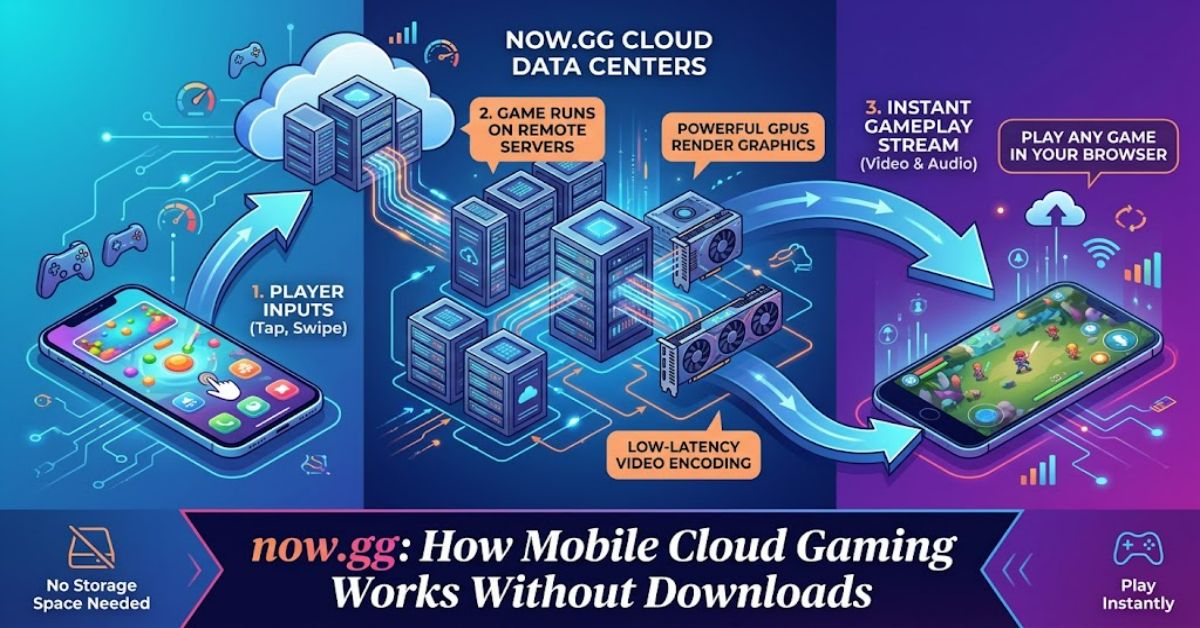
The model changes where the demanding computing work happens. Instead of relying entirely on the user’s device to install, store and render a mobile game, much of that workload is handled remotely. The resulting gameplay is streamed to the browser.
That distinction matters. A player with limited storage can potentially access a large game without first clearing space for an installation. Someone using a Chromebook, Windows computer or another supported device can also access mobile titles without relying on a conventional Android installation.
The platform is operated by now.gg, Inc., which states that it is headquartered in Campbell, California, with offices in London, Delhi, Tokyo, Seoul and Beijing. The company says its workforce exceeds 500 employees across more than 20 countries.
How now.gg works
The simplest way to understand now.gg is as a remote Android environment delivered through the internet.
When a supported game is launched, the game runs within the cloud infrastructure rather than being fully installed on the local device. The browser receives the streamed output while sending player inputs back to the remote environment.
This architecture provides three important benefits: reduced local storage requirements, wider device access and faster entry into supported games.
| Feature | Traditional mobile installation | now.gg cloud model |
| Game installation | Required | Generally not required |
| Local storage | Game files occupy storage | Minimal game storage locally |
| Processing | Primarily local device | Cloud infrastructure |
| Access method | Installed app | Web browser |
| Internet dependency | Moderate | High |
| Device flexibility | Limited by operating system and hardware | Broader browser-based access |
The difference is particularly useful for users whose hardware is capable of running a browser but unsuitable for installing or comfortably running demanding mobile software.
now.gg also promotes a distributed Android architecture through its nowCloudOS platform. The company describes this as an approach that distributes computing workloads through cloud infrastructure while maintaining compatibility with existing Android applications.
Why the platform appeals to players
The strongest argument for now.gg is convenience.
Downloading a large mobile game can involve waiting, storage management, updates and compatibility checks. Cloud delivery removes much of that friction. A player can select a supported title and start from the browser.
The platform’s current catalogue also extends beyond conventional mobile games. Its website features categories including browser, casual, strategy, simulation, role-playing, action, adventure, puzzle, arcade, sports and educational games.
This creates an important information-gain insight: now.gg is not simply competing with app stores on installation convenience. It is gradually behaving more like a browser-based distribution layer for interactive content.
For developers, that distinction can be valuable. now.gg says developers can host mobile games on its cloud platform and publish browser-accessible links without requiring additional app modification in the standard workflow. Its developer tools include testing and production environments for Android and HTML5 games.
That can shorten the distance between discovering a game and actually playing it.
The trade-offs behind free cloud gaming
The convenience comes with limitations.
The first is latency. Cloud gaming cannot eliminate the physical distance between a player, network infrastructure and the server running the game. A weak Wi-Fi connection, network congestion or high latency can create input delays, visual degradation or interruptions.
That makes fast-paced competitive games more demanding than slower casual titles. A cloud platform may make a game accessible on older hardware, but it cannot guarantee a consistently responsive connection.
The second trade-off is advertising. now.gg explicitly states that advertising helps keep its service free. This is commercially straightforward, but it means the user experience is partly shaped by an advertising-supported business model.
Privacy is another consideration. now.gg’s published privacy policy explains that it collects information connected with account creation, service use, personalisation and analytics, while also describing advertising-related data practices. Users should therefore distinguish between “free to play” and “free of data or commercial considerations”.
| Issue | Benefit | Trade-off |
| No downloads | Saves storage and setup time | Requires reliable internet |
| Browser access | Works across more device types | Browser and hardware compatibility still matter |
| Free access | Low financial barrier | Advertising supports the service |
| Cloud processing | Reduces local hardware demands | Performance depends on network conditions |
| Centralised infrastructure | Easier updates and distribution | Outages or service limitations affect access |
The wider impact of mobile cloud gaming
The larger significance of now.gg lies in distribution rather than simply gaming.
Traditional mobile gaming assumes that the user owns compatible hardware, has enough storage and is willing to download an application. Cloud gaming challenges those assumptions.
For developers, this can create another route to acquisition. A user can encounter a game, open a browser and begin playing before deciding whether the title deserves a permanent installation.
For consumers, it could gradually make the distinction between “mobile game” and “browser game” less meaningful. If a game can be streamed to a laptop, phone or tablet, the operating system becomes less important than the quality of the connection.
That does not mean local installations will disappear. Native applications still provide advantages in performance, offline access, device integration and predictable latency.
The Future of now.gg in 2027
The most credible direction for now.gg in 2027 is greater integration between cloud gaming, browser distribution and developer publishing tools.
Its nowCloudOS strategy suggests that the company sees cloud infrastructure as more than a way to stream existing Android games. The longer-term ambition is to support applications designed specifically for cloud environments.
The main constraint will remain infrastructure. Cloud gaming requires computing capacity, network availability and efficient streaming. Growth therefore depends not only on software but also on data-centre economics, regional coverage and internet quality.
Regulation and privacy will also remain important, particularly where younger users and advertising are involved. now.gg states that it does not knowingly collect personal information from children under 16 and sets out additional privacy provisions for relevant jurisdictions.
The technology has clear potential, but adoption will depend on whether convenience consistently outweighs the limitations of latency, advertising and connectivity.
Key Insights
- Cloud gaming moves part of the hardware requirement from the user’s device to remote infrastructure.
- now.gg’s browser-first model reduces installation friction and local storage demands.
- Network quality is a fundamental performance variable rather than a minor technical detail.
- Advertising is central to the platform’s free-access proposition.
- Developer distribution is potentially as important as consumer convenience.
- Cloud-native mobile applications could become a more significant part of the platform’s long-term strategy.
Conclusion
now.gg represents a practical shift in how mobile games can be delivered. Rather than treating installation as the starting point, its cloud model places browser access at the centre of the experience.
That approach can make games more accessible across different devices and reduce the friction associated with downloads, storage and compatibility. However, cloud delivery does not remove technical constraints. It exchanges some local hardware requirements for dependence on network performance and remote infrastructure.
Its free, advertising-supported model also introduces a commercial trade-off that users should understand. The platform is therefore best viewed neither as a replacement for app stores nor as a universal solution to mobile gaming. It is an alternative distribution layer with particular strengths for instant access and device flexibility.
FAQ
Is now.gg free to use?
now.gg promotes free access to its cloud gaming service and states that advertising helps keep the platform free.
Does now.gg require game downloads?
For supported titles, the service is designed to let users play through a browser without downloading the game to their local device.
Can now.gg be used on a PC?
The company states that its cloud gaming service can be accessed across a range of devices and operating systems through compatible browsers.
Does now.gg need a strong internet connection?
Yes. Because gameplay is streamed from cloud infrastructure, connection stability and latency can significantly affect the experience.
Is now.gg safe for children?
Its published terms and privacy policy state that it does not knowingly collect or solicit personal information from children under 16. Parents should still review the platform’s current policies and advertising environment.
Does now.gg work for game developers?
Yes. now.gg provides developer publishing tools for hosting and managing supported Android and HTML5 applications in cloud environments.
Methodology
This article was prepared using the supplied editorial brief and verified against publicly available now.gg company, platform, developer and privacy information. The analysis distinguishes between the company’s stated capabilities and broader conclusions about cloud gaming. No firsthand product testing was conducted, so no fabricated performance measurements or personal testing claims have been included.
References
now.gg. (2026). About Us. now.gg.
now.gg. (2026). What Is now.gg? now.gg Blog.
now.gg. (2026). nowCloudOS: Built on Distributed Android Technology. now.gg.
now.gg. (2026). Mobile Cloud: Accessibility, Shareability and Monetization. now.gg.
now.gg. (2026). Developer Documentation: Publish. now.gg.
now.gg. (2024). Terms and Privacy Policy. Effective 11 July 2024.