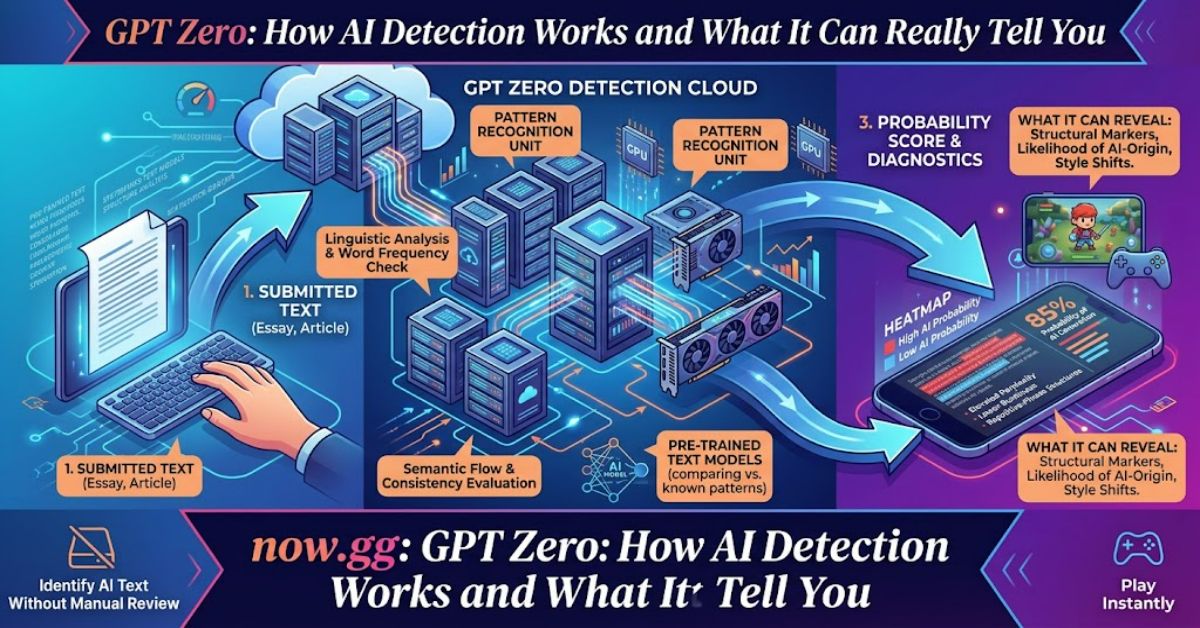
GPT Zero is an artificial intelligence content detection platform designed to estimate whether text was written by a human, generated by an AI model or contains a mixture of both. The tool became widely recognised during the early wave of generative AI adoption in education, when teachers and institutions were searching for ways to understand whether submitted work had been produced with systems such as ChatGPT.
The platform was founded by Edward Tian in 2023 while he was a student at Princeton University. Since then, its scope has expanded considerably. GPT Zero says its detector can analyse documents at sentence, paragraph and document level, while its wider authenticity suite now includes tools for plagiarism, hallucination and AI-generated content detection.
In June 2026, Superhuman announced an agreement to acquire GPT Zero, describing the company as part of a broader authenticity strategy. By September 2026, Superhuman stated that GPT Zero had formally become part of the company.
That change is significant because it places AI detection inside a larger productivity and authorship ecosystem rather than treating it as a standalone checker.
How GPT Zero Detects AI Writing
An AI detector does not simply search for a hidden label saying that text was created by ChatGPT. Instead, its models analyse characteristics of the writing and estimate which class the document most closely resembles.
GPT Zero’s API, for example, can return classifications including HUMAN_ONLY, MIXED and AI_ONLY, alongside probabilities and confidence categories. The platform also supports document, paragraph and sentence-level analysis.
Earlier discussions of AI detection often focused on concepts such as perplexity and burstiness. GPT Zero says that, since autumn 2023, its production detector has moved away from using those measures as its detection method and instead uses a deep-learning architecture.
This is an important distinction. Users should not assume that changing punctuation, adding a few unusual words or deliberately varying sentence length will reliably change an AI detector’s conclusion.
| Approach | What it provides | Main limitation |
| Document-level detection | Overall classification | Can hide variation within a document |
| Sentence-level detection | Highlights potentially AI-like sections | Individual sentences can be ambiguous |
| Mixed-text detection | Identifies documents containing different writing signals | Human editing can complicate classification |
| AI Patterns | Explains recurring AI-like writing characteristics | Patterns are evidence, not authorship proof |
| Plagiarism checking | Identifies potential textual overlap | Similarity does not establish why text was created |
GPT Zero’s September 2026 GPTZero 4o release also shows how the company is targeting more difficult cases, including paraphrased and mixed human-AI writing.
Why AI Detection Is Hard
The central problem with AI detection is that writing style is not a fingerprint.
Human writers can produce highly predictable prose. AI systems can produce varied prose. Students may heavily edit machine-generated material, while professional writers may use grammar assistants or other software without surrendering authorship.
This creates a fundamental interpretive problem: a detector can estimate whether text resembles AI-generated writing, but that is different from proving who wrote it.
GPT Zero itself has increasingly emphasised interpretation. Its Advanced Scan system provides explanations and highlights, while its AI Patterns feature introduced in August 2026 attempts to identify recurring stylistic and rhetorical patterns associated with AI-like writing.
That is arguably a more useful direction than presenting users with a single percentage.
For educators, the practical lesson is straightforward: detection should be one signal within a wider review process. A suspicious result can justify a conversation about drafts, sources, revision history or the student’s understanding of the work. It should not automatically determine misconduct.
GPT Zero’s Expanding Feature Set
The platform’s development in 2026 suggests that AI detection is becoming only one part of its offering.
AI Vision, for example, allows users to scan supported websites through GPT Zero’s Chrome extension. The tool can flag content while users browse platforms including Reddit, X, LinkedIn, Medium and Substack.
GPT Zero has also developed Hallucination Check, which addresses a separate problem created by generative AI: false or unreliable citations. Its technical documentation describes a system that combines structured citation analysis, external sources and retrieval methods to investigate questionable references.
This creates three distinct authenticity questions:
| Question | Relevant tool or capability |
| Was AI involved in creating this text? | AI detection |
| Does the writing display AI-like patterns? | AI Patterns |
| Are cited claims or references reliable? | Hallucination Check |
| Does text overlap with existing material? | Plagiarism detection |
| What happened while a document was created? | Authorship and writing-process tools |
The broader insight is that authenticity is becoming a multi-dimensional problem. Knowing whether AI was involved is not enough if the underlying facts are inaccurate or the citations are fabricated.
The Superhuman Acquisition and What It Means
Superhuman’s June 2026 announcement said GPT Zero would expand its authenticity layer and become available through Superhuman Go. The company described the acquisition as a way to combine AI detection with other tools designed to establish the origin and integrity of content.
By September 2026, Superhuman confirmed that GPT Zero was part of the organisation, alongside its existing authenticity and authorship capabilities.
This creates a potentially important strategic shift. AI detection was initially associated strongly with schools and student essays. The acquisition opens a route into professional writing, publishing, business communication and wider knowledge work.
However, scale also increases the importance of responsible interpretation. A detector embedded into workplace software could influence hiring, assessment or editorial decisions. False positives therefore become a governance issue rather than simply a technical inconvenience.
The Future of GPT Zero in 2027
The most likely direction for GPT Zero in 2027 is a broader authenticity platform rather than a narrower AI detector.
Its 2026 product releases already show movement towards explainable detection, mixed-text analysis, hallucination checking and browser-based content analysis. GPT Zero 4o was introduced in September 2026 with a focus on AI-generated, paraphrased and mixed writing.
The major challenge will be maintaining trust while generative AI becomes more capable. Detection systems face an adversarial environment: models improve, humans edit generated text and new writing workflows blur the line between human and machine production.
The strongest long-term products are therefore likely to provide evidence and context rather than a simplistic verdict.
Key Insights
- AI detection is an estimation problem, not a definitive authorship test.
- Sentence-level explanations can be more useful than a single document score.
- Mixed human-AI writing is one of the hardest cases for detection systems.
- GPT Zero’s 2026 product development shows movement towards broader content authenticity.
- Hallucination detection addresses a different but closely related problem: whether AI-generated information can be trusted.
- The Superhuman acquisition could move GPT Zero further into mainstream workplace and productivity software.
Conclusion
GPT Zero has moved well beyond the simple question of whether a paragraph “looks AI-generated”. Its current product direction covers detection, interpretation, plagiarism, hallucination checking, browser-based analysis and broader signals about how content is produced.
That expansion reflects a genuine problem created by generative AI. Organisations increasingly need to understand not only what content says, but how it was produced and whether its claims can be trusted.
Yet detection scores should remain evidence rather than verdicts. Writing is variable, AI-assisted workflows are increasingly complex and no automated system can remove the need for human judgement in high-stakes decisions.
The 2026 move into Superhuman gives GPT Zero access to a much wider productivity ecosystem. If that integration is handled carefully, its greatest value may ultimately be less about catching AI and more about giving people better evidence about the origin, reliability and integrity of digital content.
FAQ
What is GPT Zero used for?
GPT Zero is used to analyse writing for signals associated with AI-generated content. It also provides tools related to plagiarism, hallucination detection, AI writing patterns and content authenticity.
Is GPT Zero accurate?
GPT Zero publishes its own benchmarking results and regularly updates its detection models. However, no AI detector should be treated as infallible, particularly when human and AI writing are mixed.
Can GPT Zero detect ChatGPT writing?
GPT Zero is designed to identify text that resembles output from large language models, including systems such as ChatGPT. Its newer models also target modified and mixed AI-generated writing.
Does GPT Zero prove that someone used AI?
No. A detector result indicates that text resembles a particular class of writing. It does not independently establish who wrote the text or prove how it was produced.
Who owns GPT Zero?
Superhuman announced an agreement to acquire GPT Zero in June 2026 and confirmed in September 2026 that GPT Zero had become part of Superhuman.
Can GPT Zero check more than AI writing?
Yes. Its broader authenticity suite includes plagiarism and hallucination-related tools, while AI Vision can analyse content on supported websites through its browser extension.
Methodology
This article uses the supplied RubbleMagazine.co.uk brief as its structural basis and supplements the provided GPT Zero description with current first-party information published by GPT Zero and Superhuman during 2026. No firsthand product testing was conducted, so no fabricated testing results or personal performance claims have been included.
The acquisition is treated as a 2026 corporate development rather than relying on the older description in the supplied brief. GPT Zero’s own documentation and Superhuman’s corporate announcements were used to distinguish current product capabilities from broader analytical interpretation.
References
GPT Zero. (2025). What is GPT Zero? GPT Zero Support.
GPT Zer’o. (2026). AI Patterns, and a New Way to Understand AI-Like Writing. GPT Zer’o.
GPT Zer’o. (2026). How We’re Making Advanced Scan Highlighting Even More Accurate. GPT Zer’o.
GPT Zer’o. (2026). Introducing GPT Zero 4o. GPT Zero.
GPT Zer’o. (2026). How does GPT Zero’s Hallucination Check detector work: A technical report. GPT Zer’o.
Superhuman. (2026). Superhuman to Acquire GPT Zer’o, AI Authenticity Platform. Superhuman.
Superhuman. (2026). GPT Zer’o is Now Part of Superhuman: What It Means for Signals of Authentic Work. Superhuman.