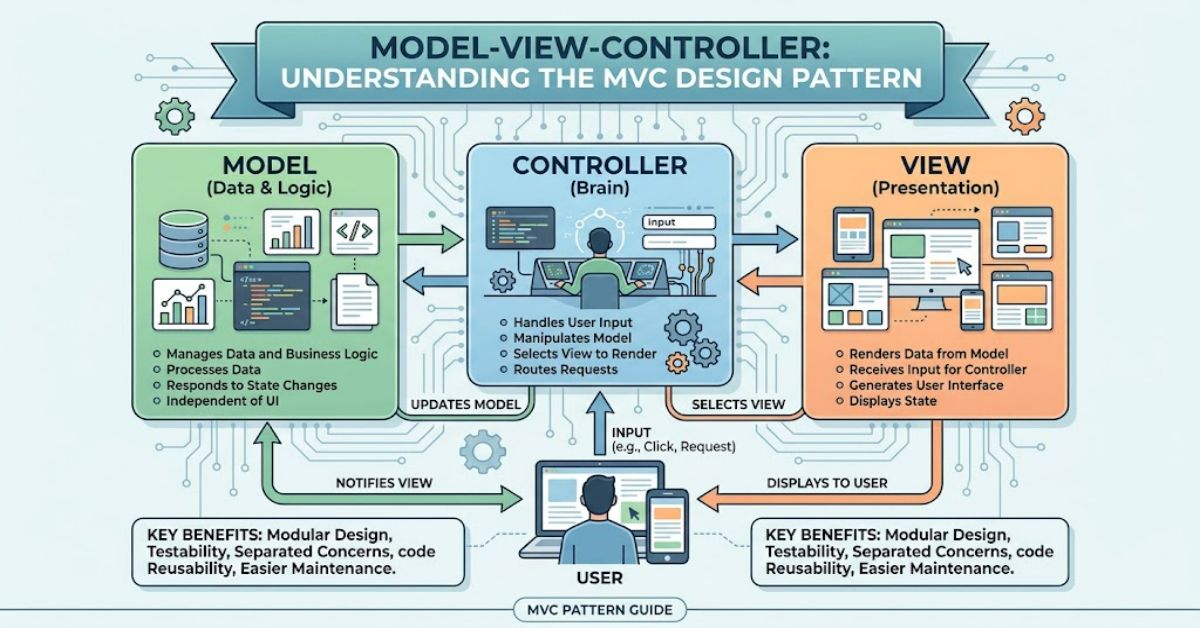
Model View Controller (MVC) is a software design pattern that separates an application into three interconnected parts: the Model, the View and the Controller. The Model manages data and business rules, the View displays information to users, and the Controller interprets user input and coordinates the application’s response. This separation helps developers build software that is easier to understand, test and maintain.
MVC is used in web applications, desktop software and other systems that need a clear distinction between information, presentation and interaction. For example, in an online shop, the Model might manage product prices and stock levels, the View might display product details, and the Controller might process a customer’s request to add an item to a basket.
The pattern matters because software becomes harder to maintain when data handling, interface code and application decisions are tightly mixed together. A small change to a product page could unexpectedly affect a calculation or database operation if all responsibilities sit in one place. MVC encourages a more organised structure by giving each component a defined role.
However, MVC is not a framework in itself, nor does it prescribe one universal implementation. Frameworks such as Ruby on Rails and ASP.NET Core use related architectural conventions, but they differ in how requests, routes, templates and application services are organised. Developers must understand those differences rather than assume every MVC project follows an identical workflow.
This guide explains how the three components work together, where the pattern is useful, its limitations and how to decide whether it suits a project.
What Are the Three Components of MVC?
The strength of this architecture comes from assigning each component a clear responsibility. Although the components work together, they should not all perform the same tasks.
1. Model: Data and Business Rules
The Model represents the application’s data and the rules that govern it. It may retrieve information from a database, validate values, calculate totals or enforce business requirements.
In an online shop, a product model might store a product name, price and stock quantity. It could also support rules that prevent an order from exceeding available stock.
A well-designed Model keeps important business rules away from presentation code. This matters because the same rules may be needed by different screens, reports or application interfaces.
2. View: User Interface and Presentation
The View presents information to the user. In a website, this may be an HTML template displaying product names, prices, images and buttons.
Views should generally avoid complex business decisions. They can format values and organise information, but calculations involving pricing rules or stock availability should belong in an appropriate application or domain layer.
This separation allows developers to change the appearance of a page without rewriting the rules that determine what the application does.
3. Controller: Requests and Coordination
The Controller receives user input or an application request and coordinates the response. It may validate incoming request data, call the relevant Model or service, and select a View or another response format.
For example, a controller might receive a request to display a product, retrieve the corresponding record and pass the result to a template.
A controller should not become a home for every business rule. When it grows too large, the separation MVC is intended to provide starts to break down. Microsoft’s ASP.NET Core documentation similarly describes controllers as request handlers that work with models and return suitable views or API responses.
How Model View Controller Works in Practice
Consider a customer updating their delivery address in an online shop.
1. Customer submits a form
The browser sends the updated address.
2. Controller processes the request
Checks the request and coordinates the update.
3. Model and application services
Validate relevant rules and save authorised changes.
4. View presents the result
Shows confirmation or explains what needs correcting.
The exact request flow varies by framework. In a traditional server-rendered application, the server may return a complete HTML page. In an API-based application, the Controller may return JSON, leaving a separate front-end application to display the response.
One important distinction is that the Model does not necessarily mean the database itself. It refers to the application’s data representation and associated rules; a database is a storage system that the application may use.
MVC Compared with Other Architectural Patterns
MVC is one way to separate responsibilities, but it is not the only option.
| Pattern | Main distinction | Often suitable for |
| MVC | Separates Model, View and Controller responsibilities | Server-rendered websites and structured web applications |
| Model-View-ViewModel (MVVM) | Uses a ViewModel to connect presentation and application state | Interfaces with substantial data binding |
| Model-View-Presenter (MVP) | A Presenter coordinates between the View and Model | Interfaces requiring explicit presentation logic |
| Layered architecture | Organises code into layers, such as presentation, application and data access | Business applications with clear dependency boundaries |
These approaches are not always mutually exclusive. An MVC application can also use layered architecture, service classes and data-access abstractions.
The practical choice depends on how the application handles user interaction, where business rules belong and how much complexity the team needs to manage.
Practical Benefits and Hidden Trade-Offs
MVC can improve maintainability because a change to one component may not require changes throughout the application. It can also support testing: developers can test business rules separately from templates and request-handling code.
However, three limitations deserve attention.
- More structure can mean more files. A small application may gain little from creating separate classes and templates for every minor feature.
- Controllers can become overloaded. Putting database queries, business decisions, validation and formatting into one controller creates tightly coupled code despite the nominal MVC structure.
- Separation does not guarantee security. Applications still need authorisation checks, server-side validation, safe database access and protection against common web vulnerabilities.
A further practical risk is duplicated business logic. If two controllers implement their own versions of a pricing rule, their behaviour may diverge. Centralising shared rules in an appropriate Model or service reduces this risk.
A Quick Guide to MVC Responsibilities
| Task | Appropriate responsibility | Common mistake |
| Store and retrieve product data | Model or data-access layer | Embedding database queries in templates |
| Enforce a pricing rule | Domain model or business service | Repeating calculations across controllers |
| Handle an incoming request | Controller | Making the controller responsible for all business logic |
| Display a product list | View | Putting complex application decisions in presentation code |
| Check user permissions | Authorisation or application layer, coordinated where appropriate | Assuming a hidden button prevents unauthorised access |
| Test a business rule | Model or service-level test | Testing everything only through the browser |
This division is a guide, not a rigid rulebook. Mature applications often add services, repositories, middleware and dedicated request models to keep responsibilities manageable.
The Future of Model View Controller in 2027
MVC is likely to remain relevant in 2027, particularly for established server-rendered applications and business systems built around conventional request-response workflows. Its core value is architectural clarity rather than novelty.
Current framework documentation continues to support MVC-style development. Microsoft documents MVC as a framework for web applications and APIs, while Ruby on Rails continues to organise request handling and rendering around controllers and views.
At the same time, modern applications increasingly combine server-rendered pages with JavaScript interfaces, APIs and separate front-end frameworks. MDN’s explanation of MVC notes that application logic can be distributed differently in client-side architectures.
The likely direction is therefore coexistence rather than a complete replacement of MVC. Teams may use MVC for administrative dashboards, content-driven websites and conventional forms while adopting other patterns for highly interactive interfaces.
No single pattern guarantees faster development or better performance. Those outcomes depend on implementation quality, application requirements, team experience and infrastructure.
Key Takeaways for Developers
- Start with responsibility boundaries. Decide which component owns each rule before creating files and classes.
- Keep controllers focused. They should coordinate requests, not become the home for every calculation and database operation.
- Test business rules independently. Isolated tests make changes easier to verify without relying entirely on browser-based testing.
- Treat security separately. MVC structures code but does not replace authentication, authorisation or input validation.
- Use the framework’s conventions carefully. Frameworks may use the same terminology but implement different request and rendering workflows.
- Avoid unnecessary abstraction. A small project may need less structure than a large, multi-team application.
Conclusion
Model View Controller remains a useful software design pattern because it gives developers a practical way to separate data, presentation and request handling. When applied carefully, it can make applications easier to understand, test and maintain while reducing the risk that a change in one area affects unrelated functionality.
Its benefits depend on how responsibilities are assigned. A project with controllers full of business rules or views containing database logic gains little from merely adopting the MVC label. Clear boundaries, focused components and sensible testing matter more than following a diagram mechanically.
MVC also works alongside other architectural approaches. Service layers, APIs and modern front-end frameworks can extend or complement it when requirements become more demanding.
For developers choosing an architecture, the best approach is to match the structure to the problem. MVC offers a strong starting point for many web applications, but its complexity should remain proportionate to the application’s actual needs.
Frequently Asked Questions
What does Model View Controller mean?
Model View Controller is a software design pattern that divides an application into three responsibilities: the Model manages data and business rules, the View presents information, and the Controller handles input and coordinates actions.
Is MVC a framework or a design pattern?
MVC is a design pattern. Frameworks such as ASP.NET Core MVC and Ruby on Rails provide tools and conventions for implementing it.
What is the difference between Model and Controller?
The Model represents application data and relevant business rules. The Controller processes requests and coordinates actions involving the Model and the response returned to the user.
Is MVC still used in 2027?
MVC remains relevant for server-rendered websites, administrative systems and business applications. Other patterns are also common, especially for highly interactive front ends. The right choice depends on the project’s requirements.
What are the main disadvantages of MVC?
MVC can introduce extra files and complexity in small projects. Poor implementations may also create oversized controllers, duplicated business rules and unnecessary dependencies between components.
Is MVC suitable for beginners?
Yes. It introduces separation of concerns through three understandable responsibilities. Beginners should first learn the basic request flow, then explore how their chosen framework handles routing, validation and data access.
References
MDN Web Docs. (n.d.). MVC. Mozilla. Retrieved 13 October 2026.
Microsoft. (n.d.). Overview of ASP.NET Core MVC. Microsoft Learn. Retrieved 13 October 2026.
Ruby on Rails. (n.d.). Layouts and rendering in Rails. Ruby on Rails Guides. Retrieved 13 October 2026.
Methodology
This article was prepared using established software architecture concepts and documentation from MDN Web Docs, Microsoft Learn and the Ruby on Rails Guides. The examples are illustrative explanations, not results from software testing or firsthand field research. Framework behaviour can change between versions, and individual projects may implement MVC differently. The article therefore describes the general pattern and uses framework documentation to illustrate common practices rather than claiming that all MVC applications follow one identical structure.
The analysis also considers trade-offs, including controller complexity, duplicated business rules and the additional structure that MVC may introduce. The 2027 discussion is a cautious outlook based on continued framework support and the coexistence of server-rendered and client-side approaches; it is not a guaranteed industry forecast.
Editorial disclosure: This article was drafted with AI assistance. A human editor should independently verify references, technical claims and publication details before it goes live.