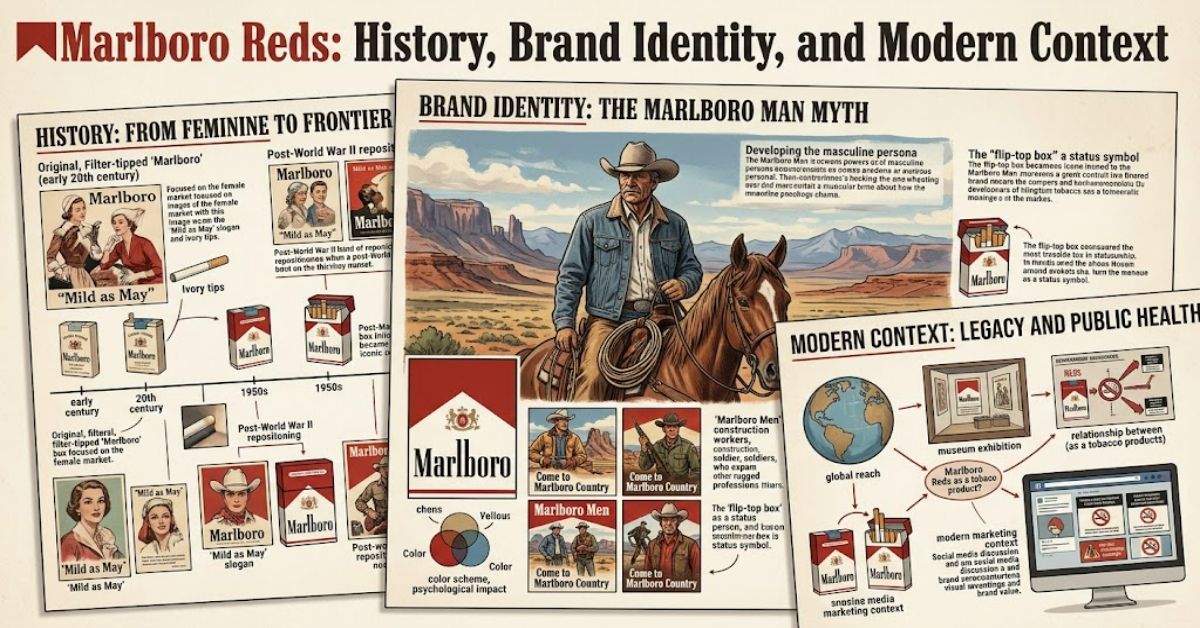
Marlboro Reds are widely associated with the classic Marlboro cigarette identity and its traditional full-flavour positioning. The brand is produced within the wider Philip Morris corporate structure, although corporate ownership differs between the United States and international markets. Philip Morris International (PMI) says Marlboro leads its international cigarette portfolio and has been the world’s best-selling international cigarette brand since 1972.
The history behind that position is more complicated than the familiar red-and-white pack suggests. Marlboro was originally established and registered as a trademark in the early twentieth century. PMI’s corporate history identifies 1908 as a key milestone for the brand. By 1972, Marlboro had become the world’s best-selling cigarette, helping establish an exceptionally strong international brand identity.
Today, however, Marlboro exists in a very different regulatory and commercial environment. Tobacco advertising is heavily restricted in many countries, cigarette packaging is standardised in markets such as the UK, and PMI is investing heavily in products that do not burn tobacco.
That makes Marlboro Reds useful as a case study in brand history as much as tobacco consumption. Its story connects advertising, packaging, corporate strategy, regulation and public health.
How Marlboro Became a Global Brand
Marlboro’s modern identity developed over several decades. Philip Morris established the trademark early in the company’s history, but the brand’s later success came from a much broader marketing transformation.
The company eventually connected Marlboro with a highly distinctive visual and cultural identity. The red colour, typography and imagery became recognisable far beyond the cigarette itself.
By 1972, Marlboro had reached the position of world’s best-selling cigarette, according to PMI’s historical account. That milestone illustrates the scale of the brand’s international expansion.
PMI now describes Marlboro as its leading international cigarette brand, sold across 170 markets. The company reported a 10.7% Marlboro share of the international cigarette market in 2025, excluding China and the United States under its stated measurement definition.
These figures should be read as corporate-reported market measures rather than an independent assessment of global tobacco consumption.
Marlboro Reds and the Brand’s Visual Identity
The word “Reds” is strongly associated with the traditional red Marlboro presentation and its established full-flavour positioning. However, cigarette names, variants, packaging and specifications differ between countries because tobacco products are subject to local regulations.
That distinction matters when comparing products internationally. A cigarette sold under a familiar Marlboro name may not have identical specifications, packaging or legal presentation in every market.
| Feature | Traditional Marlboro Identity | Modern Regulatory Context |
| Brand | Marlboro | Remains a major international cigarette brand |
| Colour association | Red and white | Restricted or removed in standardised-packaging markets |
| Positioning | Traditional full-flavour identity | Marketing claims heavily constrained |
| Packaging | Historically distinctive | Plain packaging required in the UK |
| Corporate portfolio | Cigarettes | Increasing emphasis on smoke-free products |
In the UK, the Standardised Packaging of Tobacco Products Regulations 2015 require cigarettes to use a standardised package design. Brand names are tightly restricted in their presentation, while promotional imagery, logos and additional colours are prohibited.
This means one of the strongest historical assets of cigarette branding — packaging recognition — has been deliberately reduced by regulation.
The Public-Health Context
Any discussion of Marlboro Reds also needs to address the health implications of combustible cigarettes.
Cigarettes contain nicotine, which is addictive. More broadly, tobacco smoke contains harmful and potentially harmful constituents associated with cancer, cardiovascular disease, respiratory effects, reproductive problems and addiction. The US Food and Drug Administration maintains a formal list of such constituents and expanded it in April 2026.
This creates an important distinction between brand characteristics and health outcomes. A cigarette’s flavour profile, packaging or perceived strength does not make smoking safe.
Philip Morris International itself acknowledges that cigarettes cause harm and says its corporate strategy is increasingly centred on smoke-free products. As of July 2026, PMI reported that smoke-free products represented 42% of its global net revenues.
That shift is particularly significant because Marlboro historically represented the company’s cigarette business.
Marlboro’s Place in Philip Morris’s Changing Business
PMI and Altria have operated as separate companies since 2008. PMI focuses on international markets outside the United States, while Altria manages Philip Morris USA and other US businesses.
This corporate distinction is important when researching Marlboro. Statements about Marlboro’s international business should not automatically be treated as statements about every Marlboro product sold in the United States.
PMI has also moved towards heated tobacco, nicotine pouches and other smoke-free categories. In February 2024, the company reported that IQOS had surpassed Marlboro in net revenue as its leading nicotine product during the fourth quarter of 2023.
That was a notable strategic moment: the company’s most important cigarette brand was no longer its largest nicotine product by revenue.
Three Important Insights From Marlboro’s Evolution
Brand recognition can survive without traditional packaging. Marlboro’s historical identity was heavily connected with distinctive visual branding, yet the underlying brand name remains commercially important even where plain-packaging rules have removed much of that visual differentiation.
Corporate transformation does not erase product history. PMI’s current smoke-free strategy exists alongside an established cigarette portfolio. The company is changing its revenue mix while continuing to sell conventional cigarettes.
Regulation changes the meaning of a famous brand. A brand that was once communicated through colours, imagery and advertising is now presented under significantly tighter restrictions in markets such as the UK.
The Future of Marlboro Reds in 2027
The future of Marlboro Reds will be shaped less by traditional advertising than by tobacco regulation, cigarette demand and PMI’s wider transition towards smoke-free products.
PMI says it aims for smoke-free products to generate more than two-thirds of total net revenues by 2030. That does not mean conventional cigarettes will disappear by 2027, and the company continues to maintain a substantial cigarette portfolio.
The more defensible expectation is therefore gradual portfolio change rather than an abrupt end to Marlboro cigarettes. Regulation may also continue to constrain packaging and presentation.
For the brand, 2027 is likely to be another stage in a longer transition from a business centred primarily on combustible tobacco towards a broader nicotine portfolio.
Key Takeaways
- Marlboro was established as a trademark in the early twentieth century.
- The brand became the world’s best-selling cigarette in 1972, according to PMI’s corporate history.
- Marlboro remains PMI’s leading international cigarette brand.
- UK plain-packaging rules significantly restrict traditional cigarette branding.
- Cigarette smoke contains constituents associated with serious health effects.
- PMI’s commercial strategy increasingly prioritises smoke-free products.
- Marlboro’s future therefore sits between a long-established cigarette legacy and a changing nicotine market.
Conclusion
Marlboro Reds occupy a distinctive place in modern consumer and tobacco history. Their importance is not simply a matter of cigarette sales. The product became part of a much larger branding system that helped Marlboro become one of the world’s most recognisable tobacco names.
That commercial legacy now exists alongside a very different regulatory environment. Plain packaging has reduced the role of visual branding in markets such as the UK, while public-health authorities continue to document the serious risks associated with combustible tobacco.
At the same time, Philip Morris International is reshaping its business around smoke-free products. Marlboro remains central to its international cigarette portfolio, but the company has publicly set a long-term objective of moving revenue towards alternatives that do not burn tobacco.
The result is an unusual transition: one of the world’s most established cigarette brands remains commercially significant while the company behind it is simultaneously pursuing a future less dependent on conventional cigarettes.
FAQ
What are Marlboro Reds?
Marlboro Reds are associated with Marlboro’s traditional full-flavour cigarette variant. Product specifications and naming can differ between markets because tobacco products are regulated differently across countries.
Who makes Marlboro cigarettes?
Marlboro is part of the Philip Morris corporate portfolio. PMI manages the international Marlboro business, while Philip Morris USA is part of Altria following the companies’ separation in 2008.
When did Marlboro become a major cigarette brand?
Marlboro was established as a trademark in the early twentieth century and became the world’s best-selling cigarette in 1972, according to PMI’s historical account.
Are Marlboro Reds safer than other cigarettes?
There is no basis for treating the Marlboro Reds brand identity as an indication of safety. Combustible tobacco exposes users to harmful substances and nicotine is addictive.
Why does Marlboro packaging look different in the UK?
The UK requires standardised packaging for cigarettes. The rules restrict colours, logos, imagery and the presentation of brand and variant names.
Is Philip Morris moving away from cigarettes?
PMI says it is building a business increasingly focused on smoke-free products. It reported that such products represented 42% of global net revenues as of July 2026.
Methodology
This article was researched using primary corporate and regulatory sources, including Philip Morris International and the US Food and Drug Administration, alongside UK government information on tobacco packaging regulations.
Company-reported market figures have been identified as such rather than presented as independent measurements. The article does not claim that individual Marlboro variants have identical specifications worldwide. It also does not provide purchasing recommendations or imply that any combustible cigarette is safe.
The main limitation is that product formulation and variant availability can vary by jurisdiction and change over time. Readers should therefore treat brand descriptions as general rather than universal product specifications.
Editorial disclosure: This article was drafted with AI assistance and should be reviewed and independently verified by a human editor before publication.
References
Philip Morris International. (2026). Key milestones. Philip Morris International.
Philip Morris International. (2026). About Philip Morris International: Frequently asked questions. Philip Morris International.
Philip Morris International. (2026). Smoking and cigarettes: Frequently asked questions. Philip Morris International.
Philip Morris International. (2026). Why is Philip Morris International still selling cigarettes? Philip Morris International.
Philip Morris International. (2024). Philip Morris International’s heated tobacco product IQOS replaces Marlboro as its leading brand. Philip Morris International.
Food and Drug Administration. (2026). Harmful and potentially harmful constituents in tobacco products and tobacco smoke. U.S. Department of Health and Human Services.
Food and Drug Administration. (2026). Cigarette labeling and health warning requirements. U.S. Department of Health and Human Services.
Department of Health and Social Care. (2026). Tobacco and vapes: Packaging, appearance and display. GOV.UK.