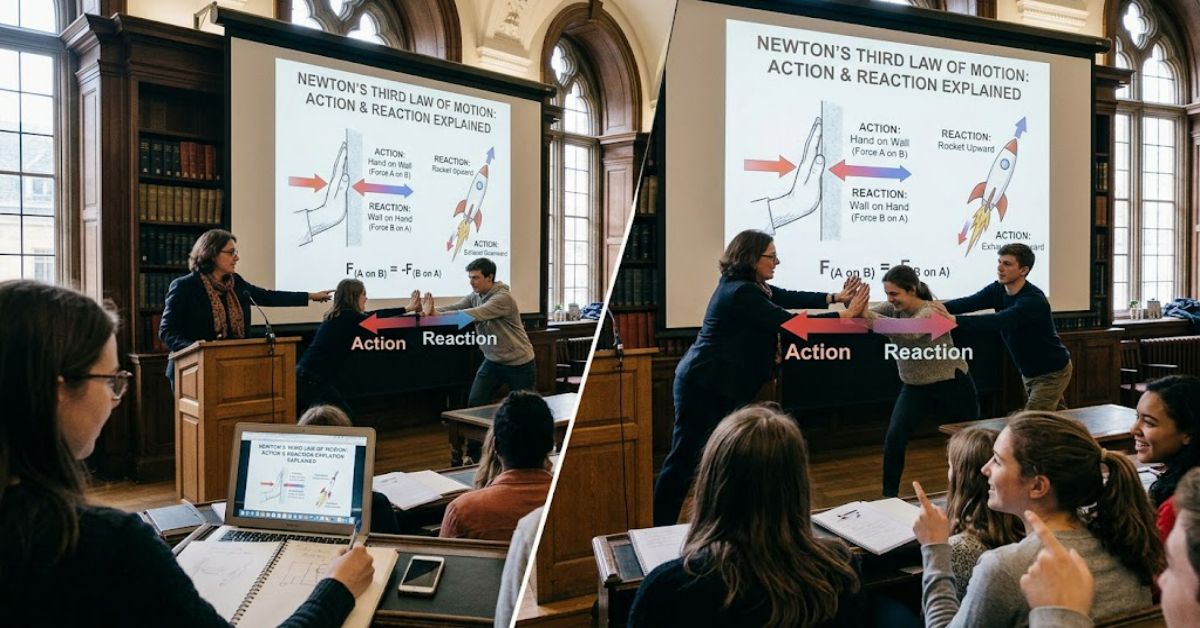
Newton’s third law is one of the most familiar principles in physics. Often summarised as “for every action, there is an equal and opposite reaction”, it describes what happens whenever two objects interact through a force. If one object pushes, pulls or otherwise exerts a force on another, the second object simultaneously exerts a force of equal magnitude in the opposite direction on the first.
Newton published his three laws of motion in Philosophiæ Naturalis Principia Mathematica in 1687. The third law provided a general framework for understanding interactions between bodies, including collisions and mechanical forces. Modern physics expresses the principle more precisely: if object A exerts a force on object B, object B exerts an equal and opposite force on object A.
The crucial detail is that the two forces act on different objects. This is the source of one of the most common misunderstandings about the law. Equal and opposite forces do not automatically cancel because cancellation applies when forces are acting on the same system.
That distinction makes Newton’s third law more than a memorised classroom definition. It is a practical tool for analysing walking, swimming, driving, flying and rocket propulsion. Understanding which objects interact, identifying the force pair and choosing the system being studied makes the principle much easier to apply.
What Does Newton’s Third Law Mean?
In modern vector notation, Newton’s third law can be written as:
F₍A on B₎ = −F₍B on A₎
The negative sign indicates that the forces point in opposite directions, while the equality indicates that they have the same magnitude.
Suppose a person pushes a wall with a force of 100 newtons. The wall exerts a force of 100 newtons back on the person in the opposite direction, assuming the interaction is represented under the same conditions. The person may feel this reaction immediately, even though the wall does not visibly move.
The principle applies to contact forces as well as other interactions. A force pair can involve a hand and a wall, a tyre and a road, a rocket and its exhaust gases, or a wing and the surrounding air.
| Interaction | Force exerted by first object | Reaction force | Result |
| Person and floor | Foot pushes floor backwards | Floor pushes person forwards | Walking |
| Car and road | Tyre pushes road backwards | Road pushes tyre forwards | Vehicle acceleration |
| Swimmer and wall | Swimmer pushes wall | Wall pushes swimmer | Swimmer moves away |
| Rocket and exhaust | Rocket pushes gases backwards | Gases push rocket forwards | Thrust |
| Wing and air | Wing deflects air downwards | Air pushes wing upwards | Lift contribution |
OpenStax uses similar examples to demonstrate that the forces are equal and opposite but act on separate systems.
Why Equal and Opposite Forces Do Not Cancel
This is the most important concept to understand.
Imagine a swimmer pushing against the side of a pool. The swimmer applies a force to the wall. The wall simultaneously applies an equal force to the swimmer in the opposite direction. If the swimmer is the system being studied, only the force acting on the swimmer belongs in the relevant free-body diagram.
The swimmer’s push on the wall does not cancel the wall’s push on the swimmer because the first force acts on the wall while the second acts on the swimmer.
By contrast, two forces acting on the same object can cancel. For example, an object resting on a horizontal surface may have its weight acting downward and a normal force acting upward. If the object is stationary and the conditions produce equal magnitudes, the net force is zero. These forces are not a Newton’s third-law pair because both act on the same object.
This distinction provides a useful analytical rule:
Third-law pairs always involve two interacting bodies and act on different bodies.
Everyday Examples of Action and Reaction
Walking provides a simple demonstration. Your foot pushes backwards against the ground. The ground exerts a forward frictional force on your foot, helping accelerate your body forwards. Without an appropriate interaction between the foot and surface, ordinary walking would be impossible.
The same principle operates in a car. A powered wheel attempts to push the road backwards through tyre-road contact. The road exerts a forward force on the tyre. That interaction contributes to the vehicle’s acceleration. OpenStax identifies this ground-wheel interaction as a direct application of the third law.
Swimming works differently in its details but follows the same structure. A swimmer pushes water backwards, and the water exerts a reaction force that moves the swimmer forwards.
These examples reveal an important insight: movement does not require an object to push directly in the direction it wants to travel. Instead, successful propulsion often depends on pushing another body or medium in the opposite direction.
Newton’s Third Law in Rockets and Aircraft
Rocket propulsion is one of the clearest applications.
A rocket engine accelerates exhaust gases backwards at high speed. The gases exert an equal and opposite force on the rocket, producing forward thrust. This does not require the rocket to push against the ground or surrounding atmosphere.
NASA uses rocket and aircraft propulsion to demonstrate the law. Its educational material explains that rockets move forward because exhaust gases are expelled backwards, while aerodynamic applications involve interactions between wings, propellers and air.
Aircraft provide a more complicated example because several forces operate simultaneously. For a conventional aeroplane, aerodynamic forces include lift and drag, alongside thrust and weight. A wing changes the motion of surrounding air, producing aerodynamic forces on the aircraft. Propellers or jet engines also accelerate air or exhaust gases to produce thrust.
The third law therefore helps explain propulsion, but it should not be treated as the only aerodynamic principle involved. Pressure distributions, momentum transfer and fluid dynamics provide additional layers of explanation.
A Common Misconception About Force
A frequent mistake is to assume that the larger or heavier object must exert a larger third-law force.
It does not.
If a small car collides with a large lorry, the force exerted by the car on the lorry is equal in magnitude to the force exerted by the lorry on the car during the interaction. What differs is the resulting acceleration.
Newton’s second law explains why. For a given force, acceleration depends on mass:
F = ma
A smaller mass can therefore experience a much larger acceleration than a larger mass even though the interaction forces are equal.
| Concept | Newton’s Third Law | Newton’s Second Law |
| Main question | How do interacting bodies exert forces? | How does net force affect motion? |
| Relationship | Equal and opposite force pair | Net force = mass × acceleration |
| Objects involved | Two interacting bodies | A selected system |
| Key feature | Forces act on different bodies | Net forces determine acceleration |
| Common error | Assuming forces cancel | Ignoring all external forces |
This is why identifying the system is so important when solving mechanics problems. OpenStax specifically emphasises system selection when applying Newton’s laws and constructing free-body diagrams.
Historical Context
Newton’s formulation appeared in the Principia in 1687, but the intellectual history of action and reaction predates Newton. Historians of science have identified earlier discussions of reciprocal action, including debates involving Aristotle, René Descartes and other thinkers. The significance of Newton’s work was to place these ideas within a broader mathematical framework of mechanics.
The original formulation was more formal than the modern classroom phrase. Newton described the mutual actions of two bodies as equal and directed towards contrary parts. Modern textbooks translate this into vector notation, making the relationship easier to apply to quantitative problems.
The Future of Newton’s Third Law in 2027
Newton’s third law will remain a foundation of classical mechanics in 2027 because engineering systems still require reliable analysis of forces and momentum. Its applications extend from vehicle dynamics and aerospace engineering to robotics, structural mechanics and biomechanics.
The important change is not to the law itself but to how it is taught and applied. Simulation software and digital modelling allow students and engineers to visualise force interactions that are difficult to observe directly.
The limitation is that classical mechanics does not describe every physical situation. At extremely small scales or under conditions requiring relativistic treatment, more advanced theories are needed. Within ordinary engineering and educational contexts, however, Newtonian mechanics remains exceptionally useful.
Key Conclusions
- Newton’s third law describes reciprocal forces between interacting bodies.
- The two forces are always equal in magnitude and opposite in direction.
- They act on different objects, so they do not cancel in a single object’s free-body diagram.
- Walking depends on interaction between the feet and the ground.
- Cars rely on tyre-road forces for acceleration.
- Rockets generate thrust by accelerating exhaust gases backwards.
- Newton’s second law explains why equal interaction forces can produce different accelerations.
Conclusion
Newton’s third law provides one of the clearest descriptions of interaction in classical physics. Whenever two bodies exert forces on one another, those forces form a matched pair: equal in magnitude and opposite in direction.
Its apparent simplicity can make the law easy to misunderstand. The key is not simply remembering the phrase “equal and opposite reaction”, but identifying the two interacting objects and determining which force acts on which body. Once that distinction is made, many everyday phenomena become easier to analyse.
Walking, swimming, driving and rocket propulsion all demonstrate the same fundamental relationship. In each case, an object changes its motion through an interaction with something else.
The law also works alongside Newton’s other laws rather than replacing them. The third law identifies reciprocal interactions, while the second law determines how the net external force affects acceleration. Together, these principles form a powerful framework for understanding motion and remain central to physics and engineering more than three centuries after Newton’s original formulation.
FAQ
What is Newton’s third law in simple terms?
Newton’s third law states that when one object exerts a force on another, the second object exerts an equal force in the opposite direction on the first.
Why do action and reaction forces not cancel?
They do not cancel because they act on different objects. Forces cancel only when the relevant forces act on the same system.
What is an example of Newton’s third law?
Walking is a simple example. Your foot pushes backwards against the ground, while the ground exerts a forward force on your foot, helping you move forwards.
How does Newton’s third law explain rocket propulsion?
A rocket accelerates exhaust gases backwards. The gases exert an equal and opposite force on the rocket, producing forward thrust.
Does Newton’s third law apply to collisions?
Yes. During a collision, each object exerts a force on the other. The forces are equal in magnitude and opposite in direction, although the objects can experience different accelerations because their masses differ.
Are weight and normal force a third-law pair?
No. Weight acts on an object because of Earth’s gravitational interaction, while the normal force acts on the object from the supporting surface. They act on the same object and therefore are not a third-law pair.
Methodology
This article was researched using established physics education and historical sources, including OpenStax, NASA and Cambridge University Press. The physical explanations were cross-checked against standard formulations of Newton’s laws, particularly the distinction between third-law force pairs and forces acting on the same system.
No laboratory experiment, product test or firsthand field observation was conducted for this article. Accordingly, no fabricated firsthand measurements or personal testing claims have been included. Examples such as walking, swimming, vehicle traction and rocket propulsion are documented applications of the law.
The article is intended as an accessible educational explanation rather than a complete treatment of classical mechanics. A human editor should verify all references and technical claims before publication.
References
Cambridge University Press. (2012). The Principia [1687, first edition]. In A. Janiak (Ed.), Isaac Newton: Philosophical Writings.
Home, R. W. (1968). The third law in Newton’s mechanics. The British Journal for the History of Science, 4(1), 39–51.
National Aeronautics and Space Administration. (n.d.). The law of action and reaction: Newton’s third law. NASA.
National Aeronautics and Space Administration, Glenn Research Center. (n.d.). Newton’s third law – action & reaction. NASA.
OpenStax. (2020). Physics: 4.4 Newton’s third law of motion. Rice University.
OpenStax. (2016). University Physics Volume 1: 5.5 Newton’s third law. Rice University.
Russell, J. L. (1976). Action and reaction before Newton. The British Journal for the History of Science, 9(1), 25–38.