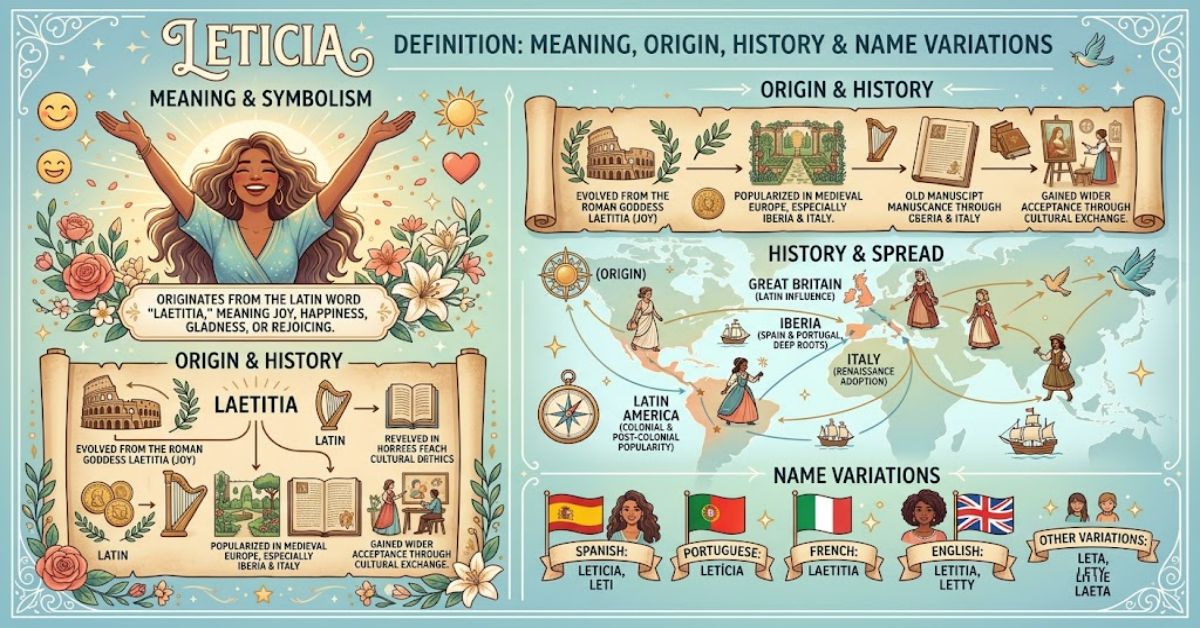
The simplest leticia definition is “joy”, “happiness” or “gladness”. The name is connected with the Latin Laetitia, a word associated with joy, rejoicing, pleasure and delight. Leticia is generally recognised as the Spanish form of Letitia, while closely related forms appear in several European languages.
Unlike names whose meanings are uncertain or based on disputed interpretations, Leticia has a comparatively clear linguistic history. Its roots can be traced to Latin and to the word laetitia, which described a state of happiness or gladness. The related Latin adjective laetus carried meanings including glad and happy.
That gives the name an appealing quality for parents researching names based on positive qualities. Rather than referring to a physical object, place or occupation, Leticia expresses an emotion. Its meaning is therefore easy to understand across cultures.
The spelling also tells an interesting story. Leticia belongs to a wider family of names that developed through different languages and naming traditions. Letitia became established in English, Letícia is found in Portuguese and Hungarian usage, Letizia is the Italian form, while Laetitia remains closely connected to the original Latin form.
What Does Leticia Mean?
The primary meaning of Leticia is joy or happiness. Other closely related interpretations include gladness, pleasure and delight.
| Element | Information |
| Name | Leticia |
| Meaning | Joy, happiness, gladness |
| Latin source | Laetitia |
| Language association | Spanish |
| Related English form | Letitia |
| Italian form | Letizia |
| French form | Laetitia |
| Portuguese form | Letícia |
| Older English form | Lettice |
The emotional meaning is particularly important because Laetitia was not simply associated with a brief moment of amusement. Historical Latin usage connected the word with broader ideas of gladness, rejoicing and pleasure.
This helps explain why modern descriptions of the name commonly use words such as “joy”, “happiness” and “gladness”.
The Latin Origin of Leticia
The linguistic foundation of Leticia is the Latin Laetitia. Etymological sources define laetitia in terms of joy, gladness, rejoicing, pleasure and delight. The related adjective laetus meant glad or happy.
The development from an abstract Latin noun into a personal name is part of a wider historical pattern. Many European names originated from words describing virtues, emotions, physical qualities or desirable characteristics.
In this case, the quality being expressed is positive emotion.
The historical connection also means that Leticia should not be treated as an isolated modern invention. It belongs to an established European naming family with forms that have appeared across different languages and periods.
Leticia and Letitia: What Is the Difference?
Leticia and Letitia are closely related rather than completely separate names.
Letitia is the traditional English form derived from Latin Laetitia. Leticia is identified as the Spanish form of Letitia. Other related versions include Letícia in Portuguese and Hungarian, Letizia in Italian, and Laetitia in French and Late Roman usage.
The spelling difference is therefore largely connected to language and pronunciation.
| Name form | Main linguistic association | Connection |
| Leticia | Spanish | Spanish form of Letitia |
| Letitia | English | Traditional English form |
| Letícia | Portuguese/Hungarian | Related form |
| Letizia | Italian | Italian form |
| Laetitia | Latin/French | Original Latin form and French variant |
| Lettice | Historical English | Medieval form |
This distinction is useful when researching genealogy, historical documents or family naming traditions. A person recorded as Lettice or Letitia in an older document may belong to the same broader naming tradition as someone named Leticia today.
Historical Use of the Name
The history of the name extends well beyond modern Spanish-speaking communities. According to historical name research, Letitia was used in England during the Middle Ages, often appearing in the form Lettice. The name later experienced a revival in the 18th century.
That historical journey demonstrates how personal names can change spelling while retaining their underlying identity.
The French form Laetitia also has a documented history. Modern name references identify it as the original Latin form as well as a French variant.
The name therefore sits at an interesting point between classical language and modern naming culture. Its meaning is ancient, but its forms have continued to adapt to different linguistic environments.
How Is Leticia Pronounced?
Pronunciation can vary depending on the language and country where the name is used.
In Spanish, Leticia is commonly pronounced with the characteristic Spanish treatment of vowels and consonants. English speakers may use a pronunciation closer to “leh-TISS-ee-ah” or a similar variation.
There is no single pronunciation that applies universally because personal names often change slightly when they move between languages.
For someone choosing the name, the important distinction is between the written form and local pronunciation. A family using the Spanish form may naturally pronounce it differently from an English-speaking family using the related Letitia.
Why the Meaning of Leticia Matters
One of the strongest features of Leticia is its positive semantic association.
Names connected with happiness have an enduring appeal because their meanings communicate an emotional quality rather than a social status or material object. Leticia effectively carries an idea of joy within its linguistic history.
That does not mean a person’s personality is determined by their name. A name meaning “joy” does not guarantee a joyful character. Its significance is cultural and symbolic rather than predictive.
The distinction is important. Name meanings are best understood as historical associations rather than personality tests.
Related Names and Variations
People researching Leticia may encounter several forms during family-history or name research.
Letitia: The established English form with the same Latin origin.
Laetitia: A form that stays closer to the original Latin spelling and is also used in French.
Letizia: The Italian form of the name. It was notably borne by Napoleon Bonaparte’s mother.
Letícia: A Portuguese and Hungarian form.
Lettice: An older English form that was used during the medieval period.
Lettie and Letty: Diminutive forms associated with Lettice and the wider Letitia family.
This variety gives the name considerable historical depth. What looks like a single modern spelling can actually represent a much larger network of related forms.
Leticia in Modern Naming Culture
Today, the name is particularly recognisable because of its Spanish spelling. Its straightforward meaning also makes it attractive to people researching names with positive associations.
A useful insight is that Leticia combines three qualities that do not always appear together: a clear meaning, a classical origin and multiple established international forms.
That combination gives it flexibility. Someone interested in Spanish naming traditions can use Leticia, while families connected with English, Italian, French or Portuguese traditions may prefer one of its related versions.
The Future of Leticia in 2027
By 2027, interest in traditional names with transparent meanings is likely to remain part of wider naming culture, although individual name popularity can change significantly between countries.
Leticia’s strongest long-term feature is not a particular popularity ranking. It is its established linguistic identity. The connection with Laetitia gives the name historical continuity, while its Spanish form keeps it recognisable in contemporary use.
Digital genealogy and international family research may also make spelling variants more visible. Someone researching an ancestor named Lettice, Letitia or Letizia may discover that these forms belong to the same wider naming family.
The safest prediction is therefore cultural rather than numerical: the name’s historical meaning is likely to remain stable even as its popularity varies.
Key Takeaways
- Meaning: Leticia is associated with joy, happiness and gladness.
- Origin: Its linguistic root is the Latin Laetitia.
- Spanish connection: Leticia is recognised as the Spanish form of Letitia.
- International forms: Letícia, Letizia and Laetitia are closely related versions.
- Historical depth: The naming family has been used in Europe for centuries.
- Older form: Lettice was an established medieval English form.
- Symbolic value: The name expresses a positive emotional quality rather than a profession, place or physical characteristic.
Conclusion
The leticia definition is ultimately rooted in one of the most positive concepts found in personal naming: joy. Derived from the Latin Laetitia, the name carries associations with happiness, gladness, pleasure and rejoicing.
Its history is broader than the modern Spanish spelling suggests. Leticia belongs to a family of names that includes Letitia, Laetitia, Letizia, Letícia and the historical English form Lettice. Each reflects the way languages adapt names while preserving their underlying meaning.
For anyone researching the name, its combination of classical origin, clear symbolism and international variations makes it especially interesting. The name does not promise a particular personality, but its linguistic history gives it an enduring association with happiness.
Frequently Asked Questions
What is the Leticia definition?
Leticia means “joy”, “happiness” or “gladness”. It is the Spanish form of the name Letitia and ultimately connects to the Latin Laetitia.
What does the name Leticia mean in Latin?
The name is derived from Latin Laetitia, meaning joy, gladness, pleasure, delight or rejoicing.
Is Leticia a Spanish name?
Yes. Leticia is recognised as the Spanish form of Letitia, although the wider name family has roots in Latin and related forms are used in several languages.
Is Leticia the same as Letitia?
They are closely related forms of the same naming tradition. Letitia is the traditional English form, while Leticia is the Spanish form.
What are the variants of Leticia?
Related forms include Letitia, Laetitia, Letícia, Letizia and Lettice. Short forms such as Lettie and Letty are also associated with the wider name family.
Is Leticia a biblical name?
Leticia is not generally classified as a biblical name. Its documented origin is Latin, from Laetitia, meaning joy or gladness.
What does Leticia symbolise?
Symbolically, Leticia represents joy, happiness and gladness. This is a linguistic meaning rather than an indication that everyone with the name will have a particular personality.
Methodology
This article was prepared by examining established etymological and historical name references, with particular attention to the documented relationship between Leticia, Letitia and Latin Laetitia. Sources were cross-checked for meaning, linguistic forms and historical usage.
No personal testing or firsthand observation was conducted, so none has been presented as such. The article also avoids treating name meanings as evidence of personality or behaviour. Historical name popularity can vary by country and period, so no unsupported popularity claims have been made.
The principal validation sources were Behind the Name and the Online Etymology Dictionary, alongside the historical Latin reference cited by Behind the Name.
Editorial disclosure: This article was drafted with AI assistance. All factual claims and references should be independently checked by the RubbleMagazine.co.uk editorial team before publication.
References
Behind the Name. (2026). Letitia: Meaning, origin and history of the name. Behind the Name.
Behind the Name. (2026). Laetitia: Meaning, origin and history of the name. Behind the Name.
Lewis, C. T., & Short, C. (1879). A Latin dictionary. Clarendon Press.
Online Etymology Dictionary. (2026). Letitia: Origin and history of the name. Online Etymology Dictionary.