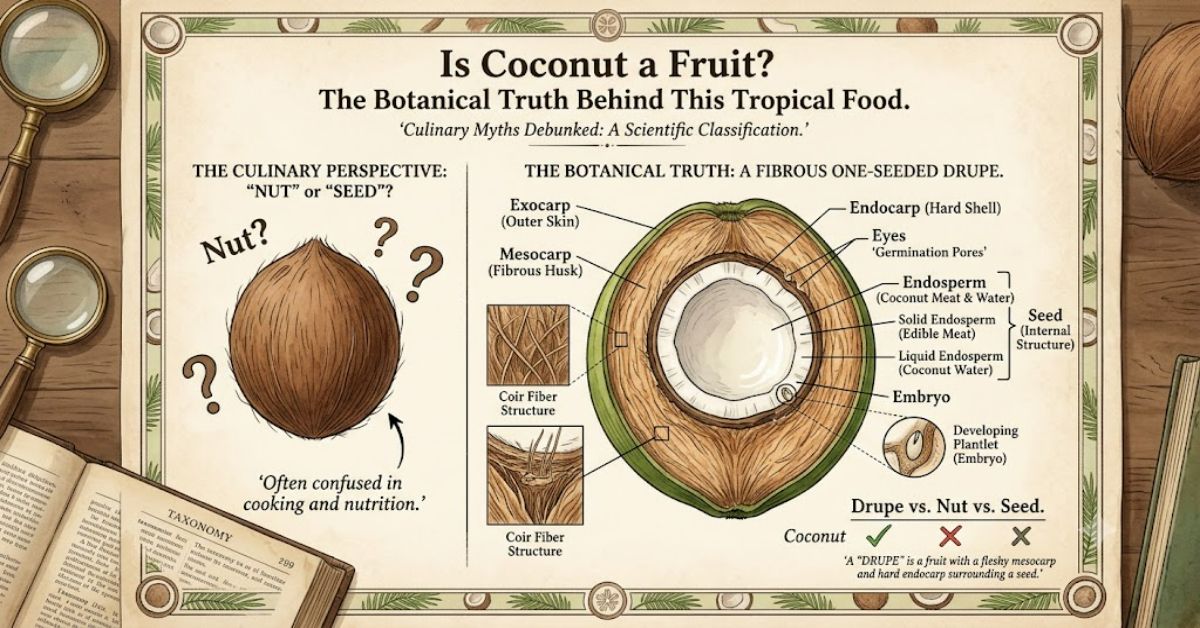
The answer to the question is coconut a fruit is yes. Botanically, a coconut is classified as a fibrous one-seeded drupe, a type of fruit that develops from the ovary of a flowering plant. Although many people think of coconuts as nuts because of their hard shell and name, scientific classification places them among fruits.
A coconut develops from the coconut palm (Cocos nucifera) flower after fertilisation. Like peaches, cherries, and olives, it contains a seed surrounded by protective layers. However, its unique structure, thick fibrous husk, and hard inner shell make it unlike the soft fruits people usually associate with the term “fruit”.
Understanding coconut classification requires looking beyond everyday language and examining botanical definitions. The difference between culinary categories and scientific categories explains why confusion continues among consumers, gardeners, and even food writers.
Why Botanists Classify Coconut as a Fruit
Botanical classification is based on plant development rather than taste or appearance. A fruit is generally defined as the mature ovary of a flowering plant that contains seeds.
Coconuts meet this definition because they form from the flower’s ovary and protect a developing seed.
The coconut has three major layers:
| Layer | Description | Function |
| Exocarp | Smooth outer skin | Protects the fruit surface |
| Mesocarp | Thick fibrous husk | Provides protection and helps seed dispersal |
| Endocarp | Hard inner shell | Shields the seed |
Inside the shell are the edible white flesh and coconut water, both parts of the seed structure. This combination creates a fruit unlike most familiar examples found in supermarkets.
Coconut Compared With Other Drupes
The botanical family of coconuts becomes clearer when compared with other drupes.
| Fruit | Classification | Similar Feature |
| Coconut | Fibrous one-seeded drupe | Hard protective layer around seed |
| Peach | Drupe | Stone surrounding seed |
| Cherry | Drupe | Single seed inside hard pit |
| Olive | Drupe | Fleshy fruit surrounding seed |
The main difference is that coconuts have an unusually thick fibrous middle layer. While peaches and cherries have soft edible flesh around their stone, coconuts have a protective husk designed for survival and transportation.
Why Many People Think Coconut Is a Nut
The confusion comes from everyday language. In cooking, coconuts are often grouped with nuts because they are hard, contain oils, and are used similarly in recipes.
However, a true nut has a different botanical definition. A nut is a dry fruit that usually does not open naturally when mature and contains a single seed.
Examples of true nuts include:
- Hazelnuts
- Acorns
- Chestnuts
Coconuts differ because they develop from a flower’s ovary and contain multiple fruit layers. They are therefore not classified as nuts by botanists.
This distinction matters in areas such as agriculture, food science, and allergy research. Food labelling may group products differently from botanical science because consumer safety and commercial practices follow separate standards.
The Cultural and Economic Importance of Coconut
Coconut palms have played an important role in tropical societies for thousands of years. Countries across Southeast Asia, the Pacific Islands, Africa, and the Caribbean rely on coconut farming for food production and economic activity.
According to agricultural organisations, millions of small farmers depend on coconut cultivation. The fruit provides:
- Coconut water for beverages
- Coconut milk for cooking
- Coconut oil for food and cosmetics
- Fibre for ropes and materials
- Shell products for crafts and fuel
The coconut industry demonstrates how one botanical fruit can support multiple economic sectors.
Nutritional Value and Practical Uses
Coconut products vary significantly depending on how they are processed.
| Coconut Product | Common Uses | Key Characteristics |
| Coconut water | Drinks | Naturally contains electrolytes |
| Coconut flesh | Food ingredient | Provides fibre and fats |
| Coconut oil | Cooking and cosmetics | High saturated fat content |
| Coconut milk | Curries and desserts | Rich, creamy texture |
Although coconut contains beneficial nutrients, some products are calorie-dense due to their fat content. Balanced consumption remains important, especially when using concentrated forms such as coconut oil.
Risks and Misunderstandings Around Coconut
One common misunderstanding is assuming that all coconut products provide the same nutritional benefits. Fresh coconut flesh, coconut water, and refined coconut oil have very different nutritional profiles.
Another issue involves allergies. Coconut is technically not a tree nut, but some people with tree nut allergies may still require medical advice before consuming it.
Food classification can also affect packaging and regulation. Different countries may use different approaches when defining coconut for allergy labelling purposes.
The Future of Coconut in 2027
By 2027, coconut production is expected to remain important as demand grows for plant-based ingredients, natural cosmetics, and sustainable materials.
Climate change remains one of the biggest challenges for coconut farming. Rising temperatures, changing rainfall patterns, and extreme weather events can affect palm productivity.
Researchers and agricultural organisations are increasingly focusing on:
- More resilient coconut varieties
- Sustainable farming methods
- Improved farmer support systems
- Better supply chain management
The future of coconut will likely depend on balancing commercial demand with environmental protection and farmer livelihoods.
Key Takeaways
- Coconut is scientifically classified as a fruit, specifically a fibrous one-seeded drupe.
- Its unusual structure creates confusion because it resembles a nut.
- Botanical classification differs from everyday culinary terminology.
- Coconut supports global industries beyond food production.
- Sustainable farming practices will shape the future of coconut cultivation.
Conclusion
The question “is coconut a fruit” has a clear scientific answer: yes. Despite its nut-like appearance and culinary reputation, the coconut is a fruit because it develops from the ovary of a flowering plant and contains a seed protected by several layers.
Its classification as a fibrous drupe highlights the diversity of plant structures found in nature. Unlike many fruits, coconuts evolved with a strong outer covering that helps protect the seed and allows it to travel across environments.
Beyond classification, coconut remains an important agricultural resource with cultural, nutritional, and economic value. Understanding its true botanical identity helps consumers appreciate the complexity behind one of the world’s most recognisable tropical foods.
Frequently Asked Questions
Is coconut technically a fruit?
Yes. Coconut is technically a fruit because it develops from the ovary of a coconut palm flower and contains a seed.
What type of fruit is a coconut?
A coconut is a fibrous one-seeded drupe, meaning it has a protective outer layer surrounding a single seed.
Why is coconut called a nut?
Coconut is often called a nut because of its hard shell and common culinary use, but botanically it is not a true nut.
Is coconut related to peaches and cherries?
Yes. Like peaches and cherries, coconut belongs to the drupe category because each contains a seed protected by a hard layer.
Is coconut healthy to eat?
Coconut can be part of a balanced diet. It provides fibre and nutrients, but some coconut products are high in calories and saturated fats.
Can people with nut allergies eat coconut?
Coconut is not a true tree nut, but individuals with allergies should consult healthcare professionals before consuming it.
Methodology
This article was prepared using botanical references, agricultural information, and established food science sources. The classification of coconut was evaluated through botanical definitions of fruits and drupes. Nutritional and agricultural claims should be verified against current scientific publications and institutional sources before publication.
Limitations include differences between botanical classification and food industry terminology, as consumer categories often use practical rather than scientific definitions.
References
Royal Botanic Gardens, Kew. (2023). Plant classification and botanical terminology. Kew Science.
Food and Agriculture Organization. (2023). Coconut production and sustainable agriculture. FAO.
Encyclopaedia Britannica. (2024). Coconut: Plant and fruit classification. Encyclopaedia Britannica.