Learning how to stop procrastinating is less about forcing yourself to work harder and more about understanding why you are avoiding the task in the first place. People often delay work because a task feels boring, difficult, uncertain or emotionally uncomfortable. The longer it is avoided, the more stressful it can become.
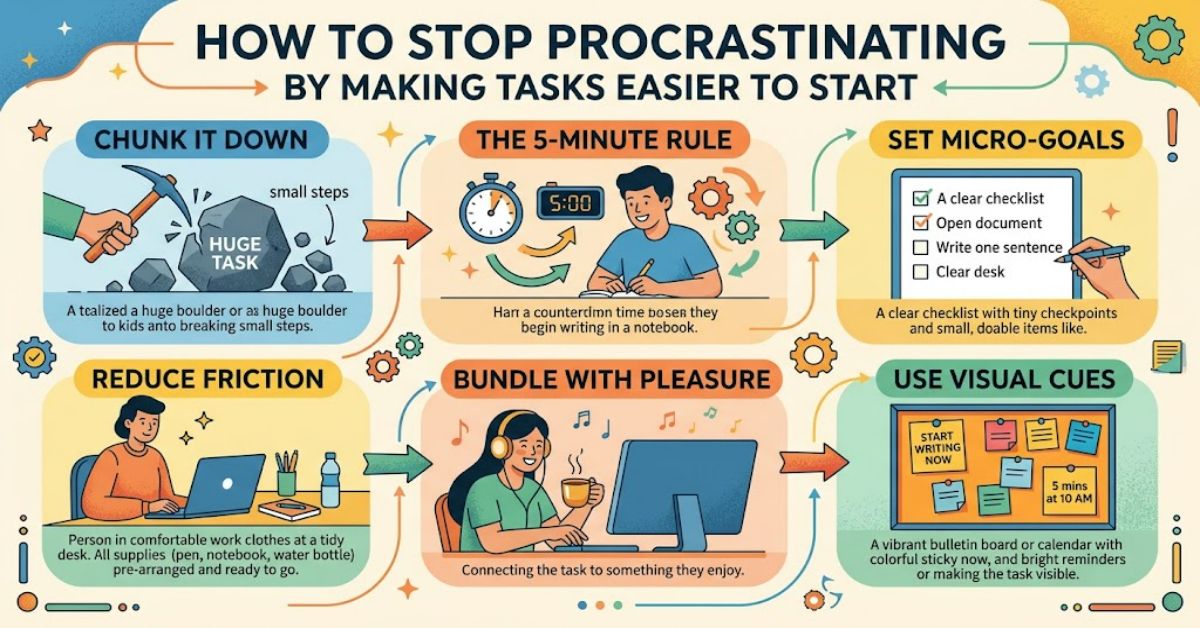
A useful approach is to manage the emotion attached to the task while lowering the effort required to begin. Instead of thinking, “I need to finish this entire project,” focus on the first action: open the document, write the heading, read one page or spend five minutes organising your notes.
This shift matters because starting and finishing are different problems. A large task can feel overwhelming when viewed as one block, but a small first step creates less resistance. Once work begins, momentum can make the next step easier.
Procrastination can also become a cycle. Avoidance provides short-term relief, but the unfinished task remains in the background. That can increase guilt and anxiety, making the task even harder to approach later. Breaking that cycle requires practical systems rather than relying entirely on motivation.
Why Do People Procrastinate?
Procrastination is commonly misunderstood as poor discipline. In reality, emotional regulation plays an important role. A person may delay something because they are worried about making mistakes, uncertain about where to begin or simply uncomfortable with the effort involved.
The task itself may not be the main problem. The emotional response to the task can be.
For example, writing a report may create anxiety because the expected standard feels unclear. Cleaning a room may feel unpleasant because there is no immediate reward. Studying may trigger frustration because the material is difficult.
Recognising the underlying discomfort gives you something specific to address.
Lower the Mental Barrier to Starting
One of the most practical ways to stop procrastinating is to make the first step almost too easy to refuse.
Rather than setting a goal such as “study for three hours”, create a starting goal such as “study one topic for ten minutes”. Instead of “write the article”, decide to draft the opening paragraph.
This does not mean lowering your standards permanently. It means separating starting from completing.
| Difficult starting point | Lower-friction alternative |
| Finish the whole report | Open the document and create three headings |
| Study for two hours | Study for ten focused minutes |
| Clean the entire house | Clear one surface |
| Answer every email | Reply to the easiest message first |
| Exercise for an hour | Put on your exercise clothes and walk for five minutes |
The purpose is to create movement. Once you begin, continuing often requires less psychological effort than starting.
Use Time Limits Instead of Motivation
Waiting until you feel motivated can keep a task permanently postponed. A timer provides a clearer boundary.
Try working for 10, 20 or 25 minutes, followed by a short break. During that period, focus on one defined activity. Remove unnecessary distractions and avoid switching between unrelated tasks.
A short session can be particularly useful when a task feels intimidating. You are not promising yourself that you will work all day. You are committing to a manageable period.
If you continue after the timer ends, that is useful progress. If you stop, you have still completed the agreed session.
Identify the Real Reason You Are Avoiding the Task
When procrastination appears, ask a simple question: What exactly am I trying to avoid feeling?
Possible answers include:
- Fear of failure
- Boredom
- Confusion
- Perfectionism
- Frustration
- Lack of confidence
- Feeling overwhelmed
This question changes the solution.
If the problem is confusion, clarify the instructions. If the problem is perfectionism, create a deliberately rough first draft. If the task is boring, use a short timer or pair it with an appropriate reward.
The goal is not to eliminate every uncomfortable feeling. It is to prevent that discomfort from controlling your behaviour.
Make Your Environment Work for You
Your surroundings can either increase or reduce friction. If your phone constantly interrupts you, keeping it away from your immediate workspace can make concentration easier. If you repeatedly waste time searching for files, organise them before beginning important work.
A useful system is to prepare the next task in advance. Leave the document open, place the required materials nearby or write down the first action before ending your current work session.
That means tomorrow’s starting point has already been decided.
| Friction | Practical adjustment |
| Phone notifications | Silence or move the phone away |
| Unclear priorities | Choose one main task |
| Too many browser tabs | Close unrelated tabs |
| Missing materials | Prepare them beforehand |
| Large project | Divide it into smaller actions |
These changes are simple, but they reduce the number of decisions required before work begins.
How to Stop Procrastinating Consistently
Long-term improvement comes from building repeatable habits rather than expecting perfect productivity every day.
Start by choosing a realistic daily priority. Give it a specific starting time and define what “done” means for that session. Avoid creating an unrealistic list of ten major tasks when three meaningful tasks would be enough.
It also helps to track completed actions rather than only unfinished work. Visible progress can reinforce the behaviour and make future starts feel less demanding.
Another important point is to avoid turning one unproductive day into a larger failure. Missing a planned session does not mean the routine has failed. Restarting at the next opportunity is more useful than spending additional time feeling guilty.
The Risks of Relying on Pressure
Pressure can sometimes produce short-term results, especially when a deadline is close. However, depending on panic as a productivity system has drawbacks.
Repeated last-minute work can increase stress, reduce time available for checking quality and create an association between important tasks and anxiety. It may also encourage rushed decisions.
A better approach is to create earlier personal deadlines. If an assignment is due on Friday, treating Thursday as the personal deadline creates some space for unexpected problems.
The aim is not constant productivity. It is greater control over when and how work gets done.
A Simple Anti-Procrastination Routine
A practical routine can look like this:
- Choose one important task.
- Identify the smallest useful first step.
- Remove one obvious distraction.
- Set a short timer.
- Work only on that defined task.
- Take a brief break.
- Decide whether to continue or schedule the next session.
This process reduces the need to negotiate with yourself repeatedly. You know what the task is, when you will begin and what the first action involves.
The Future of Procrastination Management in 2027
By 2027, productivity tools are likely to become increasingly focused on personalised planning, reminders and behavioural patterns. However, technology will not remove the emotional causes of procrastination.
The more useful direction is likely to be systems that help people recognise when a task is becoming overwhelming and divide it into practical next actions. Human judgement will still matter, particularly where avoidance is connected to stress, uncertainty or unrealistic workloads.
The strongest approach will therefore combine technology with simple behavioural principles: clear priorities, smaller starting points, realistic schedules and regular review.
Key Insights
- Procrastination is often an avoidance response to discomfort.
- Starting a task can be more difficult than continuing it.
- Smaller actions reduce psychological resistance.
- Timers create manageable commitments without requiring strong motivation.
- Environment design can remove unnecessary friction.
- Consistency matters more than an occasional highly productive day.
Conclusion
Knowing how to stop procrastinating begins with changing the way a difficult task is approached. Instead of treating delay as evidence of laziness, identify the discomfort behind the avoidance and make the first step easier.
A large project becomes more manageable when it is divided into specific actions. A vague intention becomes stronger when attached to a time and place. A distracting environment can be improved by removing unnecessary choices and interruptions.
The objective is not to become productive every minute of every day. It is to create a reliable way of beginning important work even when motivation is low. Once starting becomes easier, progress becomes less dependent on mood and more dependent on a practical system.
FAQ
What is the easiest way to stop procrastinating?
Start with the smallest useful action. Open the document, write one sentence, organise one item or work for five to ten minutes. Reducing the starting barrier can make the task feel less intimidating.
How can I stop procrastinating when I feel overwhelmed?
Break the task into smaller steps and choose only the next action. Avoid trying to solve the entire project at once. A clear first step reduces uncertainty.
Why do I procrastinate even when I know a task is important?
Importance does not remove emotional discomfort. Fear, boredom, perfectionism, confusion or frustration can still encourage avoidance. Identifying the specific discomfort can help you choose a better strategy.
Does the five-minute rule help with procrastination?
It can. Committing to only five minutes reduces the perceived cost of starting. You may continue afterwards, but the initial goal remains deliberately small.
Can procrastination be completely eliminated?
Probably not in a realistic sense. Most people will occasionally delay uncomfortable tasks. The more useful goal is to recognise the pattern quickly and return to the task without allowing one delay to become a long-term cycle.
Methodology
This article follows the supplied RubbleMagazine editorial framework and focuses on the provided keyword detail: managing emotions and lowering the mental barrier to starting a task. The article does not claim firsthand testing or fabricated performance measurements. Any publication should independently verify research claims, references and author credentials before release, as required by the supplied editorial brief.