An AWS outage can affect websites, applications, databases, APIs and business systems that depend on Amazon Web Services. However, an AWS outage does not necessarily mean that the entire AWS platform is down.
As of 7 September 2026, AWS’s public Service Health Dashboard shows no recent global service issues. The dashboard is designed to display current and historical health information for AWS services and Regions.
That distinction matters because AWS operates a large collection of independent services across multiple geographic Regions and Availability Zones. A problem affecting one Region can cause serious disruption for customers located there while leaving other AWS infrastructure operating normally.
There is also a difference between a public service incident and an account-specific problem. AWS provides a public dashboard for general service health, while customers can use their personalised AWS Health Dashboard to see events affecting their own accounts and resources.
For users asking whether AWS is down, the first step is therefore to check the official service status rather than relying on social media reports or assumptions based on one failing website.
How to Check for an AWS Outage
The most reliable starting point is the AWS Health Dashboard. AWS says its public Service Health page provides information about reported service events across AWS Regions and can be viewed without signing in.
| Check | What it tells you |
| AWS Service Health | Whether AWS has reported a public service event |
| AWS Personal Health Dashboard | Events affecting your account or organisation |
| Application monitoring | Whether your own application is responding |
| Region status | Whether a particular geographic location is affected |
| Logs and metrics | Whether the failure is inside your infrastructure |
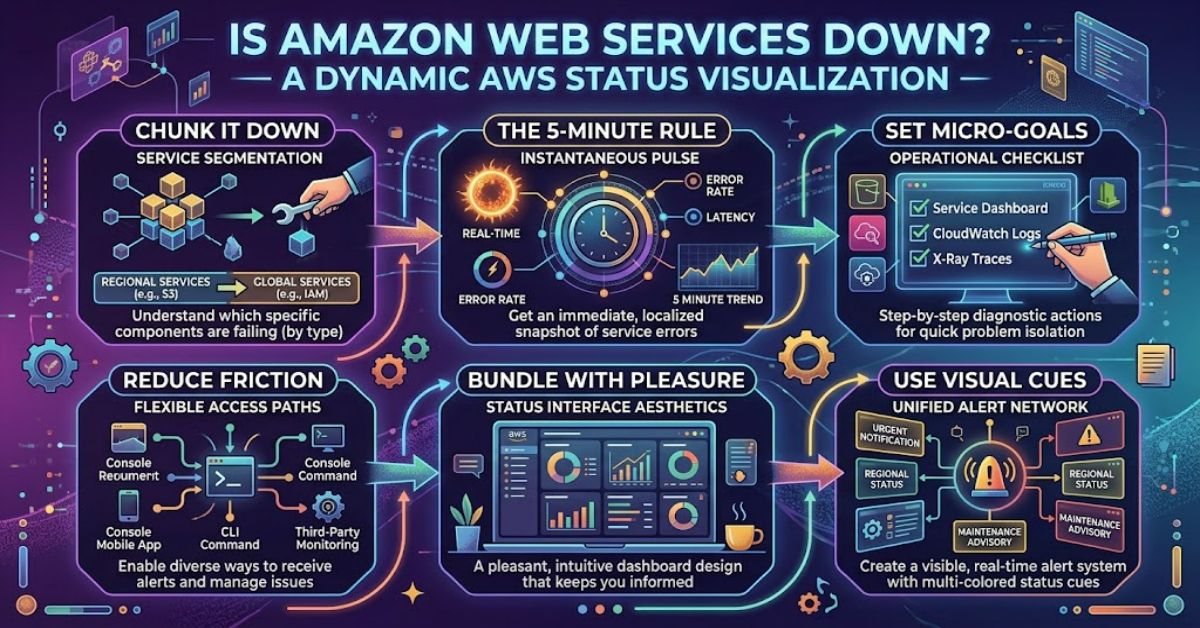
This creates an important diagnostic sequence. If the AWS dashboard reports an incident, the problem may be external to your application. If AWS reports normal service but your application remains unavailable, the cause could be configuration, networking, permissions, capacity or an application-level failure.
Is AWS Completely Down?
A complete worldwide AWS failure is very different from a regional incident.
AWS divides its infrastructure into Regions, with Availability Zones providing additional separation inside those geographic locations. This architecture means that a failure in one location does not automatically make every AWS customer worldwide unavailable.
For businesses, this creates both an advantage and a responsibility. AWS infrastructure provides opportunities for redundancy, but simply running an application on AWS does not automatically make that application resilient.
A company using only one Region can still experience major downtime if that Region encounters a serious incident.
What Causes AWS Problems?
Cloud disruptions can have different causes. They may involve software defects, networking problems, hardware failures, power issues, configuration errors or problems involving dependencies between services.
The May 2026 AWS incident in Northern Virginia illustrates why physical infrastructure remains important. Reuters reported that overheating at an AWS data centre disrupted services and affected companies including Coinbase. AWS services were subsequently brought largely back online.
This is a useful reminder that cloud computing does not eliminate physical infrastructure risk. Cloud platforms abstract servers and data centres from customers, but those physical systems still exist underneath the service layer.
Global Outage vs Regional Outage
Understanding the difference between global and regional failures can prevent unnecessary panic.
| Situation | Likely impact | Best response |
| Global AWS incident | Multiple services and Regions may be affected | Monitor AWS updates and activate continuity procedures |
| Regional incident | Customers using the affected Region may experience disruption | Redirect workloads where architecture permits |
| Single-service issue | One AWS product may be degraded | Check dependencies and service-specific updates |
| Account-specific issue | Individual customer resources are affected | Review AWS Health and account configuration |
| Application failure | AWS may be operating normally | Investigate application logs and infrastructure |
The practical lesson is simple: never diagnose an outage solely from the fact that one application is unavailable.
What Should Businesses Do During an Outage?
The first priority should be confirmation. Check AWS status information and your own monitoring before making major infrastructure changes.
If an AWS incident is confirmed, avoid making unnecessary configuration changes that could make recovery harder. Review AWS updates, monitor error rates and identify which components are actually affected.
Businesses with multi-Region architecture may be able to redirect traffic to another Region. Those without that redundancy may need to concentrate on data recovery, service restoration and communication with customers.
This is where disaster recovery planning becomes important. A recovery plan should not exist only as a document. Teams need to know which systems are critical, where backups are stored, who makes failover decisions and how long recovery is expected to take.
The Hidden Risk: Dependencies
One of the less obvious problems during cloud incidents is dependency failure.
An application may appear to rely on only one AWS service while actually depending on several others. For example, an application could use compute infrastructure, object storage, identity services, databases, monitoring and networking components at the same time.
A failure in one foundational service can therefore create secondary problems elsewhere.
This means resilience testing should examine dependencies rather than simply asking whether the main application server has a backup.
The Future of AWS Outages in 2027
By 2027, cloud resilience is likely to focus increasingly on automated detection, cross-Region recovery and dependency-aware monitoring.
However, automation does not remove infrastructure risk. A poorly designed automatic failover system can create additional problems if it redirects traffic to a destination that lacks capacity or depends on the same failed service.
The stronger approach is controlled automation backed by tested recovery procedures. Organisations will also need to balance resilience against cost, latency, data residency and operational complexity.
Multi-Region deployment can improve availability, but it is not free. Maintaining duplicate infrastructure, synchronising data and testing failover all introduce additional technical and financial requirements.
Key Insights
- An AWS outage can be global, regional, service-specific or account-specific.
- The official AWS Health Dashboard is the best starting point for checking public incidents.
- A working AWS platform does not guarantee that an individual application is healthy.
- Regional redundancy can reduce the effect of local infrastructure failures.
- Service dependencies can make seemingly small incidents much larger for customers.
- Disaster recovery plans need practical testing, not just documentation.
Conclusion
The current AWS service information does not indicate a widespread global outage on 7 September 2026. That does not mean every AWS customer will experience uninterrupted service. Cloud incidents can affect specific Regions, services, accounts or dependencies without becoming a worldwide failure.
For users experiencing problems, checking the AWS Health Dashboard should be the first step. After that, application monitoring, logs, network checks and account-specific health information can help establish whether the problem originates with AWS or within the customer’s own environment.
For organisations, the larger lesson is resilience. Multi-Region architecture, reliable backups, dependency mapping and tested disaster recovery procedures can significantly reduce the consequences of infrastructure disruption. AWS provides extensive infrastructure, but availability ultimately depends on how that infrastructure is designed and operated.
FAQ
Is AWS down right now?
As of 7 September 2026, the public AWS Health Dashboard shows no recent widespread service issue. Individual customers or Regions can still experience problems, so account-specific health information should also be checked.
How can I check for an AWS outage?
Check the public AWS Service Health Dashboard first. It reports public service events across AWS Regions. Customers can also use the personalised AWS Health Dashboard to review events affecting their accounts.
Why is my AWS application down if AWS is operational?
Your application may have an account-specific configuration issue, networking problem, permissions failure, capacity problem or software error. Check application logs and monitoring alongside AWS service status.
Can an AWS outage affect only one Region?
Yes. AWS infrastructure is distributed across geographic Regions and Availability Zones. A regional incident can affect customers using that location without creating a worldwide outage.
Does using multiple AWS Regions prevent downtime?
It can reduce the impact of a regional failure, but it does not guarantee uninterrupted service. Applications still need suitable failover architecture, data replication, capacity and tested recovery procedures.
Methodology
This article uses the keyword and editorial requirements supplied in the RubbleMagazine brief. The current AWS status was separately checked against the AWS Health Dashboard on 7 September 2026. AWS documentation was used to distinguish public service health information from account-specific health information.
The article does not claim firsthand testing of AWS infrastructure. Historical outage context was included only where supported by a published source. Reuters’ reporting on the May 2026 Northern Virginia incident was used for the physical-infrastructure example.
Before publication, the supplied editorial brief requires human verification of current status, named claims, references and any firsthand authority signals.