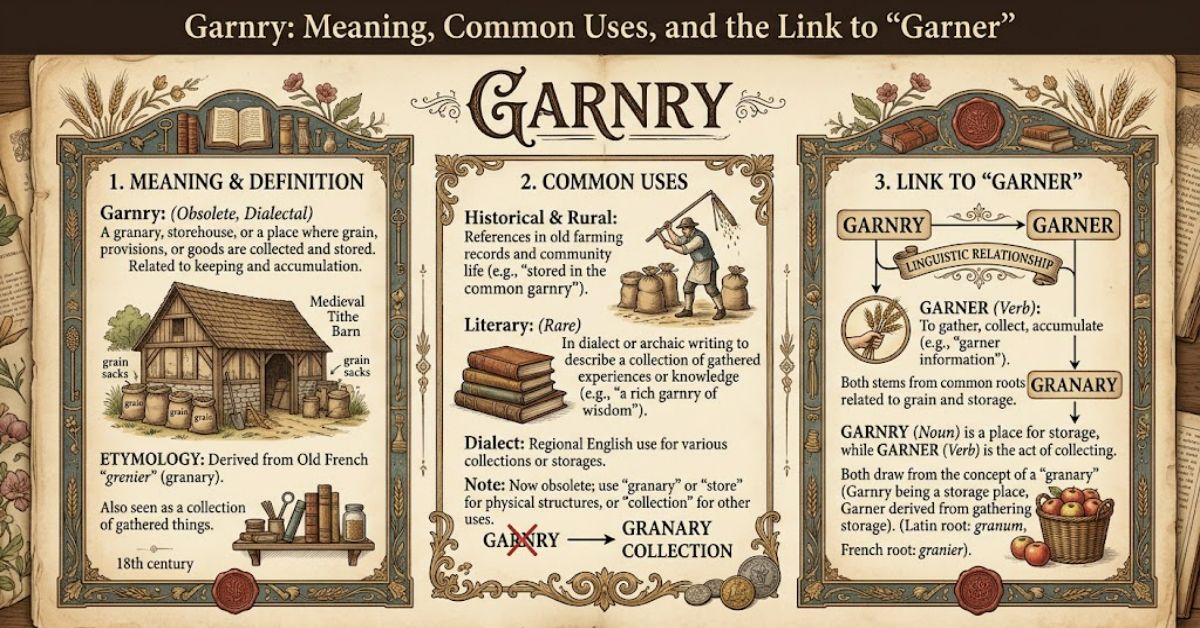
The word “garnry” can be confusing because it does not have the same established dictionary status as “garner”. In many searches, it is likely to be a spelling error or variation of the word “garner”. However, it can also appear in searches connected with Peter Garnry, a financial professional, so the intended meaning depends on context.
The standard English word is “garner”. Cambridge Dictionary defines it as a formal verb meaning to collect something, usually after considerable work or difficulty. Oxford gives a similar definition, describing it as obtaining or collecting something such as information or support.
Merriam-Webster provides an additional historical dimension. The verb originally related to gathering something into storage, particularly a granary. In modern English, its more common meaning is to acquire, earn, accumulate or collect.
That distinction is useful because a search for “garnry” may represent several different intentions. Someone may simply have mistyped “garner”, may be looking for the meaning of the word, or may have encountered the surname Garnry in a financial context.
Understanding these possibilities prevents the term from being treated as though it has one fixed definition. The spelling, sentence and surrounding subject all matter.
Is Garnry a Word?
“Garnry” is not the standard dictionary form of the word discussed in the supplied material. The recognised English term is “garner”.
| Search Term | Likely Interpretation | Standard Usage |
| Garnry | Spelling variation or proper-name search | Context-dependent |
| Garner | English verb | Standard |
| Garnered | Past tense | Standard |
| Garnering | Present participle | Standard |
| Garner | Historical noun | Archaic |
The distinction is particularly important for writers and students. Replacing “garner” with “garnry” in formal English would generally be considered incorrect unless “Garnry” is being used as a person’s name.
What Does Garner Mean?
The modern verb “garner” means to obtain, gather or accumulate something. It is frequently used with abstract nouns such as attention, support, praise, votes, interest and recognition.
For example:
- A new film may garner critical praise.
- A campaign may garner public support.
- A researcher may garner useful evidence.
- A company may garner attention through an innovative product.
Cambridge describes the word as collecting something, often after significant effort. Oxford similarly uses the idea of obtaining or collecting information or support.
This makes “garner” slightly different from the simple verb “get”. In formal writing, it often suggests that something has been accumulated as a result of effort.
Garner as “Collect”
The most direct modern meaning is to gather or accumulate.
A sentence such as “The organisation garnered evidence” suggests that evidence was collected over time. Likewise, “The proposal garnered support” means that support was gained.
The verb is transitive, meaning it normally takes an object. Writers therefore say someone “garnered attention” rather than simply “garnered”.
Garner as “Earn”
Another common meaning is to gain something valuable or respected.
A performer might garner praise after a successful performance. A politician might garner votes during an election. A researcher might garner recognition for important work.
This meaning is strongly established in modern usage. Merriam-Webster lists “acquire by effort”, “earn”, “accumulate” and “collect” among the principal meanings.
The Older Meaning of Garner
The history of the word is more literal than its modern use suggests.
Merriam-Webster explains that “garner” was historically associated with a granary or storage place for grain. The word entered English through forms related to the Old French and Latin words for grain storage.
Collins also records “garner” as an archaic noun meaning a granary or a place used for storage or safekeeping.
This creates an interesting semantic connection:
Physical storage → gathering → accumulation → gaining something valuable
The modern verb retains the basic idea of gathering, but the object has changed. Instead of grain being stored in a physical granary, a person can now “garner” praise, information, support or attention.
Garnry vs Garner
The easiest way to distinguish the terms is to consider whether the word is being used as a common English verb or as a name.
| Feature | “Garnry” | “Garner” |
| Standard English verb | No | Yes |
| Means collect or obtain | Not as a standard verb | Yes |
| Historical storage meaning | Not established in the supplied evidence | Yes |
| Can appear as a name | Possible | Yes |
| Suitable in formal English | Only when context requires the name | Yes |
If someone writes “the project garnry support”, the intended word is almost certainly “garner”: “the project garnered support”.
If “Garnry” appears in a person’s name, however, it should not automatically be corrected. Proper names follow different rules from ordinary vocabulary.
Who Is Peter Garnry?
Another possible reason for the search term is Peter Garnry. In this context, “Garnry” is not a misspelling of “garner”; it is a surname.
That distinction is important for search intent. A person researching finance, markets or investment analysis may encounter Peter Garnry, while someone studying English vocabulary may be looking for the verb “garner”.
The two subjects should therefore remain separate unless the surrounding context connects them.
Why Context Matters
Search engines frequently receive incomplete queries. A short term such as “garnry” gives little information about what the searcher actually wants.
A useful interpretation framework is:
| Search Context | Most Likely Meaning |
| English grammar | Garner |
| Vocabulary definition | Garner |
| “Garnered attention” | Garner |
| Finance or investment | Potentially Peter Garnry |
| Person’s name | Garnry as a surname |
| Typing error | Likely “garner” |
This is one reason search results can appear mixed for unusual spellings.
Common Uses of Garner
The word appears naturally in formal and professional writing.
Garner attention: To attract notice or interest.
Garner support: To gain backing from people or organisations.
Garner praise: To receive positive recognition.
Garner votes: To obtain votes during an election.
Garner interest: To attract interest from an audience or market.
Garner recognition: To gain acknowledgement for an achievement.
Collins specifically records common combinations such as “garner a reputation”, “garner interest”, “garner praise”, “garner respect” and “garner votes”.
Why the Spelling Causes Confusion
“Garner” already has an unusual pronunciation for some learners, particularly because its spelling does not clearly signal the vowel sound to everyone. A person hearing the word may therefore reproduce it incorrectly when typing it.
Search behaviour also creates another layer of confusion. Misspellings can become recurring search terms, particularly when users copy terminology from social media, comments or informal writing.
That does not make “garnry” an alternative standard spelling. It simply means that the term can exist as a search variation.
The Future of Garnry in 2027
There is little evidence to suggest that “garnry” will become a recognised alternative spelling of “garner” by 2027. Established dictionaries continue to define “garner” as the standard English word for collecting, obtaining or accumulating something.
Digital search may continue to preserve misspellings because users search exactly as they remember or type a word. At the same time, search systems are increasingly capable of interpreting spelling variations and connecting them with likely intended terms.
The more durable development is therefore not a change in the dictionary spelling, but better contextual interpretation. A query involving finance may point towards a person, while a grammar-related query will usually point towards the verb.
Key Takeaways
- “Garnry” should not normally replace “garner” in formal English.
- “Garner” means to collect, obtain, accumulate or earn.
- The word has historical connections with grain storage and granaries.
- Modern usage often involves abstract things such as praise, attention or support.
- Peter Garnry represents a separate proper-name search intent.
- Context is the best way to determine what a search for “garnry” means.
Conclusion
The meaning of “garnry” depends largely on why and where the term appears. As an ordinary English word, it is best understood as a likely spelling variation of “garner”, which is the established verb meaning to collect, accumulate or obtain something.
“Garner” has a much older history than its modern business and everyday uses suggest. Its original connection with grain storage developed into the broader idea of gathering and eventually into meanings involving praise, support, attention and recognition.
There is also an important second possibility: Garnry may refer to a surname, including that of financial professional Peter Garnry. In that case, changing the spelling to “garner” would be incorrect.
For readers, writers and searchers, the practical lesson is simple: context matters. If the subject is English vocabulary, “garner” is almost certainly the intended word. If the subject is a person or financial analysis, “Garnry” may be a proper name rather than an error.
Frequently Asked Questions
Is “garnry” a correct English word?
It is not the standard spelling of the English verb “garner”. In most vocabulary-related searches, “garnry” is likely to be a spelling variation or typo.
What does “garner” mean?
“Garner” means to collect, obtain, accumulate or earn something. It is often used with words such as attention, praise, support, votes and recognition.
Is “garnry” another spelling of garner?
It should not be treated as a standard alternative spelling. “Garner” is the established dictionary form.
Who is Peter Garnry?
Peter Garnry is a financial professional whose surname may explain searches for “Garnry”. This is a separate use from the English verb “garner”.
What is the old meaning of garner?
Historically, “garner” could refer to a granary or storage place for grain. The modern verb developed from this storage-related meaning.
How do you use garner in a sentence?
You can write: “The new policy garnered widespread support.” Here, “garnered” means that the policy gained or accumulated support.
Methodology
This article treats the supplied keyword detail as the starting point and distinguishes between the possible search meanings identified there. Dictionary definitions and etymological information were checked against Merriam-Webster, Cambridge Dictionary, Oxford Advanced Learner’s Dictionary and Collins English Dictionary.
No firsthand interview, field observation or linguistic experiment was conducted. The discussion of “garnry” as a likely spelling variation is therefore presented cautiously rather than as a definitive linguistic classification. The separate proper-name interpretation should also be verified against the relevant person’s current professional profile before publication.
Editorial disclosure: This article was drafted with AI assistance and should be reviewed by a human editor before publication. Dictionary definitions, names and other factual claims should be checked against the original sources before publication.
References
Cambridge University Press. (n.d.). Garner. Cambridge Dictionary.
Collins. (n.d.). Garner definition and meaning. Collins English Dictionary.
Merriam-Webster. (2026). Garner. Merriam-Webster.com Dictionary.
Oxford University Press. (n.d.). Garner verb. Oxford Advanced Learner’s Dictionary.