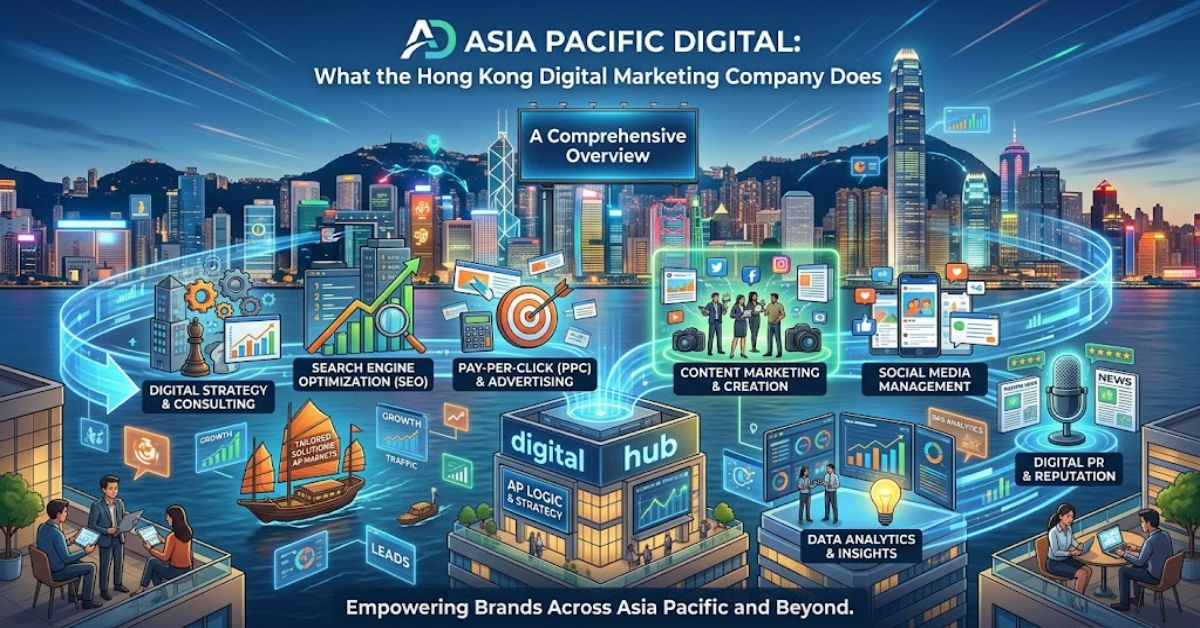
Asia Pacific Digital is a search term most commonly associated with AsiaPac Digital, an AI-driven omnichannel digital marketing technology company headquartered in Kowloon, Hong Kong. The supplied company information states that the business was founded in 1996 and operates under the corporate name AsiaPac Net Media Limited.
The company’s positioning reflects a major shift in digital marketing. Traditional advertising focused heavily on individual channels such as websites, search advertising, email or social media. Modern marketing technology increasingly connects these channels through shared data, automation and artificial intelligence.
AsiaPac Digital sits within that broader technology-driven model. Its focus is not simply on producing advertising material, but on using digital systems to connect marketing activity with customer behaviour and measurable business outcomes.
Its Hong Kong base is also significant. Hong Kong has long served as a commercial bridge between mainland China, other Asian markets and international businesses. For a digital marketing organisation, that location can support work across markets where consumer behaviour, languages, platforms and regulatory expectations vary considerably.
The term Asia Pacific Digital can therefore be understood in two ways. It can describe the broader idea of digital activity across the Asia-Pacific region, but in search results it may specifically refer to AsiaPac Digital as a company. Understanding that distinction is important when researching the organisation, its services or its business history.
What Is AsiaPac Digital?
AsiaPac Digital, identified in the supplied material as AsiaPac Net Media Limited, is a digital marketing technology company based in Hong Kong.
Its stated positioning combines artificial intelligence with omnichannel marketing. Omnichannel means that customer interactions across different platforms are treated as part of a connected journey rather than as isolated marketing activities.
For example, a potential customer might first encounter a company through a search advertisement, visit its website, interact with social media content and later receive an email. An omnichannel strategy attempts to connect those interactions so that marketing decisions are based on a broader understanding of the customer.
This approach requires more than creative work. It depends on data collection, analytics, audience segmentation, campaign management and technology infrastructure.
A Company Built Around Digital Change
The supplied information dates the company’s founding to 1996. That is an important detail because the digital marketing industry of the mid-1990s was dramatically different from today’s environment.
At that time, commercial internet use was still developing. Search engines, social networks, smartphones, programmatic advertising and modern marketing automation did not yet resemble the systems businesses use today.
A company operating from 1996 therefore had to adapt as digital marketing developed from basic online presence into a complex technology ecosystem.
| Period | Digital Marketing Environment | Strategic Priority |
| 1990s | Early commercial internet | Establishing online presence |
| 2000s | Search and web advertising | Customer acquisition |
| 2010s | Social, mobile and data analytics | Multi-channel engagement |
| 2020s | AI, automation and connected data | Personalisation and efficiency |
| 2027 outlook | Greater AI integration | Responsible, measurable orchestration |
The important point is that longevity alone does not prove technological leadership. A long operating history matters because it shows exposure to multiple technology cycles, but current capabilities must still be assessed independently.
How the Omnichannel Model Works
An omnichannel marketing system normally connects several stages of the customer journey.
Data Collection
Digital platforms generate information about searches, website activity, advertising interactions and customer behaviour. Useful marketing systems need to organise these signals without losing sight of privacy and consent requirements.
Audience Analysis
Analytics can then identify patterns within customer data. Artificial intelligence may assist with segmentation, prediction and optimisation, although the quality of the underlying data remains critical.
Campaign Activation
Once audiences have been identified, marketing activity can be deployed across relevant channels. This can include search, display, social, email and other digital touchpoints.
Measurement
The final stage is measurement. Businesses need to understand whether campaigns generated meaningful outcomes rather than simply producing impressions or clicks.
This creates a central strategic lesson: omnichannel marketing is fundamentally an integration problem. Adding more platforms does not automatically create a better customer experience.
Why AI Matters to Digital Marketing
AI has changed the expectations placed on marketing technology companies.
Instead of manually reviewing every campaign variable, marketers can increasingly use machine learning and automated systems to identify patterns and optimise decisions.
| AI Application | Potential Marketing Role | Main Limitation |
| Audience modelling | Identify customer segments | Dependent on data quality |
| Predictive analytics | Estimate likely behaviour | Predictions are not guarantees |
| Automation | Reduce repetitive tasks | Poor rules can scale errors |
| Personalisation | Tailor customer experiences | Privacy and consent concerns |
| Campaign optimisation | Adjust marketing performance | Requires reliable measurement |
The strongest use of AI is not necessarily replacing marketers. It is reducing repetitive analytical work while allowing human teams to concentrate on strategy, positioning and creative judgement.
That distinction becomes particularly important in Asia-Pacific markets, where cultural differences can make automated assumptions unreliable.
The Asia-Pacific Challenge
Digital marketing across Asia-Pacific is not one uniform market.
Consumers in Hong Kong, Singapore, Japan, Australia, South Korea, India and Southeast Asian markets can use different platforms and respond differently to advertising formats. Language and cultural expectations also influence communication.
A regional strategy therefore has to balance standardisation with localisation.
One of the less obvious challenges is data fragmentation. A company may have excellent data within one platform but limited visibility across the complete customer journey. Connecting these systems can be technically and organisationally difficult.
A second challenge is attribution. When customers interact with multiple channels before making a purchase, deciding which channel deserves credit becomes complicated.
A third is privacy. Greater personalisation requires greater responsibility around how information is collected, stored and used.
These constraints apply to the wider Asia Pacific Digital sector as much as to individual companies operating within it.
Strategic Advantages and Risks
The model offers several potential advantages.
Integration: Connecting multiple channels can provide a more complete view of customer journeys.
Automation: AI and marketing automation can reduce repetitive operational work.
Measurement: Digital campaigns can generate detailed performance data.
Scalability: Technology can make it easier to manage campaigns across multiple markets.
However, the model also carries risks.
AI can produce poor recommendations when the underlying data is incomplete. Automated personalisation can become intrusive. Cross-market campaigns can overlook local cultural differences. Most importantly, sophisticated technology does not compensate for weak marketing strategy.
The practical implication is straightforward: technology should support business objectives rather than become the objective itself.
AsiaPac Digital in Context
The supplied company information identifies AsiaPac Digital as an established Hong Kong business with a long history in digital marketing. That history is useful context, but it should not be interpreted as evidence that every current capability is superior to competitors.
For readers researching the company, three factors deserve particular attention:
| Area | What to Examine |
| Technology | AI, automation and data capabilities |
| Market coverage | Regional expertise and localisation |
| Business outcomes | Measurable campaign performance |
This provides a more useful framework than judging a digital agency purely by its service list.
The Future of Asia Pacific Digital in 2027
By 2027, AI is likely to play an even larger role in marketing operations. The European Union’s AI Act and other emerging regulatory frameworks are also increasing attention on transparency, risk management and responsible AI use.
For Asia-Pacific companies, regulation will not be uniform. Different jurisdictions will continue to develop different privacy and AI requirements.
That creates an operational challenge for regional marketers. A campaign system designed for one market may need additional controls when deployed elsewhere.
The most valuable marketing technology will therefore likely be technology that combines automation with governance. AI can accelerate decision-making, but businesses will still need human oversight, accurate data and clear accountability.
Key Takeaways
- AsiaPac Digital is associated with AsiaPac Net Media Limited and is based in Hong Kong.
- The company was founded in 1996 according to the supplied information.
- Its stated focus combines AI, digital marketing technology and omnichannel engagement.
- Omnichannel systems attempt to connect customer interactions across different platforms.
- AI can improve marketing efficiency but remains dependent on data quality and human oversight.
- Asia-Pacific markets require localisation because consumer behaviour and regulatory environments differ.
- Technology should ultimately be judged by measurable business outcomes rather than the number of features it offers.
Conclusion
Asia Pacific Digital is best understood in the supplied context as a reference to AsiaPac Digital, a Hong Kong-based digital marketing technology company operating under AsiaPac Net Media Limited. Its stated history stretches back to 1996, giving it a long connection with the development of digital marketing.
The company’s AI-driven and omnichannel positioning reflects where the marketing industry has moved: towards connected customer journeys, automated analysis, data-driven decision-making and measurable performance.
Yet sophisticated technology brings its own challenges. Data fragmentation, privacy obligations, attribution problems and cultural differences can all reduce the effectiveness of regional campaigns. AI can improve efficiency, but it cannot remove the need for sound strategy and human judgement.
For businesses assessing AsiaPac Digital or similar providers, the most useful questions concern technology capability, regional expertise, data governance and measurable outcomes. Those factors provide a stronger basis for evaluation than marketing terminology alone.
Frequently Asked Questions
What is Asia Pacific Digital?
The term is commonly associated with AsiaPac Digital, identified in the supplied information as AsiaPac Net Media Limited, a Hong Kong-based digital marketing technology company.
What does AsiaPac Digital do?
The supplied company description positions AsiaPac Digital as an AI-driven omnichannel digital marketing technology company, combining technology, data and digital marketing.
When was AsiaPac Digital founded?
According to the supplied information, AsiaPac Digital was founded in 1996.
Where is AsiaPac Digital based?
The company information supplied for this article identifies Kowloon, Hong Kong as its headquarters.
Does Asia Pacific Digital use AI?
AI is central to the company’s stated positioning. Its description specifically identifies the organisation as an AI-driven digital marketing technology company.
What does omnichannel digital marketing mean?
Omnichannel digital marketing connects customer interactions across multiple channels. Instead of treating search, social, websites and other platforms independently, businesses attempt to create a coordinated customer journey.
Methodology
This article was based primarily on the company description and factual details supplied in the editorial brief, including the stated corporate name, founding year, Hong Kong headquarters and AI-driven omnichannel positioning. Broader discussion of omnichannel marketing, artificial intelligence, data fragmentation and regional strategy is presented as contextual analysis rather than as a claim about proprietary company performance.
No independent hands-on testing, employee interview or commissioned field reporting was conducted for this article. Consequently, no fabricated firsthand experience or performance statistics have been included. Company-specific capabilities should be independently verified against current corporate documentation before publication.
Editorial disclosure: This article was drafted with AI assistance and requires human editorial verification before publication. Named claims, dates and current company information should be checked against primary sources.