The term eHow wiki usually refers to the historical intersection between eHow and wikiHow. They are not simply two names for the same website. Instead, they represent two different approaches to building a large online library of practical instructions.
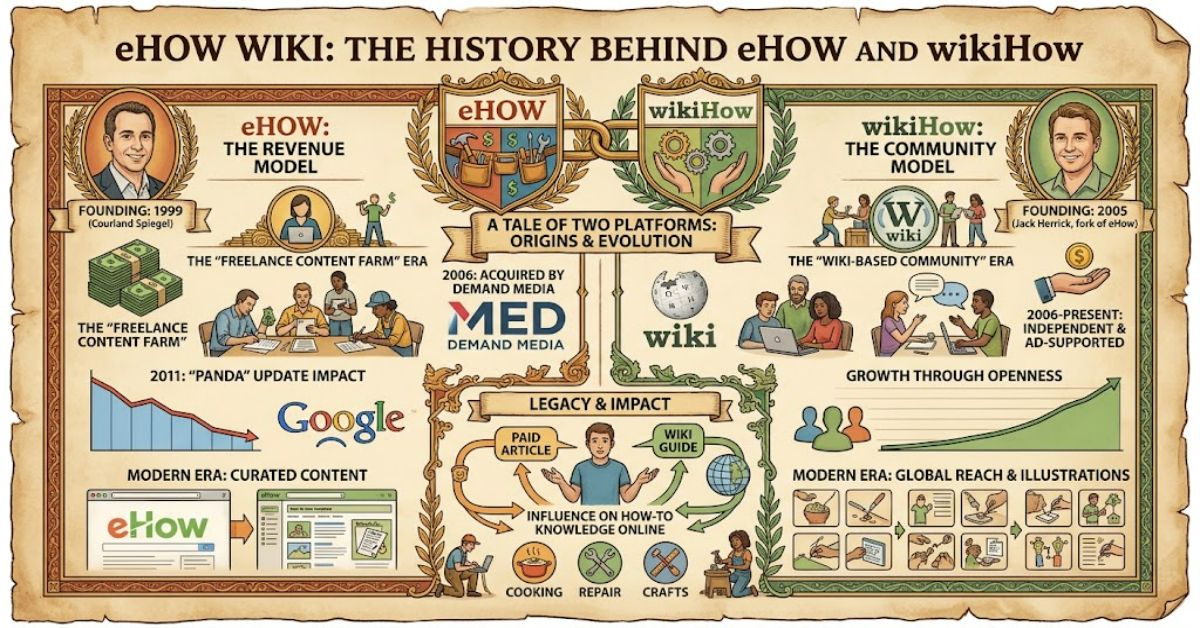
eHow was established in 1999 and developed as a commercial how-to website. Its model relied on professionally produced or commissioned content covering practical subjects. wikiHow appeared later, launching on 15 January 2005 as a collaborative project associated with eHow.
The connection became especially significant because Jack Herrick, who had acquired eHow with Josh Hannah in 2004, became convinced that the wiki model could produce a broader and more collaborative how-to manual. Herrick had been influenced by Wikipedia and wanted to apply a similar community-editing concept to practical knowledge.
That history explains why people sometimes search for “eHow wiki” when they are actually looking for information about the relationship between the two platforms.
eHow and the First Generation of Online How-To Content
eHow belongs to an earlier period of internet publishing when practical information was increasingly being organised into searchable articles.
Founded by Courtney Rosen in 1999, eHow initially focused on written instructions and later expanded into video. The site experienced financial difficulties early in its history, including a Chapter 7 bankruptcy filing in February 2001. It was subsequently acquired by Demand Media in 2006.
Its commercial model was fundamentally different from the open contribution system later associated with wikiHow. Writers were commissioned to create articles, allowing the company to produce content at scale but also tying publishing decisions to commercial incentives.
This distinction matters because the eHow experience helped shape Herrick’s thinking about how a universal how-to resource could be built.
How wikiHow Emerged From eHow
Jack Herrick and Josh Hannah acquired eHow in 2004. Around the same period, Herrick was studying the rapid development of Wikipedia and considering whether its collaborative structure could work for practical instructions.
wikiHow launched on 15 January 2005, deliberately choosing the fourth anniversary of Wikipedia’s launch. It initially existed as a project within eHow rather than as a completely separate company.
The underlying idea was straightforward but significant: instead of relying primarily on paid writers, a large community could create, edit and improve instructional material.
| Feature | eHow | wikiHow |
| Origin | Founded in 1999 | Launched in 2005 |
| Core model | Commercial publishing | Collaborative publishing |
| Content production | Paid or commissioned contributors | Community contributors and editors |
| Main purpose | Practical how-to information | Broad collaborative how-to manual |
| Historical relationship | Earlier platform | Developed from ideas formed while running eHow |
The difference was therefore not simply branding. It was a difference in the underlying production system.
Why the Wiki Model Changed the Equation
A traditional editorial model has an obvious advantage: content production can be planned, commissioned and managed. Its limitation is scale. Every additional topic requires editorial resources.
A wiki changes that equation. Contributors can identify missing subjects, add instructions and improve existing pages. This creates a potentially self-reinforcing system: more useful content attracts readers, some readers become contributors, and contributions can expand the knowledge base.
Herrick later explained that his frustration with eHow’s model helped lead him towards wikiHow. In his account, producing both comprehensive coverage and consistently strong quality through a paid-content model presented difficult trade-offs.
This is one of the most useful insights from the eHow wiki story. The important innovation was not simply publishing how-to articles online. It was changing who could participate in creating and maintaining them.
The 2006 Break and Separate Paths
The relationship between the two services changed substantially in 2006. eHow was sold to Demand Media, while wikiHow continued under Herrick’s direction. The separation allowed the two platforms to pursue different operating models.
For wikiHow, this meant concentrating on the collaborative approach that had started as an experiment. For eHow, the Demand Media acquisition brought it into a larger commercial digital publishing organisation.
| Date | Development | Significance |
| 1999 | eHow founded | Established an early commercial how-to platform |
| 2004 | Herrick and Hannah acquired eHow | Created the environment for the next experiment |
| 15 January 2005 | wikiHow launched | Introduced the collaborative how-to model |
| 2006 | eHow sold to Demand Media | Separated the two businesses |
| 2009 | wikiHow surpassed 20 million monthly visitors | Demonstrated substantial audience growth |
| 2016 | wikiHow reached 100 million monthly visitors | Showed the scale achieved by the community model |
The later growth of wikiHow suggests that the collaborative approach could operate at considerable scale. Dartmouth’s account of Herrick’s career reports more than 20 million monthly visitors by 2009 and 100 million by 2016.
The Cultural Impact of the eHow Wiki Connection
The eHow wiki relationship is useful beyond the history of two websites because it reflects a broader transition in internet culture.
Early web publishing often separated writers from readers. A publisher created the material and the audience consumed it. Wiki systems blurred that distinction.
That model introduced new risks as well. Open participation can create inconsistent writing, outdated instructions and disagreements between contributors. Editorial review, moderation and revision therefore become essential. The value of a community knowledge system depends not only on how many people can contribute, but also on how effectively information is maintained.
wikiHow’s subsequent development demonstrates the potential of combining structured editorial processes with large-scale community participation. Its current company profile describes thousands of volunteers maintaining hundreds of thousands of guides across multiple languages.
The Future of eHow Wiki in 2027
By 2027, the historical phrase “eHow wiki” is likely to remain more useful as a search and research term than as the name of a single platform.
The larger lesson concerns how practical information is produced. Search engines, AI-generated answers and community-edited resources are increasingly competing and interacting as sources of everyday knowledge.
The core challenge will remain verification. A how-to article can be easy to produce but difficult to validate, particularly when instructions involve safety, health, money or specialist equipment.
For readers researching the history of eHow and wikiHow, the distinction between the two models remains important. eHow represents a commercial content-production approach, while wikiHow grew from the idea that a community could collaboratively build and maintain a universal how-to resource.
Key Insights
- The eHow wiki connection is historical rather than evidence that the two names represent one current website.
- wikiHow began inside the eHow environment before becoming an independent operation.
- Jack Herrick’s experience with eHow directly influenced the development of wikiHow.
- The 2006 sale of eHow marked a decisive separation between the two businesses.
- Community editing changed the economics and potential scale of how-to publishing.
- The model also introduced a continuing need for moderation, revision and quality control.
Conclusion
The story behind eHow wiki is essentially a story about changing ideas of online knowledge. eHow helped establish the commercial how-to format during the early web, while wikiHow emerged from a different vision of how practical information could be created.
The key figure connecting the two is Jack Herrick. After working with eHow, he became interested in applying Wikipedia’s collaborative principles to practical instructions. wikiHow launched in 2005, and the subsequent separation of the two platforms allowed them to follow different paths.
Understanding this history prevents a common misconception: eHow and wikiHow are related, but they are not simply interchangeable versions of the same service. Their connection is valuable because it shows how one publishing model helped inspire another.
FAQ
Is eHow wiki the same as wikiHow?
No. eHow and wikiHow are separate platforms. The phrase “eHow wiki” generally refers to their historical connection and the development of wikiHow from ideas formed while its founders were involved with eHow.
When was wikiHow created?
wikiHow launched on 15 January 2005. Its launch date was chosen to coincide with Wikipedia’s fourth anniversary.
Did wikiHow come from eHow?
wikiHow began as a project within eHow. Jack Herrick and Josh Hannah had acquired eHow in 2004, and Herrick developed wikiHow partly in response to his experience with the earlier platform.
Who founded wikiHow?
Jack Herrick founded wikiHow. He had previously been involved with eHow and drew inspiration from Wikipedia’s collaborative model.
When was eHow sold?
eHow was sold to Demand Media in 2006. The transaction allowed wikiHow to continue independently under Herrick’s direction.
Why is the eHow wiki history important?
It demonstrates the difference between commercial content production and community-based knowledge creation, while showing how one model helped inspire another.
Methodology
This article treats the supplied keyword detail as the starting definition and separates the historical relationship between eHow and wikiHow from their later development. Dates and historical claims were checked against published accounts from the Wikimedia Foundation’s strategic documentation, Dartmouth’s profile of Jack Herrick, and historical references covering eHow and wikiHow.
The main limitation is that “eHow wiki” is not an official name for a single platform. It is therefore interpreted as a search phrase describing the relationship between eHow and wikiHow rather than as a standalone service.
References
Dartmouth Tuck School of Business. (n.d.). Alumni stories: Jack Herrick. Tuck School of Business, Dartmouth.
Metropolitan Wikimedia Strategy. (n.d.). Case studies/WikiHow. Wikimedia Foundation.
WIRED. (2019). How wikiHow became the internet’s answer to everything.
eHow. (n.d.). Historical information and platform overview.