The word Byzantine usually refers to the medieval Roman Empire ruled from Constantinople, although the empire’s own inhabitants generally called themselves Romans. Modern historians use the term to distinguish this later eastern phase of Roman history from the ancient Roman Empire centred on Rome. The supplied brief similarly defines the Byzantine Empire as the eastern half of the Roman Empire that survived for more than a thousand years after the Western Empire collapsed.
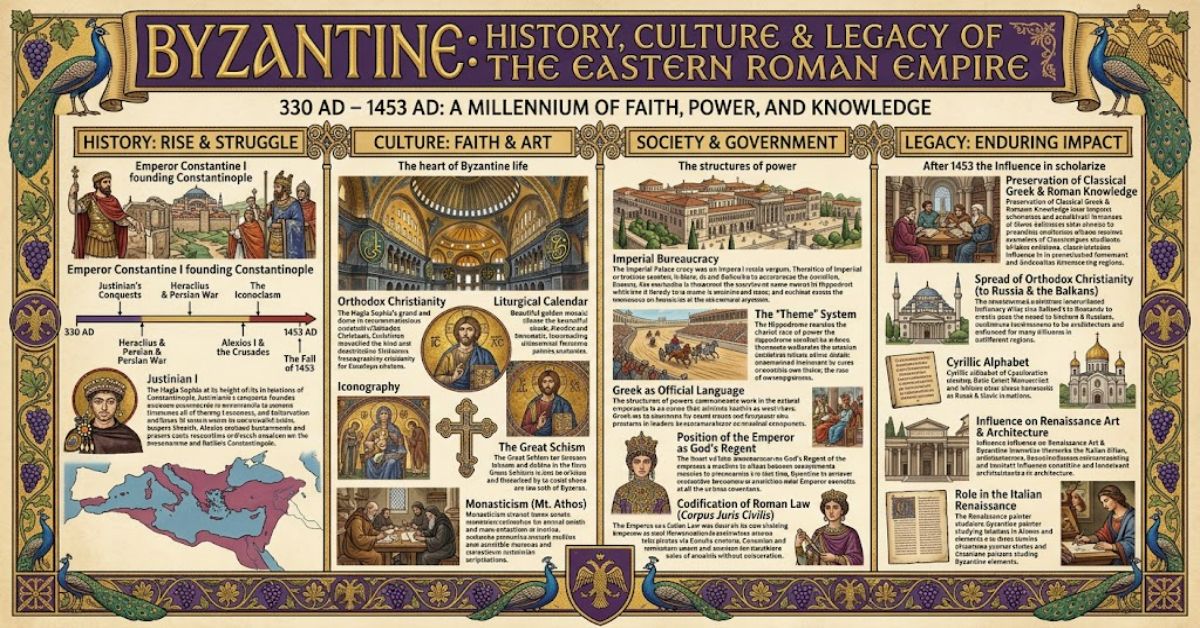
The story begins with Constantinople. In 330 AD, Constantine the Great transferred the imperial capital to the ancient city of Byzantion, renamed Constantinople. Its position between Europe and Asia made it a major centre for trade, administration and military strategy. The Metropolitan Museum of Art describes it as a new political capital and notes that its citizens continued to regard themselves as Romans.
The empire therefore was not simply a new kingdom that appeared after Rome. It was a continuation and transformation of Roman statehood. Its institutions changed over time, but Roman law, imperial administration and the idea of universal Roman rule remained important.
From Roman Empire to Byzantine Empire
The eastern and western parts of the Roman Empire became increasingly separate in administration and politics. After the death of Theodosius I in 395, the empire was divided between his sons, with Arcadius ruling the eastern half and Honorius ruling the western half. The western imperial government eventually collapsed in the fifth century, while the eastern state centred on Constantinople survived.
| Period | Major development | Historical significance |
| 330 AD | Constantinople established as imperial capital | Strengthened the eastern centre of Roman power |
| 395 AD | Empire divided between eastern and western rulers | Confirmed separate imperial administrations |
| 527–565 | Reign of Justinian I | Territorial expansion and major legal and architectural projects |
| 843 | End of Byzantine Iconoclasm | Renewed development of religious art |
| 1204 | Fourth Crusade captures Constantinople | Major political and economic disruption |
| 1261 | Constantinople recovered | Byzantine rule restored |
| 1453 | Ottoman conquest of Constantinople | End of the Byzantine Empire |
This survival was one of the defining features of Byzantine history. While western Roman territories fragmented, the eastern empire maintained an imperial government, sophisticated taxation systems, armies and a major commercial capital.
Justinian and the High Point of Imperial Ambition
Emperor Justinian I, who ruled from 527 to 565, became one of the most influential Byzantine rulers. His government attempted to recover territories once controlled by Rome, including areas of Italy and North Africa. The campaigns were costly and did not permanently restore the old Roman territorial structure, but they demonstrated the continuing ambition of Constantinople’s rulers.
Justinian’s reign is also closely associated with law and architecture. Roman legal traditions were organised into an influential body of imperial legislation commonly known as the Corpus Juris Civilis.
The same period produced Hagia Sophia, constructed under Justinian between 532 and 537. The building became one of the defining monuments of Byzantine architecture and demonstrated how imperial power, engineering and Christian worship could be combined in a single structure.
The significance of Justinian’s period lies in this combination. Military expansion mattered, but so did institutional continuity and cultural production.
Byzantine Culture, Religion and Art
Christianity became central to Byzantine identity. The empire inherited Roman institutions but increasingly expressed them through an eastern Christian culture. Greek eventually became the principal language of the Byzantine state and church, while Constantinople became a major centre of Orthodox Christianity.
Byzantine art is especially recognised for icons, mosaics, manuscripts and religious architecture. Gold backgrounds, frontal sacred figures and carefully structured compositions were used to communicate spiritual authority rather than simply imitate natural appearance.
The empire also preserved elements of classical education. Ancient Greek literature, philosophy, medicine and science continued to form part of elite education. The Metropolitan Museum notes that Byzantine intellectual culture helped preserve Greek and Roman traditions through centuries of political change.
| Cultural area | Byzantine contribution |
| Architecture | Domed churches, monumental religious buildings |
| Art | Icons, mosaics, illuminated manuscripts |
| Law | Preservation and organisation of Roman legal traditions |
| Education | Continued study of classical Greek literature |
| Religion | Development and spread of Eastern Christian traditions |
| Literature | Greek theological, historical and philosophical writing |
This cultural continuity is one reason the Byzantine legacy extends far beyond the boundaries of the former empire.
Political Pressure and the Fourth Crusade
The empire did not remain equally powerful throughout its history. Arab conquests in the seventh century removed major territories in Syria, Egypt and North Africa. Later centuries brought conflicts with neighbouring states and changing military pressures.
A particularly damaging event occurred in 1204, when forces of the Fourth Crusade captured Constantinople. The city was placed under Latin rule, while competing Byzantine successor states emerged elsewhere. Byzantine rule was restored in 1261, but the empire never fully recovered its earlier territorial strength.
This period shows an important feature of Byzantine history: political survival did not always mean territorial strength. The empire could remain culturally influential while its borders contracted dramatically.
The Fall of Constantinople
By the fifteenth century, the Byzantine Empire had become much smaller than it had been during its earlier centuries. Constantinople remained its political and symbolic centre, but Ottoman power increasingly surrounded the city.
On 29 May 1453, Ottoman forces under Sultan Mehmed II captured Constantinople. The event ended the Byzantine Empire as an independent political state. The Metropolitan Museum dates the empire’s final period to the fall of Constantinople in 1453 and describes the eastern Roman state as having endured for more than 1,100 years after its early foundation.
The term Byzantine itself is also retrospective. The empire’s inhabitants identified as Romans, while the name Byzantine became standard among later western historians. The Metropolitan Museum notes that the empire known to its citizens as the “Empire of the Romans” was subsequently associated with the name Byzantium.
The Future of Byzantine Studies in 2027
Byzantine history remains relevant because its evidence crosses several fields: archaeology, religious studies, political history, architecture, manuscript studies and art history.
Digital humanities are also changing how researchers examine surviving manuscripts, objects and buildings. Digitisation can allow scholars and the public to compare collections held in different countries, while archaeological and architectural research continues to refine understanding of Constantinople and other Byzantine centres.
The key limitation is that the surviving record is uneven. Religious buildings and elite objects are often better documented than ordinary domestic life. Modern understanding therefore depends on combining written sources with archaeology, material culture and comparative evidence.
Key Insights
- Byzantine history is best understood as a continuation and transformation of Roman civilisation.
- Constantinople’s geographical position helped sustain its political and commercial importance.
- Christianity shaped institutions, art and education without completely replacing classical traditions.
- Territorial contraction did not mean immediate cultural decline.
- The Fourth Crusade severely weakened the empire before its final centuries.
- Byzantine cultural influence continued after the political state disappeared.
- The term “Byzantine” is modern; the empire’s inhabitants considered themselves Romans.
Conclusion
The Byzantine world was neither simply ancient Rome continued unchanged nor an entirely separate medieval civilisation. It developed from the eastern Roman Empire and gradually acquired distinctive political, linguistic, religious and artistic characteristics. Constantinople provided the central setting for this transformation, linking European and Asian trade routes while supporting an imperial government for centuries.
Its history includes periods of expansion, severe territorial losses, political fragmentation and cultural renewal. Justinian’s reign demonstrates the scale of imperial ambition, while the recovery of Constantinople in 1261 shows the state’s ability to survive major disruption. The Ottoman conquest in 1453 finally ended Byzantine political independence, but not its cultural influence.
The Byzantine legacy remains visible in Orthodox Christianity, Roman legal traditions, medieval architecture, sacred art and the preservation of classical learning. Understanding Byzantine history therefore means examining not only the end of Rome, but also the remarkable ways Roman institutions and ideas adapted to a changing medieval world.
Methodology
This article was based on the supplied keyword brief and cross-checked against established museum and historical sources, particularly the Metropolitan Museum of Art’s research on Byzantium and the Roman Empire. The analysis prioritises documented dates, institutional developments, cultural evidence and major political transitions.
No firsthand testing or personal field experience was conducted, so none is presented as such. A key limitation is that “Byzantine” is a modern historical category applied retrospectively to people who generally identified themselves as Romans.
FAQ
What does Byzantine mean?
Byzantine usually refers to the medieval eastern Roman Empire centred on Constantinople. The term is modern, while the empire’s inhabitants generally identified themselves as Romans.
When did the Byzantine Empire begin?
There is no single universally accepted starting date. Many historical accounts use 330 AD, when Constantine established Constantinople as the imperial capital, while others emphasise the administrative division of the Roman Empire in the late fourth century.
Why was Constantinople important?
Constantinople occupied a strategic position between Europe and Asia and became a major centre of imperial administration, trade, Christianity and culture.
What happened to the Byzantine Empire in 1453?
Ottoman forces captured Constantinople on 29 May 1453, ending the Byzantine Empire as an independent state.
What is Byzantine art known for?
It is particularly associated with icons, mosaics, illuminated manuscripts, religious architecture and highly formal Christian imagery.
Was the Byzantine Empire Roman?
Its inhabitants considered themselves Romans, and the empire retained Roman institutions and legal traditions. “Byzantine” is primarily a modern historical term used to distinguish this eastern Roman state from earlier Roman periods.
References
Brooks, S. T. (2001, revised 2009). Byzantium (ca. 330–1453). The Metropolitan Museum of Art, Heilbrunn Timeline of Art History.
Metropolitan Museum of Art. (2001). The Arts of Byzantium. The Metropolitan Museum of Art Bulletin.
Metropolitan Museum of Art. (2012). Byzantium and Islam: Age of Transition. The Metropolitan Museum of Art.
Metropolitan Museum of Art. (2004). Byzantium: Faith and Power (1261–1557). The Metropolitan Museum of Art.