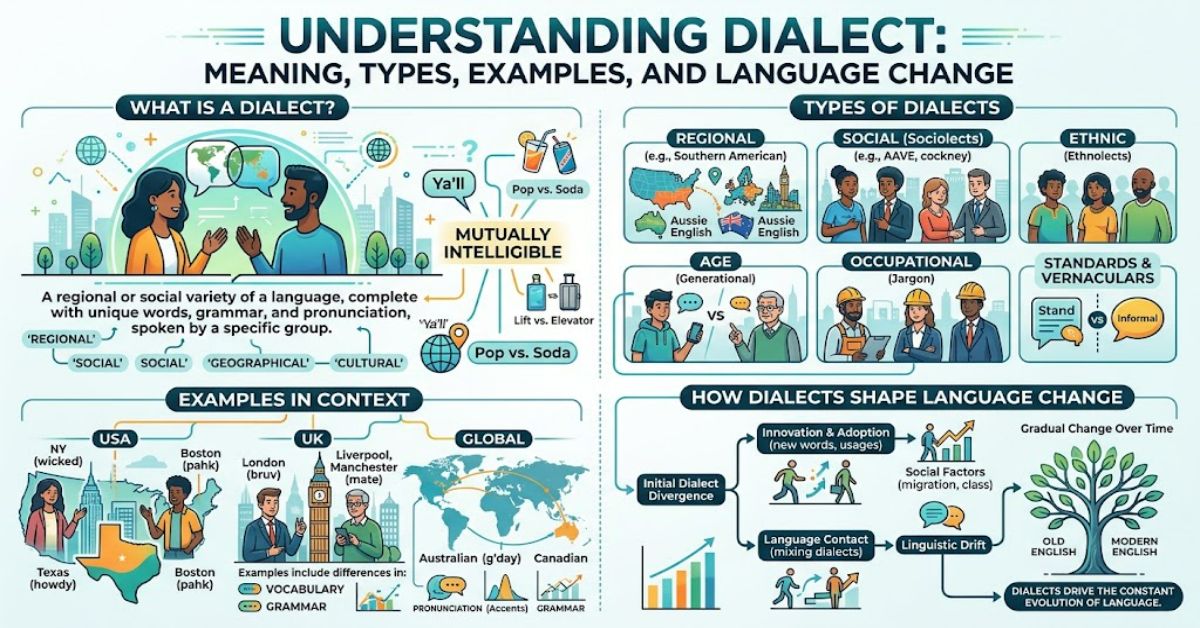
A dialect is a distinct variety of a language spoken by a particular group of people. It can differ from other varieties in vocabulary, grammar, pronunciation, and syntax while remaining part of the same broader language. British English, for example, includes regional varieties associated with places such as Yorkshire, London, and Scotland, each with its own linguistic features.
People sometimes use the word to describe speech that sounds different from what they hear in school, the media, or formal settings. However, dialects are not simply incorrect versions of a standard language. They follow patterns and rules that speakers learn naturally within their communities.
Language differences can reveal much about where people come from, their family backgrounds, and the communities in which they live. Someone might use one set of expressions at home and a more formal style at work without abandoning their regional way of speaking.
Understanding dialects also helps explain why people who speak the same language may occasionally misunderstand one another. A familiar word can have a different meaning in another region, while grammar or pronunciation may vary significantly.
The study of these differences belongs to linguistics, particularly dialectology and sociolinguistics. These fields examine how language varies across geographical areas and social groups, how varieties change over time, and how attitudes towards speech influence education, employment, and identity.
Learning about dialects encourages a more accurate understanding of language. Instead of treating differences as mistakes, it helps us recognise them as part of the natural diversity of human communication.
What Are the Main Features of a Dialect?
A dialect can differ from another variety of the same language in several ways. Linguists study these differences to understand how people communicate and how language develops within communities.
- Vocabulary: Different words may describe the same object or activity. For example, people in different parts of Britain may use different terms for a bread roll.
- Pronunciation: Speakers may pronounce vowels, consonants, or whole words differently.
- Grammar: A variety may use different verb forms or sentence patterns. Some northern English speakers use constructions such as “she were” where Standard English uses “she was”.
- Syntax: Word order and the way phrases are constructed can vary between varieties.
- Expressions: Local sayings, idioms, and forms of address often reflect shared history and culture.
The British Library’s material on grammatical variation documents differences in how speakers form past-tense verbs across the UK. These patterns are part of a dialect’s structure, not simply random departures from a standard form.
Dialect vs Accent: What Is the Difference?
The terms are related, but they do not mean the same thing. An accent concerns pronunciation, while a dialect can include pronunciation as well as vocabulary and grammar.
| Feature | Accent | Dialect |
| Pronunciation | Main focus | One part of the variety |
| Vocabulary | Usually not the defining feature | May include distinctive words |
| Grammar | Not the main focus | May use different grammatical patterns |
| Sentence structure | Generally shared with the language variety | May differ |
| Example | Pronouncing a word with a regional vowel | Using regional vocabulary and grammar |
A person can speak a regional dialect with a particular accent. Equally, two people may use similar vocabulary and grammar but pronounce words differently.
This distinction is useful in education and communication. Someone learning English may understand the vocabulary of a conversation but struggle with unfamiliar pronunciation. In another situation, the accent may be clear while a regional expression causes confusion.
The University of Sheffield’s linguistics resources explain that dialects can be distinguished through features such as vocabulary, grammar, and pronunciation, while an accent specifically concerns speech sounds.
Examples of Dialects in the United Kingdom
Britain has a wide range of regional speech varieties, shaped by migration, settlement, contact between communities, and historical language change.
| Dialect or variety | Associated area | Recognisable feature |
| Geordie | Newcastle and Tyneside | Distinctive vocabulary, grammar, and pronunciation |
| Scouse | Liverpool | Pronunciation influenced by the city’s history and migration |
| Yorkshire dialects | Yorkshire | Regional vocabulary and grammatical patterns |
| Scots | Scotland | A recognised language variety with its own literary and linguistic traditions |
| Multicultural London English | London | A newer variety shaped by contact between different language communities |
These labels cover broad patterns rather than identical ways of speaking. People within the same city or region may speak differently depending on age, social networks, family background, and personal experience.
A British Council project published in April 2026 highlighted how UK accents continue to change through migration and cultural exchange. Its discussion also challenged the assumption that one prestigious accent is inherently more correct than regional varieties.
Why Do Dialects Develop?
Dialects develop when groups of speakers interact, move apart, or come into contact with other languages and cultures. Over time, small differences in pronunciation, vocabulary, and grammar can become recognisable features of a community.
Geography is one influence. Communities separated by distance may develop different expressions because they have fewer opportunities to interact. Migration can have the opposite effect, bringing speakers together and encouraging new forms of speech.
Social identity also matters. People may adopt expressions associated with friends, family, age groups, or local communities. Music, television, and social media can spread these features beyond their original locations.
An important point is that dialect change does not always mean older forms disappear. The British Library’s Survey of English Dialects collected speech data from 313 localities across England between 1950 and 1961, preserving evidence of local vocabulary and traditional speech patterns. This collection shows why recorded language is valuable for understanding historical change.
Are Some Dialects More Correct Than Others?
No dialect is inherently superior to another. Each has patterns that speakers learn and use to communicate. However, some varieties receive greater social prestige because they are associated with education, influential institutions, or professional settings.
Standard English has an important role in formal writing, education, and public communication. Learning to use it can help people meet particular expectations without requiring them to abandon their home dialect.
Problems arise when people confuse a social preference with linguistic quality. A regional expression may be perfectly meaningful within its community even if it is unsuitable for a formal report. The difference is one of context, not proof that one speaker is more intelligent than another.
This distinction matters in schools and workplaces, where assumptions about speech can influence how people are treated. Recognising dialect diversity supports clearer communication while allowing people to retain a connection with their cultural background.
The Future of Dialects in 2027
Dialects will continue to change as communities interact through migration, education, entertainment, and digital communication. Online platforms can expose speakers to expressions from other regions, while local friendships and family networks help preserve distinctive ways of speaking.
A recent example is the development of Multicultural London English, shaped by contact between communities with different linguistic backgrounds. Its spread illustrates how new varieties can emerge through sustained social interaction rather than deliberate language planning.
Technology may also influence how dialects are recorded and studied. Speech recognition systems and voice assistants need to handle variation in pronunciation and vocabulary, although performance can differ across speakers and regional varieties.
These developments do not guarantee that every dialect will thrive. Some local forms may become less common as communities change, while others gain wider recognition through popular culture. The likely outcome is continued variation rather than a single uniform way of speaking.
Key Takeaways
- Dialects include differences in vocabulary, grammar, pronunciation, and syntax.
- An accent describes pronunciation, while a dialect covers a broader set of language features.
- Regional varieties develop through geography, migration, social contact, and historical change.
- Standard English serves useful purposes but does not make other dialects linguistically inferior.
- Historical recordings help researchers track changes in speech across generations.
- Respecting dialect diversity can improve communication and reduce unfair assumptions about speakers.
Conclusion
Dialects are an essential part of language and cultural identity. They show how communities adapt words, grammar, pronunciation, and sentence structures to suit their everyday communication. Differences between regional varieties are not evidence of poor language skills; they reflect the history and experiences of the people who speak them.
Understanding the distinction between dialect and accent makes these differences easier to recognise. An accent concerns pronunciation, whereas a dialect includes a wider range of linguistic features. Both can reveal connections to a place, a community, or a social group.
Standard forms of language remain useful in education, professional communication, and public life. However, using a standard variety does not require rejecting the language spoken at home. People can adapt their speech to different settings while maintaining their regional identity.
As communities change, dialects will continue to evolve. Studying and respecting them helps preserve linguistic history, support effective communication, and challenge assumptions about how people should speak.
Frequently Asked Questions
What is a dialect?
A dialect is a variety of a language used by a particular group of people. It can differ in vocabulary, grammar, sentence structure and pronunciation while remaining part of the same language.
What is the difference between a dialect and an accent?
An accent refers mainly to pronunciation, while a dialect includes pronunciation as well as differences in vocabulary and grammar. A person can share a dialect with others but have a slightly different accent.
What are some examples of dialects?
Examples include Geordie, Scouse and Yorkshire dialects in England, as well as Scots in Scotland. Each has distinctive linguistic features shaped by regional history, culture and contact with other communities.
Why do people speak different dialects?
Dialects develop through geographical separation, migration, cultural contact, social identity and changes in language over time. Communities gradually develop distinctive ways of speaking as their experiences and communication patterns evolve.
Is a dialect considered incorrect English?
No. Dialects are legitimate forms of language with their own grammatical patterns and vocabulary. Standard English is often expected in formal writing and professional settings, but that does not make other dialects linguistically inferior.
Can a dialect change over time?
Yes. Dialects change as people move, interact, use digital media and adopt new words or expressions. Younger generations may introduce new features, while older expressions may become less common or remain strong within particular communities.
Methodology
This article draws on linguistic education resources from the University of Sheffield, the British Library, and the British Council. These sources provide explanations of dialect variation, historical speech recordings, and contemporary examples of language change in the UK.
No original fieldwork, interviews, or independent dialect surveys were conducted for this article. Examples are illustrative and should not be treated as exhaustive descriptions of entire regions. Individual speakers vary, and dialect boundaries are not always clear-cut. Human editorial review should verify the cited material and assess whether further linguistic sources are needed before publication.
Editorial disclosure: This article was drafted with AI assistance and requires human editorial review and verification before publication.
References
- British Council. (2026, 23 April). Is Geordie a closer reflection of an “original English” accent than RP?
- British Council. (2026, 29 May). The way you talk: Why there is more to your accent than you think.
- British Library. (n.d.). Survey of English Dialects.
- British Library. (n.d.). Grammatical variation across the UK.
- University of Sheffield. (n.d.). Dialectology.