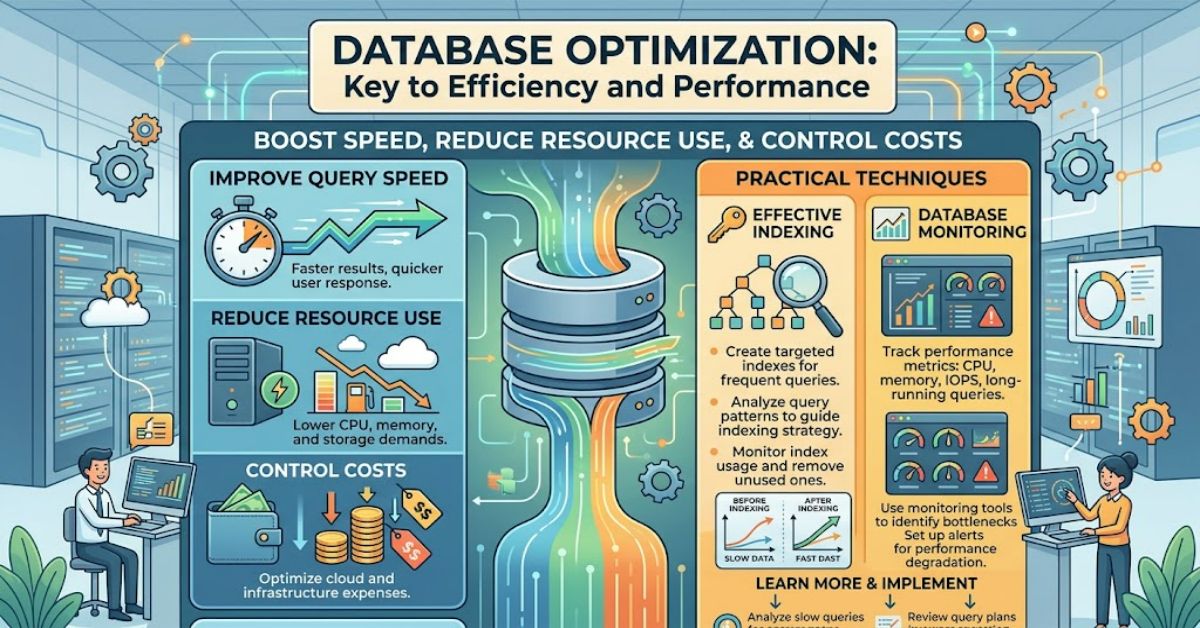
Database optimization is the process of improving a database’s structure, queries and execution paths to reduce response times and resource consumption. It helps businesses deliver faster applications, manage growing datasets and control infrastructure costs. Rather than automatically purchasing more powerful servers, organisations can often improve performance by identifying inefficient queries, reviewing indexes and addressing unnecessary database operations.
Databases support online shops, banking platforms, booking systems, customer relationship management tools and countless other digital services. When a database slows down, the effects can spread across an entire application. Pages take longer to load, transactions become delayed and users may abandon tasks before completing them.
The solution starts with measurement. Database administrators and developers need to understand whether delays originate in SQL queries, disk input/output, memory pressure, locking, network latency or insufficient computing capacity. Each problem requires a different response.
Optimisation is also an ongoing responsibility rather than a one-time technical adjustment. Applications change, tables grow and new features introduce different query patterns. A query that performs well with a thousand records might become inefficient when a table contains millions.
A structured approach helps teams prioritise changes according to their measurable impact. By combining query profiling, sensible indexing, execution-plan analysis and regular monitoring, organisations can improve performance while protecting data accuracy and system reliability.
How database performance affects business operations
A slow database can create problems beyond longer loading times. It may increase cloud computing bills, reduce transaction throughput and cause timeouts during busy periods. For organisations handling customer or financial information, poor performance can also complicate service-level commitments.
However, performance problems do not always mean a server lacks capacity. A query might repeatedly scan a large table, retrieve unnecessary columns or wait for another transaction to release a lock.
The distinction matters because hardware upgrades address capacity constraints, while query improvements address inefficient work. PostgreSQL, MySQL and Microsoft SQL Server all provide tools for examining query execution and identifying opportunities for improvement.
Practical techniques for database optimization
1. Analyse queries before changing infrastructure
Start by identifying queries that consume the most total execution time, run frequently or have unusually high response times. A query taking 100 milliseconds might appear harmless, but if it runs thousands of times each minute, its cumulative cost can be substantial.
Execution plans show how a database intends to retrieve and process data. In PostgreSQL, EXPLAIN displays the planned operations, while EXPLAIN ANALYZE executes the query and reports actual performance information. Use the latter carefully on production systems because it runs the statement.
2. Create indexes selectively
Indexes help databases locate relevant records without examining every row. They are particularly useful for columns frequently used in filtering, joining and sorting.
Consider an online shop that frequently retrieves orders belonging to a particular customer, sorted by order date. An index on the relevant customer identifier and date may improve this workload, depending on the query and existing data distribution.
Yet more indexes do not automatically produce better performance. Each additional index consumes storage and can increase the work required for inserts, updates and deletions. The right strategy is to create indexes around actual query patterns and verify that the database uses them effectively.
3. Simplify expensive SQL operations
Queries should retrieve only the information they need. Selecting every column when an application uses just three can increase data transfer and memory consumption.
Other improvements include reducing unnecessary nested queries, reviewing join conditions, limiting result sets and avoiding repeated calculations across large numbers of records.
For example, an application that loads an entire customer order history for a small dashboard may benefit from pagination or a targeted summary query. The goal is not simply shorter SQL code; it is less unnecessary work.
4. Maintain statistics and database structures
Query optimisers estimate how many rows an operation will process and choose an execution strategy. If statistics are outdated, those estimates may be inaccurate, leading to inefficient plans.
Database maintenance can include refreshing statistics, reviewing table growth, monitoring index health and performing engine-specific maintenance tasks. The appropriate schedule depends on workload, database engine and data-change patterns.
Comparing database optimisation tools
| Tool or feature | Main purpose | Best use |
| PostgreSQL EXPLAIN | Shows planned query operations | Investigating expensive queries |
| MySQL EXPLAIN | Examines query execution strategies | Reviewing scans, joins and index usage |
| SQL Server Query Store | Records query plans and performance history | Finding regressions over time |
| Monitoring dashboards | Tracks latency, CPU, memory and storage | Detecting system-wide bottlenecks |
These tools serve different purposes. Execution plans help explain individual queries, while historical monitoring helps teams discover when performance changed. SQL Server Query Store, for instance, preserves query and plan information that can help identify regressions after a plan change.
Database optimisation: useful metrics to monitor
The following metrics provide a practical starting point. They are measurement categories, not claimed industry benchmarks.
| Metric | What it reveals | Recommended response |
| Query latency | How long queries take | Investigate slow and high-percentile queries |
| Query frequency | How often a statement runs | Prioritise repeated, costly operations |
| CPU utilisation | Processing demand | Examine expensive queries and concurrency |
| Disk input/output | Storage activity and delays | Review scans, data access and storage capacity |
| Lock waits | Delays caused by competing transactions | Investigate transaction duration and contention |
| Cache hit rate | How often requested data is served from memory | Review memory allocation and access patterns |
One important distinction is the difference between average latency and high-percentile latency. A database can report a reasonable average while a small group of users experiences severe delays. Monitoring the 95th or 99th percentile can expose these problems more clearly.
Another useful insight is to compare resource consumption with business activity. If CPU usage rises sharply while transaction volume remains stable, a query or execution-plan change may be responsible. This comparison can help teams investigate regressions before purchasing additional capacity.
Risks and trade-offs
Optimisation changes can introduce new problems if they are applied without testing.
An index may improve reads but slow writes. A rewritten query may return the same records under ordinary conditions but behave differently with null values or unusual data. Caching can reduce repeated work, yet stale cached information may create incorrect results when updates occur.
Concurrency also matters. A query that performs well in isolation may struggle when hundreds of transactions compete for the same resources.
A safer process is to establish a baseline, test changes against representative data, compare execution plans and validate results before deployment. Where possible, use staging environments and maintain a rollback plan. Performance improvements should never come at the expense of data integrity or security.
The Future of Database Optimization in 2027
By 2027, automated performance recommendations, cloud monitoring and AI-assisted database administration are likely to remain important areas of development. Existing tools already support workload analysis, query-plan inspection and historical performance comparisons.
Automation can help identify unusual patterns and suggest candidate indexes, but recommendations still require context. A suggested index might improve one reporting query while increasing the cost of a high-volume transaction workload.
Cloud databases also make capacity adjustments easier in many environments, although scaling can increase recurring costs and cannot repair every inefficient query. Organisations will therefore continue to benefit from combining automated diagnostics with sound database design and human review.
The most dependable direction is measured optimisation: establish performance targets, monitor real workloads and validate changes before making them permanent. The pace of adoption will vary according to budgets, skills, compliance needs and infrastructure constraints.
Key Takeaways
- Prioritise evidence: Use execution plans and workload statistics to identify the most expensive operations.
- Balance indexing: Improve frequent reads without creating unnecessary write overhead.
- Measure user experience: Track high-percentile latency alongside average response times.
- Protect data quality: Test rewritten queries and caching behaviour against realistic conditions.
- Monitor continuously: Changes in data volume and application behaviour can make previously efficient queries slower.
- Control infrastructure costs: Resolve avoidable inefficiencies before assuming additional hardware is necessary.
Frequently Asked Questions
What is database optimization?
It is the process of improving database queries, indexes, structures and configuration to increase efficiency, reduce latency and use computing resources more effectively.
Why is database optimization important?
It can improve application responsiveness, support more concurrent users and help control infrastructure costs. It also helps teams identify bottlenecks before they cause service disruptions.
How can I optimise a database query?
Inspect its execution plan, measure actual runtime, review indexes and joins, reduce unnecessary data retrieval and test changes against representative workloads.
Do indexes always improve database performance?
No. Indexes can accelerate data retrieval, but they consume storage and add overhead to writes. Their value depends on the workload and query patterns.
Which tools help with database performance tuning?
PostgreSQL and MySQL provide EXPLAIN tools, while SQL Server offers Query Store. Monitoring platforms can complement these features with system-level metrics.
Can database optimisation reduce hardware costs?
It can reduce unnecessary resource consumption and delay capacity upgrades. Savings depend on the original bottlenecks, workload and infrastructure pricing.
References
MySQL. (n.d.). MySQL 8.4 Reference Manual: Optimization. Oracle.
PostgreSQL Global Development Group. (2026). PostgreSQL 18 documentation: Using EXPLAIN.
Microsoft. (n.d.). Tune performance with the Query Store. Microsoft Learn.
Microsoft. (n.d.). Monitor performance by using the Query Store. Microsoft Learn.
Methodology
This article Database optimization draws on official technical documentation from PostgreSQL, MySQL and Microsoft SQL Server to explain established optimisation techniques. No independent benchmark, product test or performance experiment was conducted for this article. The effectiveness of individual changes will vary according to database engine, data distribution, query design and workload.
The percentage reductions in database load mentioned in the supplied keyword brief have not been independently verified and are therefore not presented as established results. References should be checked against their original documentation before publication, and a human editor should validate technical claims and approve the final draft.
Editorial disclosure: This article was drafted with AI assistance and requires human editorial review before publication.